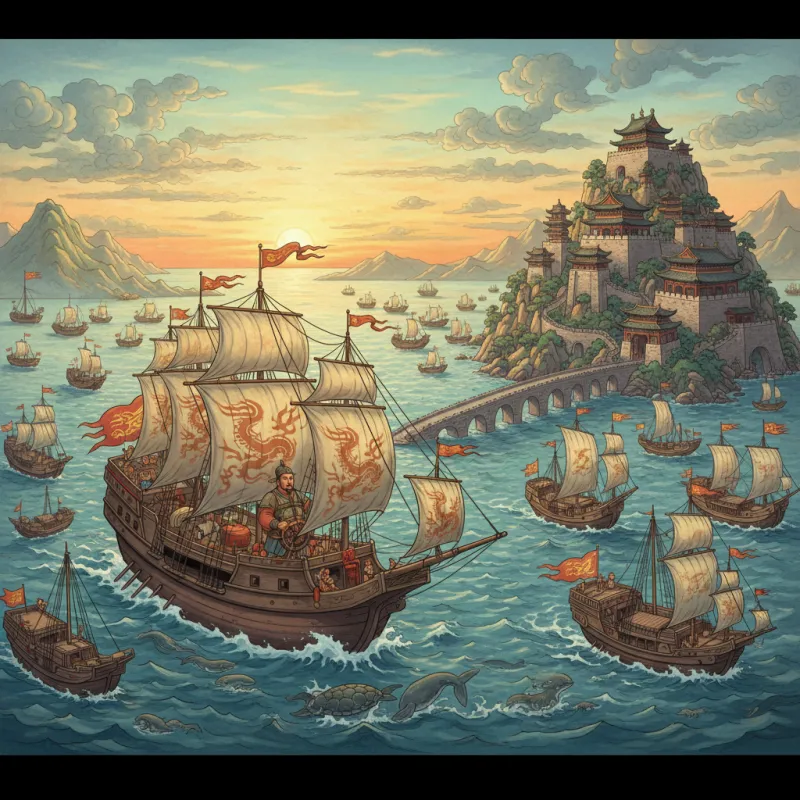
Between 1405 and 1433, fleets of Chinese ships larger than anything Europe would build for centuries sailed across the Indian Ocean, their red silk sails visible for miles. At their helm stood Zheng He (郑和, Zhèng Hé), a six-foot-tall Muslim eunuch who commanded armadas that made Columbus's three tiny vessels look like fishing boats. His treasure ships (宝船 bǎochuán) stretched over 400 feet long—imagine a football field floating on water—while his fleets carried up to 27,000 men, enough to populate a small city. Yet within decades of his death in 1433, China deliberately erased this maritime legacy, burned the records, and turned inward. Why would a civilization at the peak of its naval power choose to forget?
The Eunuch Admiral Who Changed the World
Zheng He wasn't born for greatness—he was castrated into it. Born Ma He (马和 Mǎ Hé) in 1371 to a Muslim family in Yunnan province, he was captured at age ten during the Ming conquest of the region and castrated to serve in the imperial household. This brutal practice created the eunuch class (宦官 huànguān) that wielded enormous influence in Chinese courts. Young Ma He caught the attention of Prince Zhu Di, the future Yongle Emperor (永乐帝 Yǒnglè Dì), serving him during the civil war that brought Zhu Di to power in 1402.
The grateful emperor renamed him Zheng He and gave him an impossible mission: command the largest naval expedition in human history. Think about that for a moment—a castrated Muslim from a conquered province, leading the imperial fleet of the most powerful empire on Earth. It's the kind of social mobility that makes modern rags-to-riches stories look pedestrian.
Zheng He proved himself a brilliant diplomat, navigator, and military commander. He spoke multiple languages, understood Islamic culture from his upbringing, and combined Confucian administrative skills with practical seamanship. The Yongle Emperor had chosen wisely.
Treasure Ships and the Fleet That Dwarfed Europe
The scale of Zheng He's expeditions defies easy comprehension. His first voyage in 1405 included 317 ships and 27,870 men—sailors, soldiers, diplomats, translators, doctors, astronomers, and merchants. The flagship treasure ships reportedly measured 120 meters (400 feet) long and 50 meters (160 feet) wide, with nine masts carrying red silk sails. Modern scholars debate these dimensions—some argue they're exaggerated—but even conservative estimates put them at 200 feet, still massive for the era.
Compare this to European exploration: When Vasco da Gama rounded Africa to reach India in 1498, he had four ships and 170 men. Columbus's famous 1492 voyage? Three ships, 90 men. The Santa Maria was about 19 meters long. Zheng He's support vessels were larger than Europe's flagships.
The fleet included specialized ships: combat vessels (战船 zhànchuán), supply ships (粮船 liángchuán), water tankers (水船 shuǐchuán), and horse transports (马船 mǎchuán). They carried trade goods, gifts for foreign rulers, and enough supplies for two-year voyages. The logistics alone—feeding 27,000 men at sea—required revolutionary planning and organization.
Seven Voyages Across the Known World
Between 1405 and 1433, Zheng He led seven major expeditions, each lasting one to two years. The routes stretched from Southeast Asia through the Indian Ocean to the Persian Gulf, the Red Sea, and the east coast of Africa. His ships reached at least 37 countries, from Java and Sumatra to Ceylon (Sri Lanka), India, Hormuz (modern Iran), Aden (Yemen), and Mogadishu (Somalia).
The voyages weren't purely exploratory—they were diplomatic missions designed to establish the Ming Dynasty's prestige and expand the tribute system (朝贡体系 cháogòng tǐxì) that defined Chinese foreign relations. Foreign rulers who acknowledged Chinese superiority received generous gifts, trade privileges, and protection. Those who refused faced Zheng He's military might. This approach to international relations differed fundamentally from European colonialism, which would emerge decades later. Learn more about Ming governance in The Ming Dynasty: Rise, Golden Age, and Fall.
The third voyage (1409-1411) saw military action when the King of Ceylon attempted to lure Zheng He into a trap. The admiral turned the tables, captured the king, and brought him back to China in chains. The Yongle Emperor, demonstrating the Confucian virtue of magnanimity, pardoned the king and sent him home—a calculated display of Chinese superiority.
The seventh and final voyage (1431-1433) reached furthest, possibly extending to Zanzibar and the Mozambique coast. Some fringe theories claim Zheng He reached the Americas or Australia, but credible evidence doesn't support these claims. What he definitely accomplished was impressive enough without embellishment.
What They Brought Back
The expeditions returned with exotic goods, tribute, and diplomatic missions from foreign courts. The most spectacular cargo? Live animals. Zheng He's ships brought back giraffes from Africa, which Chinese scholars identified as qilin (麒麟 qílín), the mythical creature that appeared during times of great wisdom and benevolent rule. The arrival of these "qilin" reinforced the Yongle Emperor's legitimacy—heaven itself approved his reign.
Other imports included precious stones, spices, medicinal herbs, rare woods, and luxury textiles. More importantly, the voyages brought knowledge: detailed maps, information about foreign cultures, and diplomatic intelligence. Chinese cartographers created increasingly accurate maps of the Indian Ocean world, knowledge that would be lost when China turned inward.
The expeditions also spread Chinese culture, technology, and goods throughout Asia and Africa. Chinese ceramics, silk, and metalwork became prized possessions in foreign courts. The voyages established Chinese communities in Southeast Asian ports that persist today.
The Great Turning Inward
Then it all stopped. The Yongle Emperor died in 1424, and his successors questioned the expeditions' enormous cost. Confucian officials at court, who had always opposed the eunuch Zheng He's influence, argued that the voyages drained resources better spent on defending against Mongol threats in the north. The treasure ships, they claimed, brought back exotic trinkets while neglecting agriculture and defense—the foundations of Chinese civilization.
After Zheng He's death in 1433 during the seventh voyage, the political tide turned decisively. The Xuande Emperor (宣德帝 Xuāndé Dì) ordered the treasure fleet dismantled. Later emperors went further, destroying records of the voyages and forbidding ocean-going ships. By 1500, building a ship with more than two masts was a capital offense. China, which had possessed the world's most advanced navy, deliberately chose isolation.
This decision haunts Chinese history. While China looked inward, European powers developed ocean-going technology, discovered the Americas, and established colonial empires. By the 19th century, European gunboats would force open Chinese ports in the Opium Wars—a humiliating reversal that Chinese historians still debate. What if China had continued Zheng He's voyages? Would Chinese colonies have dotted the Americas and Africa? The counterfactuals are tantalizing but ultimately unknowable.
Legacy and Modern Rediscovery
For centuries, Zheng He's achievements were nearly forgotten in China, remembered mainly in Southeast Asian Chinese communities where he was venerated as a deity. The Communist government rediscovered him in the 1950s as a symbol of Chinese achievement and peaceful exploration—contrasting Chinese diplomacy with Western colonialism.
Today, Zheng He is everywhere in Chinese popular culture: museums, monuments, television series, and historical novels celebrate his voyages. The government invokes his legacy to support the Belt and Road Initiative, positioning modern Chinese investment as a return to peaceful trade rather than colonial exploitation. Whether this comparison holds up to scrutiny is debatable, but it shows how historical narratives serve present purposes.
Zheng He's story raises profound questions about civilizational choices. China possessed the technology, resources, and organizational capacity to dominate global maritime trade centuries before Europe. Instead, it chose stability over expansion, agriculture over commerce, and isolation over engagement. Was this wisdom or missed opportunity? The answer depends on your values, but the question itself reveals how contingent history really is. Nothing was inevitable about European dominance—it required Chinese withdrawal as much as European ambition.
The treasure ships are gone, rotted away or burned deliberately. But their ghost sails still haunt the Indian Ocean, reminding us that the world we inherited wasn't the only world possible. For a brief moment, China ruled the waves, then chose to walk away. That choice shaped the modern world as much as any European voyage of discovery.
Related Reading
- Spring and Autumn to Warring States: China's Age of Philosophy
- Exploring the Dynastic Era: A Journey Through Ancient Chinese History
- Complete Chinese Dynasty Timeline: 5,000 Years in One Guide
- The Dynasties of China: A Quick Guide to 4,000 Years of History
- Song Dynasty: The World's Most Advanced Civilization
- Traditional Chinese Medicine: 5,000 Years of Healing
- Unveiling the Role of Women in Ancient Chinese Dynasties
- Exploring the Rich Tapestry of Ancient Chinese History and Culture