The terracotta warriors stood silent for over two millennia, their painted faces long faded, until a farmer digging a well in 1974 struck something hard beneath the Shaanxi soil. What he unearthed wasn't just clay—it was the ambition of an empire, frozen in time. These 8,000 life-sized soldiers, each with unique features, were merely the honor guard for Qin Shi Huang's tomb, a emperor so obsessed with immortality that he built an underground kingdom to rule in death. This discovery reminds us that ancient China wasn't just a civilization—it was a succession of worlds, each dynasty constructing its own reality on the ruins of the last.
The Dynastic Cycle: Heaven's Mandate in Motion
Chinese history operates on a principle that would seem almost mystical if it weren't so brutally practical: the Mandate of Heaven (天命, tiānmìng). When a dynasty ruled justly, Heaven blessed it with prosperity. When corruption festered and natural disasters struck, Heaven withdrew its favor, and rebellion became not just justified but cosmically ordained. This wasn't mere superstition—it was political philosophy that kept emperors accountable, at least in theory.
The pattern repeated with remarkable consistency. The Xia Dynasty (c. 2070-1600 BCE), though its historical existence remains debated, supposedly fell when its last ruler, Jie, became a tyrant. The Shang Dynasty (c. 1600-1046 BCE) replaced it, only to collapse when King Zhou's cruelty—legend says he created a pool of wine and a forest of meat for orgies—provoked the Zhou conquest. The Zhou Dynasty (1046-256 BCE) itself eventually fragmented into the chaotic Warring States period, proving that even the dynasty that invented the Mandate of Heaven couldn't escape its logic.
What fascinates me most is how this cycle created a unique historical consciousness. Chinese historians didn't just record events—they judged them, always asking whether a ruler deserved Heaven's favor. The Spring and Autumn period produced some of China's greatest philosophical minds precisely because political chaos demanded new answers to old questions about legitimate rule.
The First Emperor and the Price of Unity
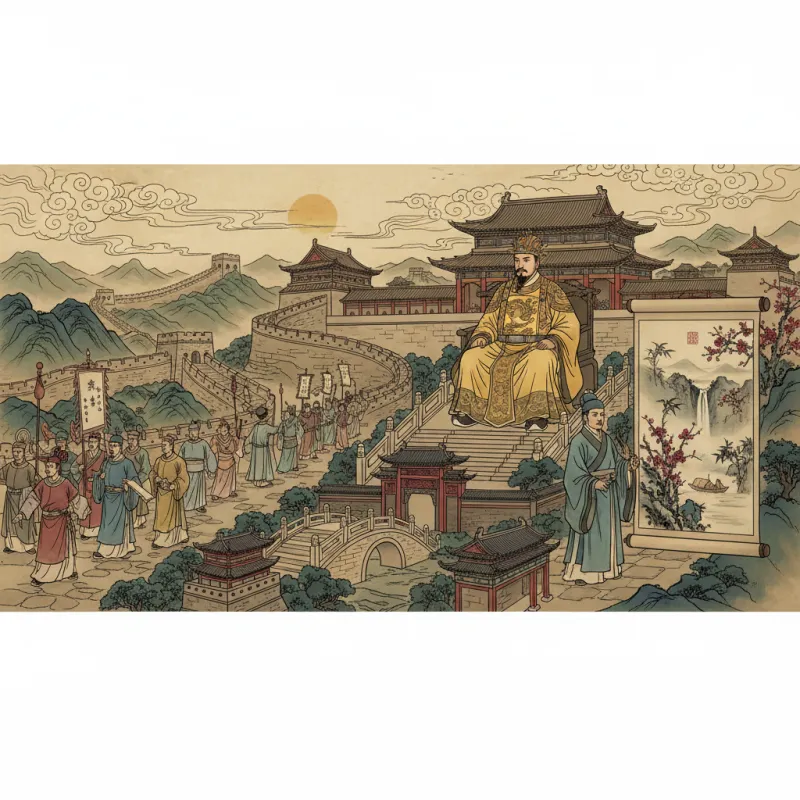
Qin Shi Huang (秦始皇, Qín Shǐhuáng, 259-210 BCE) unified China in 221 BCE, but calling him merely a "unifier" is like calling a hurricane "windy." He standardized writing, currency, weights, and measures—practical achievements that made a continental empire governable. He connected and extended defensive walls into what would become the Great Wall. He buried scholars alive and burned books that contradicted his vision. He sent expeditions to find the elixir of immortality while ironically consuming mercury pills that probably hastened his death at 49.
The Qin Dynasty lasted only 15 years after his death, collapsing into civil war almost immediately. Yet its impact echoes through every subsequent dynasty. Qin Shi Huang proved that China could be unified under a single ruler, and he created the administrative blueprint—commanderies and counties, appointed officials rather than hereditary nobles—that every later dynasty would adopt. The terracotta army wasn't just funerary art; it was a statement that even death wouldn't diminish his authority.
The Han Dynasty: When China Became "Chinese"
If the Qin built the house, the Han Dynasty (206 BCE-220 CE) made it livable. The Han lasted over four centuries, long enough that "Han" became synonymous with Chinese ethnicity—even today, 92% of China's population identifies as Han Chinese (汉族, Hànzú). This wasn't accidental. The Han emperors, particularly Wu (汉武帝, Hàn Wǔdì, r. 141-87 BCE), made Confucianism the state ideology, establishing the civil service examination system that would define Chinese governance for two millennia.
Emperor Wu's reign exemplifies Han ambition. He expanded the empire westward, opening the Silk Road and bringing Chinese silk, paper, and porcelain to Rome. He established the Imperial University in 124 BCE, training bureaucrats in Confucian classics. He also nearly bankrupted the state with constant military campaigns, proving that even successful emperors could overreach. The Silk Road trade networks he established didn't just move goods—they transmitted Buddhism into China, fundamentally altering Chinese spiritual life.
The Han also gave us paper, invented by Cai Lun around 105 CE, though earlier forms existed. This innovation seems mundane until you consider its impact: paper made knowledge portable and affordable, enabling the bureaucratic state and the spread of literacy. The Han Dynasty fell not from external conquest but internal decay—court eunuchs gained excessive power, regional warlords became autonomous, and peasant rebellions like the Yellow Turban Uprising (184 CE) shattered central authority.
The Tang Dynasty: China's Golden Age
The Tang Dynasty (618-907 CE) represents Chinese civilization at its most confident and cosmopolitan. Chang'an (长安, Cháng'ān, modern Xi'an) became the world's largest city, with over a million residents, including Persian merchants, Arab traders, and Buddhist monks from India. The Tang capital wasn't just multicultural—it was a place where foreign ideas were welcomed, debated, and absorbed.
Tang poetry reached heights never surpassed. Li Bai (李白, Lǐ Bái, 701-762) wrote verses so vivid they feel contemporary: "Raising my cup, I invite the bright moon; with my shadow, we become three." Du Fu (杜甫, Dù Fǔ, 712-770) chronicled the An Lushan Rebellion's devastation with unflinching honesty. These weren't court poets writing propaganda—they were artists whose work transcended their era.
The Tang also produced China's only female emperor, Wu Zetian (武则天, Wǔ Zétiān, r. 690-705), who ruled in her own right, not as regent. Traditional historians vilified her, but modern scholarship reveals a capable administrator who expanded the civil service examination, promoted Buddhism, and maintained stability during her reign. Her story reveals how Chinese historical records often reflected Confucian gender biases rather than objective assessment.
The Song Dynasty: Innovation Without Military Power
The Song Dynasty (960-1279) presents a paradox: culturally and technologically brilliant, yet militarily weak. The Song invented movable type printing, gunpowder weapons, the magnetic compass, and paper money. They created landscape painting as high art and developed Neo-Confucianism, which would dominate East Asian thought for centuries. Yet they constantly paid tribute to northern "barbarian" states and eventually fell to the Mongols.
This weakness stemmed from deliberate policy. The Song founders, having witnessed the Tang's collapse into warlordism, subordinated military commanders to civilian officials. They created a scholar-official class that valued literary accomplishment over martial prowess. This produced a sophisticated, urbanized society—Song cities had restaurants, entertainment districts, and a thriving merchant class—but left China vulnerable to mounted warriors from the steppes.
The development of Neo-Confucianism during the Song period, particularly through Zhu Xi (朱熹, Zhū Xī, 1130-1200), created an intellectual framework that emphasized moral cultivation and social harmony. This philosophy would shape not just China but Korea, Japan, and Vietnam for centuries, proving that cultural influence can outlast military power.
The Ming and Qing: Tradition Meets Modernity's Challenge
The Ming Dynasty (1368-1644) began with Zheng He's (郑和, Zhèng Hé) massive treasure fleets—ships larger than anything Europe would build for centuries—sailing to Africa and possibly beyond. Then, inexplicably, China turned inward. The Yongle Emperor moved the capital to Beijing and built the Forbidden City, but his successors abandoned maritime exploration, dismantled the fleet, and made it illegal to build ocean-going ships.
This decision haunts Chinese history. When European ships arrived in the 16th century, they found a wealthy, sophisticated civilization that had voluntarily withdrawn from global maritime trade. The Qing Dynasty (1644-1912), founded by Manchurian conquerors, expanded China to its greatest territorial extent but struggled to adapt to Western military technology and diplomatic norms. The Opium Wars, the Taiping Rebellion, and the Boxer Rebellion revealed a system unable to reform quickly enough to survive the modern world.
Cultural Continuity: What Survived the Dynasties
Despite political upheaval, certain cultural elements persisted across dynasties. The Chinese writing system, though it evolved, remained recognizable—a Tang scholar could read Shang oracle bones with effort. Confucian values—filial piety (孝, xiào), respect for education, emphasis on social harmony—survived Buddhist and Daoist challenges. The civil service examination, despite its flaws, created social mobility and meritocracy unusual in premodern societies.
This continuity explains why Chinese civilization feels uniquely coherent despite its vast timeline. The dynasties rose and fell, but the cultural substrate—the language, the philosophical traditions, the historical consciousness—endured. When modern Chinese leaders invoke "5,000 years of civilization," they're not just boasting. They're acknowledging a cultural continuity that, while not unbroken, remains remarkably intact.
Ancient China wasn't a single story but a series of experiments in governance, philosophy, and culture. Each dynasty learned from its predecessors' failures, adapted to new challenges, and ultimately succumbed to its own contradictions. Yet from this cycle emerged innovations—paper, printing, gunpowder, the compass—that changed world history, and philosophical traditions that still shape how a fifth of humanity thinks about ethics, governance, and the good life. The terracotta warriors still stand in Xi'an, silent witnesses to an empire that believed it would last forever. It didn't, but its legacy did.
Related Reading
- Zheng He's Treasure Fleet: When China Ruled the Seas
- The Role of Trade in Shaping Ancient Chinese Dynasties and Culture
- Wu Zetian: How China's Only Female Emperor Seized and Kept Power