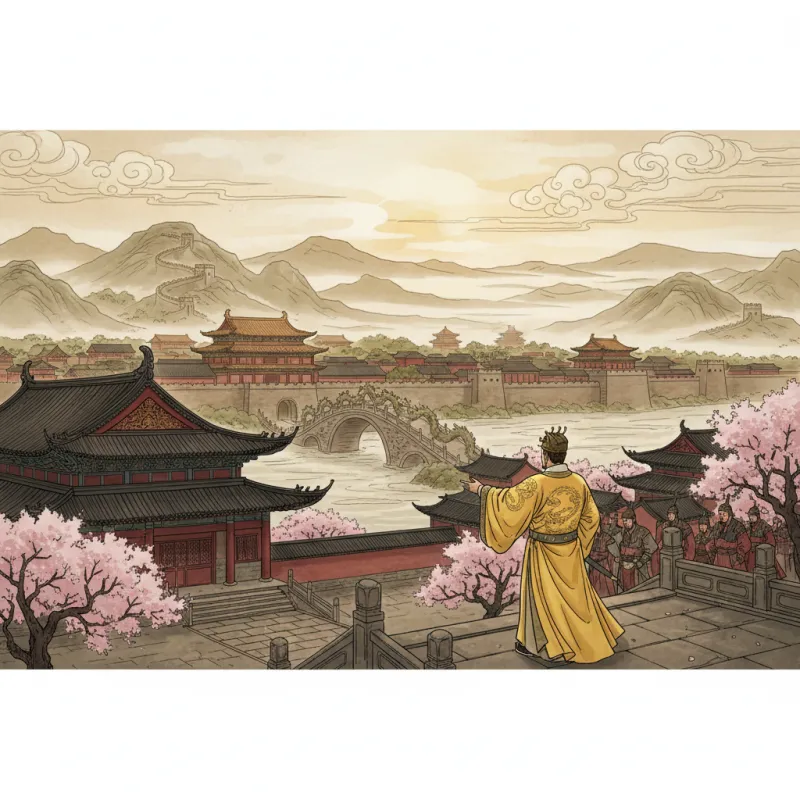
Picture this: a young emperor, barely out of his teens, stands before the Forbidden City's throne room as officials prostrate themselves in ritual submission. Outside, farmers till fields using iron plows invented centuries ago, while merchants haggle over silk and porcelain that will eventually reach markets in Rome. This scene could describe any of a dozen dynasties spanning three millennia—because for most of recorded history, China wasn't just ruled by dynasties, it was dynasties. The dynastic cycle wasn't merely a political system; it was the heartbeat of Chinese civilization, a rhythm of rise and fall that shaped everything from philosophy to agriculture, warfare to poetry.
The Mandate of Heaven: Why Dynasties Rose and Fell
The Chinese developed a sophisticated explanation for dynastic change called the Mandate of Heaven (天命, tiānmìng), and it's far more interesting than the divine right of kings claimed by European monarchs. This wasn't about bloodline alone—it was a cosmic contract. A ruler held power only as long as he governed justly and maintained harmony between heaven, earth, and humanity. Natural disasters, famines, or military defeats? These were signs that heaven had withdrawn its mandate.
This concept first emerged during the Zhou Dynasty (1046–256 BCE), when the Zhou needed to justify overthrowing the Shang. They couldn't simply claim "might makes right," so they invented something more elegant: the previous dynasty had become corrupt, heaven disapproved, and therefore rebellion was not just permitted but cosmically ordained. It's a brilliant piece of political philosophy that would echo through every subsequent dynasty, giving peasant rebels and ambitious generals alike a framework for revolution.
The cycle typically followed a pattern: a dynamic founder unifies the realm, his successors consolidate power and preside over a golden age, later emperors grow complacent or tyrannical, corruption spreads, natural disasters strike, rebellions erupt, and a new dynasty emerges from the chaos. Rinse and repeat for three thousand years.
The Formative Dynasties: Xia, Shang, and Zhou
The Xia Dynasty (c. 2070–1600 BCE) occupies an awkward position in Chinese historiography—mentioned in ancient texts but lacking archaeological confirmation that satisfies modern scholars. Traditional accounts credit Yu the Great (大禹, Dà Yǔ) with founding the dynasty after taming catastrophic floods through engineering rather than ritual, marking a shift toward practical governance. Whether the Xia existed as described or represents a mythologized memory of early Bronze Age chiefdoms remains hotly debated.
The Shang Dynasty (c. 1600–1046 BCE) stands on firmer ground, literally—oracle bones excavated at Anyang confirm the existence of Shang kings and reveal a sophisticated writing system already in use. The Shang were obsessed with divination, carving questions onto turtle shells and ox bones, applying heat, and interpreting the resulting cracks. These weren't primitive superstitions but a systematic attempt to understand causality and make decisions based on pattern recognition. The Shang also mastered bronze casting, producing ritual vessels of stunning complexity that still impress metallurgists today.
The Zhou Dynasty that followed lasted longer than any other—nearly eight centuries—though its later period dissolved into the chaos of the Warring States era. The Zhou's real contribution wasn't military prowess but intellectual ferment. This period produced Confucius, Laozi, Mozi, and dozens of other philosophers whose debates about governance, ethics, and human nature laid the foundation for all subsequent Chinese thought.
The Imperial Template: Qin and Han
If you want to understand why China looks the way it does today—unified, centralized, with standardized writing and measurements—thank (or blame) the Qin Dynasty (221–206 BCE). Qin Shi Huang (秦始皇, Qín Shǐhuáng), the First Emperor, was a megalomaniac who burned books, buried scholars alive, and built the Great Wall by conscripting hundreds of thousands of laborers. He was also a visionary who abolished feudalism, standardized currency and writing, and created the bureaucratic infrastructure that would define Chinese governance for two millennia.
The Qin lasted only fifteen years—turns out brutal totalitarianism isn't sustainable—but it proved that China could be unified under a single ruler. The Han Dynasty (206 BCE–220 CE) that followed took the Qin's administrative framework and added Confucian ideology, creating a synthesis that became the gold standard for Chinese civilization. When Chinese people today call themselves Han (汉族, Hànzú), they're referencing this dynasty's four-century dominance.
The Han established the civil service examination system (though it wouldn't reach full development until the Tang Dynasty), opened the Silk Road, and presided over technological innovations including paper, the seismograph, and advances in metallurgy. The historian Sima Qian wrote his monumental Records of the Grand Historian during this period, establishing the biographical format that would structure Chinese historical writing for centuries.
The Age of Division and Reunification
After the Han collapsed in 220 CE, China fragmented into competing kingdoms—the famous Three Kingdoms period romanticized in literature and video games. For nearly four centuries, China remained divided, with northern dynasties often ruled by non-Han peoples while southern dynasties preserved classical Chinese culture. This wasn't a dark age but a period of remarkable cultural development: Buddhism flourished, landscape painting emerged as a major art form, and poetry reached new heights.
The Sui Dynasty (581–618 CE) reunified China but burned out quickly, exhausted by massive construction projects including the Grand Canal, which connected the Yellow and Yangtze rivers. The Tang Dynasty (618–907 CE) inherited this infrastructure and built one of history's great civilizations. Tang China was cosmopolitan, confident, and culturally dominant—the New York or London of its era. Chang'an, the capital, hosted merchants from Persia, monks from India, and diplomats from Japan and Korea. Tang poetry remains the pinnacle of Chinese literary achievement, with Du Fu and Li Bai composing verses that every educated Chinese person still memorizes.
The Later Imperial Dynasties: Song, Yuan, Ming, and Qing
The Song Dynasty (960–1279 CE) doesn't get enough credit in popular imagination, overshadowed by the Tang's glamour and the Ming's monuments. But the Song presided over what some historians call an early modern revolution: urbanization accelerated, a market economy developed, printing technology spread, and Neo-Confucianism emerged as a sophisticated philosophical system. The Song also invented gunpowder weapons, though they'd eventually lose to the Mongols anyway.
The Yuan Dynasty (1271–1368 CE) was China under Mongol rule, with Kublai Khan establishing a regime that connected China to a vast Eurasian empire. The Ming Dynasty (1368–1644 CE) that overthrew the Mongols built the Forbidden City, sent Zheng He's treasure fleets across the Indian Ocean, and constructed most of the Great Wall that tourists visit today. The Ming also grew increasingly conservative and inward-looking, banning maritime trade and restricting foreign contact—decisions that would have profound consequences when European powers arrived with gunboats.
The final dynasty, the Qing (1644–1912 CE), was ruled by Manchus from the northeast. The Qing expanded China to its greatest territorial extent, incorporating Tibet, Xinjiang, and Mongolia. But the dynasty's final century was catastrophic: the Opium Wars, the Taiping Rebellion (which killed more people than World War I), and the humiliation of foreign concessions. When the Qing finally collapsed in 1912, it ended not just a dynasty but the entire dynastic system that had structured Chinese civilization for three millennia.
The Dynastic Legacy in Modern China
The dynastic era ended over a century ago, but its influence permeates contemporary China. The bureaucratic examination system evolved into the gaokao, the brutal college entrance exam that determines students' futures. The concept of a unified, centralized state remains powerful—modern Chinese nationalism draws heavily on the idea of restoring China's historical greatness after the "century of humiliation" that followed the Qing's decline.
Even the Communist Party, officially committed to Marxist materialism, has rehabilitated Confucius and embraced aspects of traditional culture once condemned as feudal. Xi Jinping's consolidation of power echoes imperial patterns, and the Belt and Road Initiative consciously invokes the ancient Silk Road. The dynastic past isn't dead—it's not even past, to paraphrase Faulkner.
Understanding Chinese dynasties isn't just an academic exercise in memorizing dates and names. It's essential for grasping how the world's most populous nation thinks about governance, legitimacy, and its place in the world. The dynastic cycle may have ended, but its rhythms still echo in Chinese political culture, a three-thousand-year-old heartbeat that continues to pulse beneath the surface of modernity.
Related Reading
- The Ming Dynasty: Zheng He and China's Age of Exploration
- Exploring Ancient Chinese Dynasties: Emperors, Battles, and Cultural Legacy
- Spring and Autumn to Warring States: China's Age of Philosophy
- The Dynasties of China: A Quick Guide to 4,000 Years of History
- Complete Chinese Dynasty Timeline: 5,000 Years in One Guide
- Traditional Chinese Medicine: 3,000 Years of Healing Philosophy
- The Battle of Changping: 400,000 Buried Alive
- Chinese Military Strategy: Sun Tzu and the Art of Winning Without Fighting