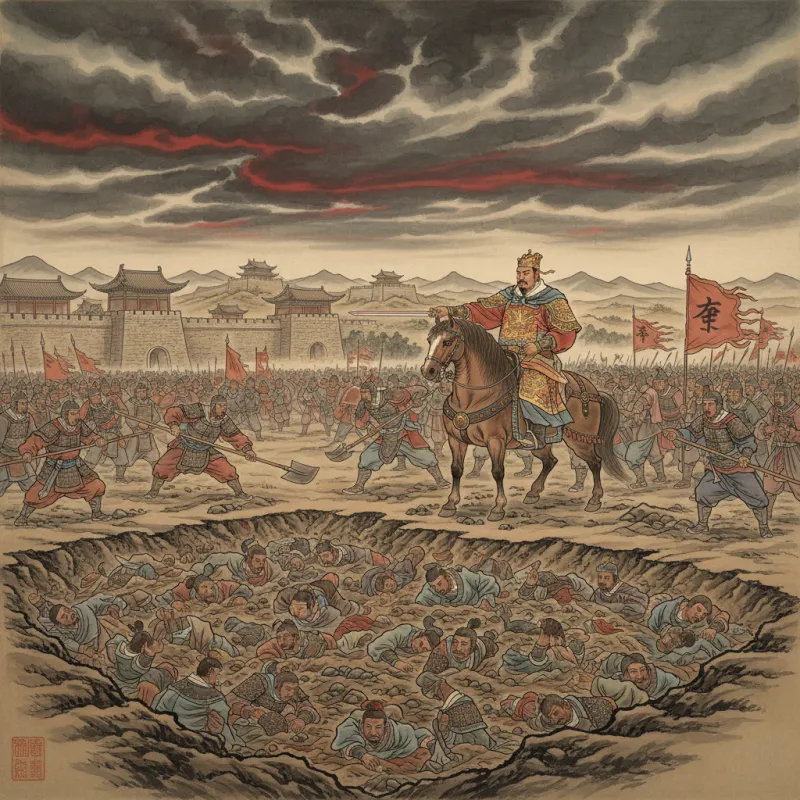
The earth around Changping still whispers its secrets. In 1995, construction workers near the ancient battlefield in Shanxi Province unearthed a mass grave containing thousands of skeletons—young men, their bones bearing marks of violent death, buried in chaotic heaps. These weren't the only remains. Since the 1950s, archaeologists have discovered multiple burial pits in the area, each containing hundreds or thousands of bodies. They are the physical evidence of what ancient historians recorded: the systematic execution of 400,000 Zhao soldiers after their surrender in 260 BCE, ordered by a Qin general whose name became synonymous with ruthlessness—Bai Qi (白起, Bái Qǐ).
The Trap That Swallowed an Army
The Battle of Changping (长平之战, Chángpíng zhī Zhàn) didn't begin as a massacre. It started as a territorial dispute over the Shangdang region, a strategic plateau that both Qin and Zhao coveted. When the small state of Han offered Shangdang to Zhao rather than surrender it to Qin in 262 BCE, Zhao's King Xiaocheng made a fatal miscalculation—he accepted. Qin's response was immediate and overwhelming.
For two years, the armies faced each other across the Changping plains. Zhao's initial commander, the cautious Lian Po (廉颇, Lián Pō), understood Qin's military superiority and adopted a defensive strategy, building fortifications and refusing to engage in open battle. His approach was working. Qin's supply lines stretched thin, and their army grew restless. But Qin's chancellor, Fan Sui (范雎, Fàn Jū), deployed a weapon more devastating than any sword: disinformation.
Qin agents spread rumors throughout Zhao's capital, Handan, claiming that Lian Po was a coward, that he planned to surrender, and that only the young general Zhao Kuo (赵括, Zhào Kuò) possessed the courage to defeat Qin. The whisper campaign worked. King Xiaocheng replaced Lian Po with Zhao Kuo, a man whose only military experience came from reading his father's military treatises. The ancient historian Sima Qian (司马迁, Sīmǎ Qiān) recorded that Zhao Kuo's own mother begged the king not to appoint her son, warning that he "only knows how to read his father's books" and lacked practical battlefield experience. Her pleas were ignored.
The Master of Slaughter
Meanwhile, Qin made its own command change, but this one was kept secret. They replaced their general with Bai Qi, already legendary for his victories and his brutality. Where Zhao broadcast their new appointment, Qin concealed theirs—a telling difference in strategic sophistication.
Bai Qi understood his opponent perfectly. He knew Zhao Kuo would abandon defensive tactics and seek a decisive engagement. So he prepared an elaborate trap. When Zhao Kuo launched his offensive, Qin's front lines retreated, drawing the Zhao army deeper into Qin territory. Then Bai Qi's cavalry swept around both flanks, cutting off Zhao's supply lines and escape routes. The Zhao army found itself surrounded in a valley with no food, no reinforcements, and no way out.
For 46 days, the Zhao soldiers held their position, eating their horses, then their leather armor, finally resorting to cannibalism. Zhao Kuo led desperate breakout attempts, but Qin's encirclement held. In one final charge, Zhao Kuo himself was killed by a Qin arrow. With their commander dead and starvation imminent, the remaining Zhao soldiers—some 400,000 men—surrendered.
The Decision That Haunts History
What happened next defines the battle's legacy. Bai Qi faced a dilemma that would be familiar to any military commander: what to do with hundreds of thousands of prisoners. Feeding them was impossible—Qin's own supply situation was precarious. Releasing them would reconstitute Zhao's military strength. Incorporating them into Qin's army risked rebellion from within.
According to the Records of the Grand Historian (史记, Shǐjì), Bai Qi consulted with his officers and made his decision. Over several nights, Qin soldiers led the Zhao prisoners in small groups to ravines near Changping and executed them, burying the bodies in mass graves. Only 240 young soldiers were spared and sent back to Zhao to spread terror about Qin's ruthlessness. The scale of the killing was unprecedented even in an era accustomed to warfare's brutality.
Modern historians debate the exact numbers—400,000 seems impossibly large for the logistics of the time, and ancient Chinese historians sometimes used large round numbers symbolically rather than literally. But even if we assume significant exaggeration, the archaeological evidence confirms that tens of thousands died and were buried in the area. The massacre was real, even if its precise scale remains uncertain.
The Aftermath: Qin's Pyrrhic Victory
The immediate military consequences seemed to favor Qin. Zhao's army was destroyed, its military-age male population devastated. Qin forces advanced to within 25 miles of Handan, Zhao's capital. The state appeared on the verge of collapse, and with it, Qin's path to unifying China seemed clear.
But Bai Qi's massacre had unintended consequences. The other Warring States, previously divided and suspicious of each other, united in terror of Qin's ruthlessness. They formed a coalition and sent reinforcements to Zhao. More critically, the massacre hardened resistance everywhere. Cities that might have surrendered to Qin now fought to the death, knowing that surrender offered no safety. The Siege of Handan that followed Changping lasted three years and ultimately failed, partly because Zhao's defenders knew exactly what fate awaited them if they surrendered.
Bai Qi himself paid a price for his victory. When he advised against continuing the campaign due to exhausted troops and overextended supply lines, Qin's King Zhaoxiang—pressured by Chancellor Fan Sui, who had grown jealous of Bai Qi's fame—ordered him to continue. When Bai Qi refused, the king forced him to commit suicide in 257 BCE. The general who had won Qin's greatest victory died by his own hand, a victim of the same ruthless political culture he had served.
The Long Shadow of Changping
The Battle of Changping achieved its immediate objective—it crippled Zhao militarily—but it prolonged the Warring States period rather than ending it. Qin would not unify China until 221 BCE, 39 years after Changping, under a different king and different generals. The massacre's legacy was a China that feared Qin but also resisted it with desperate determination.
The battle entered Chinese cultural memory as a cautionary tale on multiple levels. It warned against replacing experienced commanders with untested theorists—Zhao Kuo became the archetype of the "armchair general" who knows strategy from books but not from blood. It illustrated the dangers of believing enemy propaganda and making military decisions based on court politics rather than battlefield reality. And it raised questions about the morality of total war that Chinese philosophers and military theorists would debate for centuries.
The Art of War (孙子兵法, Sūnzǐ Bīngfǎ), written before Changping, advocates for winning without fighting and treating prisoners humanely. Bai Qi's actions at Changping represented the opposite philosophy—victory through maximum violence and terror. Yet Bai Qi's approach didn't lead to lasting success. The states that eventually unified China under the Qin Dynasty in 221 BCE did so through a combination of military force, diplomatic maneuvering, and administrative reform, not through massacre alone.
Lessons Written in Bone
Walking through the Changping battlefield memorial today, visitors encounter reconstructed trenches, museum displays of excavated weapons, and photographs of the mass graves. The site asks uncomfortable questions: How do we remember atrocities committed in the name of state power? What separates legitimate military action from war crimes? Can the ends ever justify such means?
The ancient historians who recorded Changping didn't shy away from these questions. Sima Qian, writing 140 years after the battle, clearly viewed Bai Qi's actions with moral ambivalence—praising his military genius while noting the karmic justice of his forced suicide. Later Confucian scholars were less ambiguous, citing Changping as evidence that victory without virtue is hollow and temporary.
The battle's influence extended beyond military history into Chinese literature and philosophy. The phrase "paper general" (纸上谈兵, zhǐshàng tánbīng), literally "discussing warfare on paper," derives from Zhao Kuo's story and remains in common use today. The battle appears in countless historical novels, operas, and modern films, usually emphasizing the tragedy of Zhao Kuo's incompetence and the horror of Bai Qi's solution.
Perhaps the most profound lesson of Changping is how completely it failed to achieve its strategic objective despite its tactical success. Bai Qi won the battle decisively, but Qin's path to unification became harder, not easier. The massacre created more enemies than it eliminated, turned potential subjects into implacable foes, and demonstrated that terror, while effective in the short term, breeds resistance that can last generations. Those 400,000 buried soldiers—whether the number is literal or symbolic—represent not just a military defeat but a failure of imagination, an inability to see beyond immediate tactical advantage to long-term strategic consequence.
The earth around Changping keeps yielding its dead, each excavation adding physical evidence to historical record. They remind us that the costs of war extend far beyond the battlefield, that decisions made in the heat of campaign can echo for millennia, and that sometimes the greatest victories contain the seeds of ultimate defeat.
Related Reading
- The Battle of Red Cliffs: The Most Famous Battle in Chinese History
- The An Lushan Rebellion: The Catastrophe That Changed China Forever
- The Epic Battles of Ancient China: Strategies, Emperors, and Cultural Legacy
- Battle of Fei River: When 80,000 Defeated 800,000
- The Greatest Battles in Chinese History: Wars That Shaped a Civilization
- Delving into Ancient China: A Journey Through Dynasties, Emperors, and Cultural Treasures
- Exploring the Dynastic Era: A Journey Through Ancient Chinese History
- Unveiling the Splendor of Ancient Chinese Architecture Across Dynasties