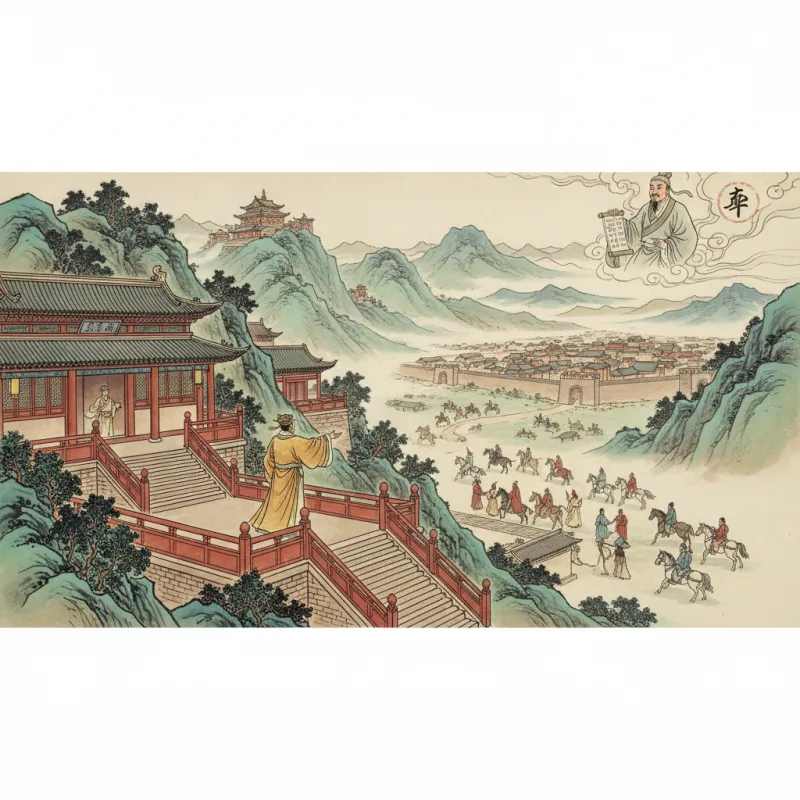
A general who wins every battle but bankrupts his state is not a master strategist — he's a liability. Sun Tzu (孙武 Sūn Wǔ), writing sometime around 500 BCE during the Spring and Autumn period, understood something that modern readers of his Art of War (孙子兵法 Sūnzǐ Bīngfǎ) consistently miss: the point of strategy isn't winning battles, it's achieving political objectives at the lowest possible cost. When he wrote "the supreme art of war is to subdue the enemy without fighting," he wasn't being poetic or philosophical. He was doing math.
The Accountant's Guide to Violence
Sun Tzu opens his treatise with calculations, not courage. The first chapter lists five fundamental factors (道 dào, 天 tiān, 地 dì, 将 jiàng, 法 fǎ) and seven considerations for comparing armies, then bluntly states: "By means of these seven considerations I can forecast victory or defeat." This is strategic assessment as accounting — tallying resources, terrain advantages, leadership quality, and organizational discipline before a single soldier marches.
The economic logic runs throughout the text. Sun Tzu notes that maintaining an army of 100,000 men costs a thousand pieces of gold per day, that prolonged campaigns exhaust the state's resources, and that even victorious armies suffer from extended warfare. He's not romanticizing military glory; he's warning rulers that war is ruinously expensive and should be concluded as quickly as possible or avoided entirely. The ancient Chinese military system was designed around this principle of efficiency — conscript armies that could be mobilized quickly and demobilized before they drained the agricultural economy.
When Sun Tzu advocates winning without fighting, he means: use intelligence gathering, diplomatic pressure, economic leverage, and psychological warfare to make the enemy surrender before you've spent gold and lives on actual combat. It's not pacifism. It's cost-benefit analysis.
Deception as Core Competency
"All warfare is based on deception" (兵者,诡道也 bīng zhě, guǐ dào yě) might be Sun Tzu's most famous line, and it's one of the few that hasn't been completely misunderstood. But the depth of his thinking on deception goes far beyond simple battlefield tricks.
Sun Tzu advocates systematic lying: appear weak when strong, strong when weak, near when far, far when near. Feign disorder to tempt the enemy into overconfidence. Pretend to flee to draw them into ambush. Bribe their officials, seduce their women, spread rumors among their troops, and generally treat truth as a tactical liability. This wasn't considered dishonorable in Warring States China — it was considered professional competence.
The historical record bears this out. When the state of Qin eventually unified China in 221 BCE, it did so through a combination of military force and strategic deception that Sun Tzu would have recognized immediately. Qin diplomats would ally with distant states to attack near ones (远交近攻 yuǎn jiāo jìn gōng), breaking up coalitions before they could form. They'd bribe enemy generals, spread disinformation about their own troop movements, and use diplomatic marriages to create false security. The Qin military machine was built on Sun Tzu's principles, even if they never acknowledged the debt.
Know Your Enemy, Know Yourself
The second most quoted line — "If you know the enemy and know yourself, you need not fear the result of a hundred battles" — is usually deployed to justify self-reflection and competitive analysis. Fine. But Sun Tzu's actual point is more specific and more ruthless: you need intelligence networks.
The final chapter of the Art of War is entirely about espionage. Sun Tzu categorizes five types of spies: local spies (recruited from enemy territory), inside spies (enemy officials you've turned), double agents (enemy spies you've captured and flipped), expendable spies (fed false information to leak), and surviving spies (who return with intelligence). He notes that no expense should be spared on intelligence gathering, that spies should be rewarded lavishly, and that the work must be kept absolutely secret.
This is not abstract philosophy. Sun Tzu is describing an intelligence apparatus that requires funding, organization, and ruthless operational security. When he says "know your enemy," he means: recruit their officials, bribe their servants, interrogate their prisoners, and build a systematic picture of their capabilities and intentions. The ancient Chinese bureaucracy would later develop sophisticated intelligence networks that operated exactly along these lines.
Terrain, Timing, and the Tyranny of Logistics
Sun Tzu devotes multiple chapters to terrain analysis with the obsessive detail of a surveyor. He categorizes ground types: accessible, entangling, temporizing, narrow, precipitous, distant. He explains how each type affects tactical options and which formations work where. This isn't romantic; it's the recognition that geography determines what's militarily possible.
The same applies to timing. Sun Tzu repeatedly emphasizes speed — not because fast armies are inherently better, but because prolonged campaigns cost more and give enemies time to prepare. He advocates striking before the enemy can concentrate forces, moving before they understand your intentions, and concluding operations before your own supplies run out.
Modern readers often skip these chapters as boring technical details. They're actually the heart of the book. Sun Tzu is explaining that strategy isn't about bold gestures or inspiring speeches — it's about understanding the physical constraints of moving thousands of men across difficult terrain with limited supplies and exploiting those constraints against your enemy.
The General Who Disobeys Orders
One of Sun Tzu's most radical ideas gets almost no attention in business school adaptations: the general in the field must have authority to disobey the ruler. "There are commands of the sovereign which must not be obeyed," he writes flatly. If the ruler orders an attack that will fail, the general must refuse. If political considerations demand a campaign that will bankrupt the state, the general must resist.
This is extraordinary in the context of ancient Chinese political thought, which generally emphasized absolute obedience to hierarchical authority. Sun Tzu is arguing that military expertise must override political authority when the two conflict — that the ruler who doesn't understand warfare should defer to the general who does.
The historical record shows this was more than theory. During the Warring States period, successful generals like Bai Qi (白起) and Wang Jian (王翦) regularly negotiated with their rulers over campaign objectives, resource allocation, and strategic priorities. They understood that their professional judgment was valuable precisely because it was independent. The tension between political authority and military expertise would remain a constant theme in Chinese history, from the Three Kingdoms period through the Ming dynasty.
What Sun Tzu Actually Means for Modern Readers
Strip away the business book nonsense and Sun Tzu's core insights remain relevant: understand your objectives clearly, assess costs realistically, gather intelligence systematically, exploit enemy weaknesses rather than attacking strengths, and conclude operations as quickly as possible. These aren't mystical Eastern wisdom — they're the basic principles of rational strategic thinking.
The Art of War endures not because it's profound philosophy but because it's practical advice that works. Sun Tzu wrote for generals who would be executed if they failed, in an era when states that lost wars ceased to exist. His book has no room for inspirational platitudes or face-saving rationalizations. It's a manual for people who need to win at the lowest possible cost, written by someone who understood that the best victory is the one you don't have to fight for.
That's the real lesson modern readers should take away: strategy is about achieving objectives efficiently, not about demonstrating courage or proving your worth. If you can get what you want through negotiation, bribery, or deception rather than violence, you should. If you must fight, fight only when you've already ensured victory through preparation and intelligence. And if the cost of winning exceeds the value of the objective, don't fight at all.
Sun Tzu would have made a terrible motivational speaker. But he would have made an excellent strategist — which was, after all, the point.
Related Reading
- The Great Wall of China: The Complete History Beyond the Myth
- The Art of War Is Not About War (It Is About Avoiding It)
- The Terracotta Army: 8,000 Soldiers Guarding an Emperor's Tomb
- Sun Tzu in Action: 5 Real Battles That Used Art of War Strategy
- The Military Strategies and Key Battles of Ancient Chinese Dynasties
- Exploring the Rich Tapestry of Ancient Chinese History and Culture
- Exploring Ancient Agricultural Practices in Chinese Dynasties
- The Silk Road Was Not a Road (And Other Things You Got Wrong)