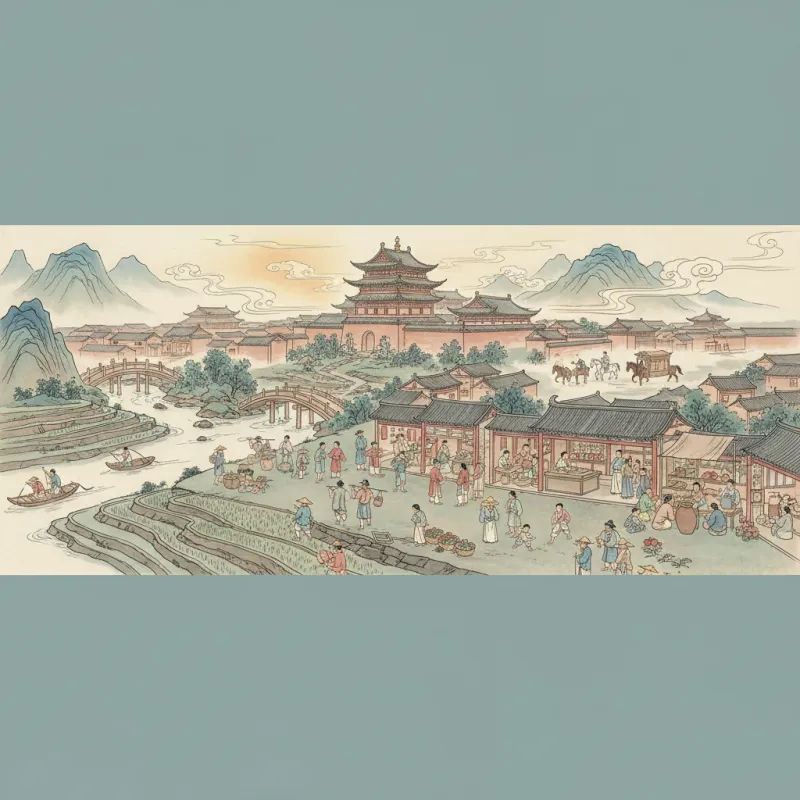
The drum sounds 400 times, and Chang'an wakes up. It's the early 8th century, and you're one of a million people living in the world's largest city — a sprawling grid of 108 walled neighborhoods where, until those drums finish beating, you're essentially locked in your ward. This isn't some dystopian fiction. This was Tuesday.
We romanticize ancient China through palace dramas and martial arts films, but what did regular people actually do between sunrise and sunset? Let's follow a day in the life of ordinary Chinese across different dynasties, because the answer changed dramatically depending on whether you were grinding millet in the Zhou Dynasty or haggling over silk prices in Tang-era markets.
Dawn: When the City Unlocks Itself
The curfew system (坊市制度, fāng shì zhìdù) defined urban life for centuries. In Tang Dynasty Chang'an, those 400 drum beats at sunrise weren't ceremonial — they were your alarm clock and your permission slip. The city's gates opened, ward gates swung wide, and suddenly a million people poured into the streets.
Breakfast was utilitarian. Forget elaborate dim sum spreads — that's a much later development. Most people ate congee (粥, zhōu), rice porridge that stretched precious grain further by boiling it with lots of water. Pickled vegetables added flavor. Wealthier households might have steamed buns (馒头, mántou), which according to legend were invented by the strategist Zhuge Liang during the Three Kingdoms period as a substitute for human head sacrifices. Whether that story is true or not, the buns were real and filling.
Tea drinking exploded during the Tang Dynasty, transforming from a medicinal curiosity to a daily necessity. Before that? People drank boiled water or grain-based beverages that would probably taste like thin, warm beer to modern palates. The Tang poet Lu Tong wrote about tea's "seven bowls," claiming the seventh bowl would make you feel a breeze from your armpits. The man was clearly drinking the good stuff.
The Grind: Work That Defined Your Existence
Here's what most people don't realize: until the Song Dynasty, your occupation was largely hereditary and legally enforced. If your father was a farmer, you were a farmer. If he was a potter, you learned to throw clay. The government maintained household registers (户籍, hùjí) that tracked not just where you lived but what you did for a living.
For the roughly 80-90% of the population who farmed, work meant backbreaking labor in fields you didn't own. The equal-field system (均田制, jūn tián zhì) of the Tang Dynasty theoretically gave each adult male about 100 mu of land (roughly 15 acres), but the reality was messier. You paid taxes in grain, cloth, and labor service. The labor service part meant you might spend a month each year building roads, digging canals, or hauling stones for some government project.
Urban workers had it different but not necessarily better. Tang Chang'an had two massive markets — the East Market (东市, dōng shì) for luxury goods and the West Market (西市, xī shì) for everyday items. If you were a silk merchant in the East Market, you dealt with Persian traders, Japanese envoys, and nobles who could afford fabric that cost more than a farmer's annual income. In the West Market, you sold pottery, tools, and food to people counting every copper coin.
The markets operated on strict schedules. They opened at noon and closed at sunset, enforced by — you guessed it — more drum beats. Try to sell outside those hours and you'd face punishment. The Tang government didn't mess around with commercial regulations.
Midday: Food, Gossip, and Social Hierarchies
Lunch was the main meal, eaten around noon when you could actually see what you were eating. For farmers, this meant taking a break in the fields — usually more congee, maybe with vegetables if the season was right, occasionally with a bit of salted fish or preserved meat if you'd been lucky or thrifty.
Urban dwellers had more options. By the Song Dynasty (960-1279 CE), street food culture exploded. Night markets emerged, curfews relaxed, and suddenly you could buy prepared food from vendors. But in earlier periods like the Tang, most people ate at home. Women did the cooking, grinding grain by hand, tending fires, preparing pickles and preserves that would last through winter.
The social aspect of meals mattered enormously. You ate with your family, sitting on mats (chairs didn't become common until the Song Dynasty). Chopsticks were standard by the Han Dynasty, though spoons remained essential for soups and congee. The wealthy used lacquerware or ceramics; everyone else made do with wood or bamboo.
Here's a detail that surprises people: ancient Chinese didn't eat much meat. Buddhist influence during the Tang Dynasty made vegetarianism respectable, but economics made it necessary. Pork was the most common meat when people could afford it, but "afford it" meant maybe a few times a month for urban workers, a few times a year for farmers. The food culture of ancient China was fundamentally grain-based, with meat as a luxury accent.
Afternoon: The Second Shift
After lunch, work resumed. For artisans, this meant returning to workshops where specialization reached impressive levels. A single bronze mirror might pass through a dozen hands — someone to cast it, someone to polish it, someone to engrave designs, someone to apply decorative backing. The division of labor in Chinese workshops anticipated Adam Smith's pin factory by over a thousand years.
Women's work was endless and largely invisible in historical records. Spinning thread, weaving cloth, making clothes, preparing food, raising children, tending gardens, feeding chickens and pigs — this was the economic backbone of every household. The government literally taxed cloth production, expecting each household to produce a certain amount of fabric annually. Women's textile work wasn't a hobby; it was a legal obligation.
Children worked too. By age seven or eight, kids were helping in fields, learning trades, or (for the tiny percentage of wealthy families) beginning their education. The education system was theoretically open to all through the imperial examination system, but realistically, only families who could afford to lose a son's labor for years of study could participate.
Evening: When the Drums Beat Again
As sunset approached, those drums sounded again — this time 600 beats, signaling the closing of markets and the beginning of curfew. In Tang Chang'an, you had to be back in your ward before the gates closed. Get caught outside after curfew and you'd face punishment — usually a beating, sometimes worse if authorities suspected criminal intent.
Dinner was lighter than lunch, often leftovers or simple soup. Then came the few hours of genuine leisure time, though "leisure" is a generous term. People mended clothes, repaired tools, told stories, gossiped about neighbors. In urban areas, there might be entertainment — street performers, storytellers, musicians — but this was more common in the Song Dynasty when curfews relaxed and night markets flourished.
Lighting was expensive. Candles and oil lamps cost money most people didn't have to spare, so when the sun went down, activities wound down too. People went to bed early because they had to wake at dawn, and the cycle would begin again.
The Rhythm of Seasons and Obligations
This daily routine shifted dramatically with seasons. Agricultural work followed the calendar with religious precision. Spring planting, summer weeding, autumn harvest, winter preparation — each season demanded different labor. The government scheduled its labor service requirements around the agricultural calendar, though not always successfully.
Festivals broke the monotony. The Spring Festival (what we now call Chinese New Year), the Qingming tomb-sweeping festival, the Mid-Autumn Festival — these were the rare days when work stopped, families gathered, and people ate special foods they'd saved for or splurged on. These festivals weren't just cultural traditions; they were psychological necessities in lives defined by repetitive labor.
Religious and ritual obligations also punctuated daily life. Ancestor worship meant regular offerings at family shrines. Local temples required attendance at festivals. The government mandated participation in certain ceremonies. Your time was never entirely your own.
What Changed and What Didn't
The Song Dynasty (960-1279 CE) transformed daily life more than any other period. Curfews relaxed. Night markets emerged. Paper money appeared. Printing made books cheaper. Cities grew more commercial and less militarized. The rigid ward system of the Tang gave way to more fluid urban spaces.
But for farmers — still the vast majority — life remained brutally consistent across dynasties. You worked land you didn't own, paid taxes that consumed much of what you produced, and hoped the harvest would be good enough to survive winter. The social structure kept you in place, and mobility was rare.
The Mongol Yuan Dynasty (1271-1368 CE) and later periods brought new elements — different crops, new technologies, expanded trade networks — but the fundamental rhythm of daily life for ordinary people remained remarkably stable. Wake at dawn, work until dusk, eat simple food, sleep, repeat.
This wasn't a life of adventure or romance. It was a life of routine, obligation, and survival. The ordinary people of ancient China didn't write histories or star in legends, but their daily labor — grinding grain, weaving cloth, hauling water, planting rice — built one of history's most enduring civilizations. Those 400 drum beats at dawn weren't just opening city gates; they were calling millions of people to the unglamorous work of keeping society functioning, one exhausting day at a time.
Related Reading
- What Did Ancient Chinese People Eat? A Dynasty-by-Dynasty Food History
- What Ordinary People Ate in Ancient China (It Was Not What You Think)
- The Imperial Examination: The World's First Standardized Test
- Ancient Chinese Fashion: What People Really Wore Through the Dynasties
- Exploring the Rich Tapestry of Ancient Chinese History and Culture
- Chinese Architecture: Forbidden Cities, Pagodas, and Garden Design
- The Dynasties of China: A Quick Guide to 4,000 Years of History