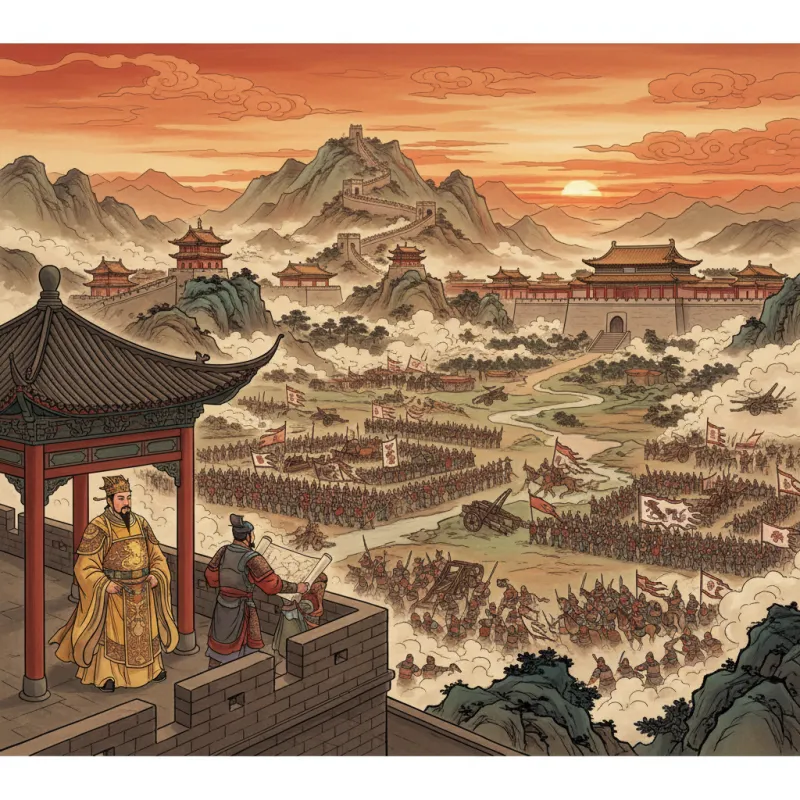
The clash of bronze weapons echoed across the Yellow River valley as Sun Wu, a military strategist from the state of Qi, presented his thirteen chapters on warfare to King Helü of Wu. The king, skeptical but intrigued, challenged Sun Wu to demonstrate his methods using the palace's 180 concubines as soldiers. What followed would become legendary: Sun Wu executed two of the king's favorite concubines for failing to follow orders, proving that discipline trumped sentiment in warfare. This ruthless demonstration earned him command of Wu's armies and gave birth to The Art of War (孙子兵法, Sūnzǐ Bīngfǎ), a text that would influence military thinking for over two millennia.
The Warring States: Where Strategy Became Science
The Warring States Period (战国时代, Zhànguó Shídài, 475–221 BC) transformed Chinese warfare from ritualized combat into calculated science. Seven major states—Qin, Chu, Zhao, Wei, Han, Yan, and Qi—competed for supremacy, each developing sophisticated military doctrines. Unlike earlier Zhou dynasty battles where aristocrats fought according to strict codes of honor, Warring States commanders embraced deception, mobility, and psychological warfare.
The Battle of Maling (马陵之战, Mǎlíng Zhī Zhàn) in 342 BC exemplifies this shift. Sun Bin, descendant of Sun Wu, faced his former classmate Pang Juan, who had betrayed and crippled him years earlier. Rather than meet Pang Juan's Wei army head-on, Sun Bin orchestrated an elaborate deception. He ordered his Qi forces to light 100,000 cooking fires on the first night of retreat, 50,000 on the second, and 30,000 on the third. Pang Juan, convinced the Qi army was deserting en masse, rushed forward with a small force—straight into an ambush where Sun Bin had carved into a tree: "Pang Juan dies beneath this tree." The Wei commander, realizing he'd been outmaneuvered by his crippled rival, committed suicide on the spot.
This battle demonstrates what made Chinese military strategy distinctive: the emphasis on shi (势, shì)—strategic advantage or momentum. Chinese commanders didn't just seek battlefield victory; they manipulated circumstances to make victory inevitable before armies even clashed.
The Qin Unification: Industrial Warfare Meets Strategic Vision
When Qin Shi Huang (秦始皇, Qín Shǐhuáng) unified China in 221 BC, he did so through military innovations that prefigured modern industrial warfare. The Qin state had spent decades implementing Legalist reforms that transformed their society into a war machine. Every aspect of Qin life served military purposes: farmers were soldiers during campaign season, iron production focused on weapons, and a merit-based promotion system ensured talented commanders rose regardless of birth.
The Battle of Changping in 260 BC showcased Qin's brutal efficiency. General Bai Qi (白起, Bái Qǐ) faced a Zhao army of 450,000 men. Rather than risk a frontal assault, Bai Qi cut off the Zhao supply lines and waited. After 46 days of siege, the starving Zhao army surrendered. Bai Qi then ordered the execution of 400,000 prisoners—a massacre so vast it shocked even hardened warriors of that era. This wasn't mindless cruelty; it was calculated terror designed to break enemy morale across all six remaining states.
The Qin approach to warfare emphasized overwhelming force, logistical superiority, and psychological intimidation. They built roads to move armies faster, standardized weapons for easier replacement, and maintained detailed records of enemy strengths. When other states still relied on aristocratic cavalry and chariots, Qin fielded massive infantry formations armed with crossbows and long pikes—the ancient equivalent of combined arms warfare.
Han Dynasty: Cavalry Warfare and the Xiongnu Challenge
The Han dynasty (汉朝, Hàn Cháo, 206 BC–220 AD) inherited Qin's military infrastructure but faced a fundamentally different challenge: the Xiongnu (匈奴, Xiōngnú), nomadic horsemen who raided Chinese settlements with impunity. Early Han emperors tried appeasement, sending princesses and tribute to Xiongnu leaders. This humiliation ended with Emperor Wu (汉武帝, Hàn Wǔdì, r. 141–87 BC), who revolutionized Chinese cavalry tactics.
General Huo Qubing (霍去病, Huò Qùbìng) epitomized this new approach. In 121 BC, at age 19, he led 10,000 cavalry deep into Xiongnu territory, covering over 1,000 kilometers in a lightning campaign. Rather than the cautious, supply-line-dependent warfare of previous dynasties, Huo Qubing adopted nomadic tactics: living off the land, moving rapidly, and striking without warning. His campaigns pushed the Xiongnu beyond the Gobi Desert and secured the Hexi Corridor, opening the Silk Road to Chinese control.
The Han military synthesis—combining Chinese organizational discipline with nomadic mobility—created a hybrid warfare model. They bred superior horses, trained cavalry forces that could match steppe warriors, and built a network of garrison towns to project power across Central Asia. This wasn't just military innovation; it represented a cultural shift where Chinese commanders learned from their enemies rather than dismissing "barbarian" tactics as inferior.
Three Kingdoms: The Romance of Strategic Genius
The Three Kingdoms period (三国时代, Sānguó Shídài, 220–280 AD) produced some of China's most celebrated military minds, though separating historical fact from the romanticized Romance of the Three Kingdoms (三国演义, Sānguó Yǎnyì) proves challenging. What's undeniable is that this era elevated strategic thinking to an art form.
The Battle of Red Cliffs (赤壁之战, Chìbì Zhī Zhàn) in 208 AD remains the period's defining engagement. Cao Cao (曹操, Cáo Cāo), controlling northern China with an army of reportedly 800,000 men, moved south to crush the allied forces of Liu Bei and Sun Quan. The allies, outnumbered perhaps five to one, couldn't win through conventional means. Instead, they exploited Cao Cao's weakness: his northern troops had no experience with naval warfare.
Zhuge Liang (诸葛亮, Zhūgě Liàng) and Zhou Yu (周瑜, Zhōu Yú) orchestrated a fire attack. They sent ships loaded with oil-soaked materials toward Cao Cao's fleet, which he'd chained together to reduce seasickness among his troops. When the fire ships struck, the entire northern fleet became an inferno. Cao Cao's army, trapped on the Yangtze River's northern bank, suffered catastrophic losses. This battle demonstrated that in Chinese strategic thinking, understanding terrain—including water—mattered as much as troop numbers.
Zhuge Liang's later campaigns against Wei showcased another Chinese military principle: the importance of logistics and administration. His famous "wooden oxen and flowing horses" (木牛流马, Mùniú Liúmǎ)—mechanical transport devices—solved supply problems in mountainous terrain. When he died during the Fifth Northern Expedition in 234 AD, his reputation rested not just on battlefield victories but on his ability to maintain armies in hostile territory through superior organization.
Tang Dynasty: Cosmopolitan Warfare and the Turkic Challenge
The Tang dynasty (唐朝, Táng Cháo, 618–907 AD) represented the apex of Chinese military power, projecting force from Korea to Central Asia. Tang armies were remarkably cosmopolitan, incorporating Turkic cavalry, Sogdian auxiliaries, and even Arab mercenaries. This diversity reflected Tang strategic thinking: use the best methods and troops regardless of origin.
General Li Jing (李靖, Lǐ Jìng) exemplified Tang military excellence. In 630 AD, he led a winter campaign against the Eastern Turks that violated every conventional wisdom about warfare. Chinese armies traditionally avoided winter campaigns, but Li Jing recognized that the Turks, confident in their seasonal advantage, would be unprepared. He struck through snowstorms, covering vast distances before the Turks could organize resistance. The campaign destroyed the Eastern Turkic Khaganate and established Tang dominance over the steppe.
The Tang military system combined professional soldiers (fubing, 府兵) with a sophisticated command structure. They maintained detailed military manuals, established military academies, and promoted based on examination results as well as battlefield performance. This institutionalization of military knowledge meant that strategic principles could be taught and refined across generations—a stark contrast to societies where military genius depended on individual commanders.
The Enduring Legacy: Strategy as Philosophy
Chinese military strategy's lasting influence stems from its philosophical depth. Unlike Western military thought, which often separated warfare from broader cultural concerns, Chinese strategists saw military action as one expression of universal principles. The Art of War discusses warfare but applies equally to business, diplomacy, and personal relationships. The concept of wu wei (无为, wú wéi)—effortless action—appears in both Daoist philosophy and military strategy, suggesting that the best victories come from positioning yourself so that success becomes natural and inevitable.
Modern military thinkers from Mao Zedong to contemporary strategists continue drawing on these ancient texts. The emphasis on deception, the importance of morale, the focus on avoiding battle when possible—these principles remain relevant because they address fundamental aspects of conflict that transcend technology and era. When Sun Tzu wrote "the supreme art of war is to subdue the enemy without fighting," he articulated a principle that resonates in an age of economic competition and information warfare.
The strategic innovations of Chinese dynasties weren't just about winning battles; they represented a sophisticated understanding of how power operates, how organizations function, and how human psychology influences conflict. That's why, 2,500 years after Sun Wu demonstrated his methods to King Helü, military academies worldwide still study Chinese strategic thought—not as historical curiosity, but as living wisdom applicable to contemporary challenges.
Related Reading
- Zheng He's Voyages: When China Ruled the Seas
- The Epic Battles of Ancient China: Strategies, Emperors, and Cultural Legacy
- Battle of Fei River: When 80,000 Defeated 800,000
- Porcelain: The Art That Named a Nation
- Unveiling the Splendor of Ancient Chinese Architecture Across Dynasties
- Confucius: Teachings That Shaped a Civilization