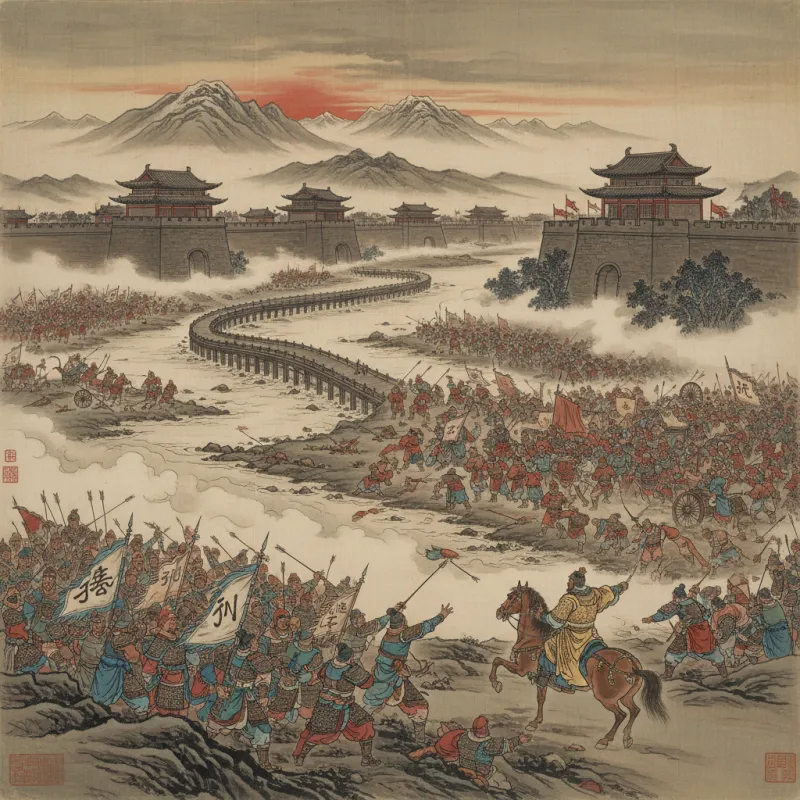
The general stood on the northern bank of the Fei River, surveying what should have been an easy victory. Behind him stretched an army so vast that, according to contemporary accounts, "their banners blocked out the sun and when they drank from rivers, the waters ran dry." Across the narrow waterway waited a force barely one-tenth his size. Yet within hours, this massive army would be fleeing in complete panic, trampling each other in their desperation to escape an enemy they vastly outnumbered. The Battle of Fei River (淝水之战 Féishuǐ zhī Zhàn) in 383 CE remains history's most spectacular demonstration that numbers mean nothing when psychology collapses.
The Fragmented Empire
To understand how 80,000 men defeated 800,000, you need to grasp the chaos of 4th-century China. The unified empire that had stood for centuries was shattered. The north had fallen to various non-Chinese peoples — collectively called the Sixteen Kingdoms period — while the Eastern Jin Dynasty (东晋 Dōng Jìn, 317-420 CE) clung to power in the south, with its capital at Jiankang (modern Nanjing).
The Former Qin (前秦 Qián Qín, 351-394 CE) had emerged as the dominant power in the north under its ruler Fu Jiān (苻坚). A Di ethnic leader who had adopted Chinese culture and governance, Fu Jiān was actually a capable and relatively benevolent ruler. He had unified most of northern China through a combination of military conquest and diplomatic skill. By 383 CE, he controlled territory stretching from Gansu to Shandong, commanding resources that dwarfed the southern Jin.
But Fu Jiān made a critical error: he believed his own propaganda. His advisors warned him repeatedly that his army, while massive, was a patchwork of recently conquered peoples with questionable loyalty. His own brother Fu Róng (苻融) cautioned against the invasion. His minister Wang Měng (王猛), the brilliant strategist who had engineered most of Qin's victories, had advised on his deathbed that Fu Jiān should never attack the Jin. Fu Jiān ignored them all.
The Psychology of Numbers
Here's what the historical records tell us: Fu Jiān assembled an army reported at 870,000 infantry and 270,000 cavalry — over one million men. Modern historians debate these figures, with some suggesting the actual force was closer to 300,000-400,000, but even the conservative estimates gave Fu Jiān overwhelming numerical superiority.
The Eastern Jin, meanwhile, could muster perhaps 80,000 troops under the command of Xie Xuan (谢玄) and his uncle Xie Shi (谢石). The Xie family were among the most powerful aristocratic clans in the south, and Xie Xuan had trained an elite force called the Beifu Army (北府军 Běifǔ jūn) — professional soldiers who would prove far more cohesive than Fu Jiān's conscripted masses.
Fu Jiān's strategy was simple: overwhelm the enemy with sheer numbers. He reportedly boasted that his army could "dam up the Yangtze River by throwing their whips into it." This wasn't just arrogance — it was a fundamental misunderstanding of military psychology. Large armies are harder to command, slower to maneuver, and more prone to panic when things go wrong.
The Fatal Maneuver
The two armies met at the Fei River in what is now Anhui Province. The Jin forces held the southern bank; the Qin army occupied the northern side. The river wasn't particularly wide or deep — not an insurmountable obstacle for either side.
Xie Xuan, the Jin commander, made a brilliant psychological gambit. He sent a messenger to Fu Jiān with a proposal: "Your army crowds the northern bank so densely that we cannot properly engage in battle. If you would withdraw slightly to give us room to cross, we can settle this matter in proper combat."
It was an absurd request. Why would an army with overwhelming numerical superiority give up a defensive position to let the enemy cross? Fu Jiān's generals immediately objected. But Fu Jiān, supremely confident, saw an opportunity. He would let the Jin forces cross halfway, then strike them while they were vulnerable in the water. It would be a massacre.
He ordered his army to pull back from the riverbank.
This is where everything fell apart.
The Collapse
The Qin army began its tactical withdrawal — but remember, this was not a professional, unified force. It was a massive collection of recently conquered peoples, many of whom had been forced into service. They didn't understand the tactical purpose of the withdrawal. They only saw their own army retreating.
As the front ranks pulled back, confusion rippled through the massive formation. Some units thought they were retreating for real. Others tried to maintain order but were pushed by the crowds behind them. The Jin forces, seeing the confusion, immediately launched their attack.
Xie Xuan's Beifu Army, disciplined and well-trained, surged across the river. At the same moment, Jin agents who had infiltrated the Qin ranks began shouting "The Qin army is defeated! The Qin army is defeated!" (秦军败了! Qín jūn bài le!)
Panic is contagious, especially in massive armies where most soldiers cannot see what's actually happening. The rumor of defeat became a self-fulfilling prophecy. The Qin army, which had never actually engaged the enemy, began to flee.
Fu Jiān himself was wounded by an arrow. His brother Fu Róng, trying to rally the troops, was killed in the chaos. The retreat became a rout. Soldiers trampled each other. Units dissolved. The massive Qin army disintegrated into a fleeing mob, pursued by Jin cavalry who cut them down by the thousands.
Contemporary accounts describe soldiers so terrified that "when they heard the wind rustling through the trees or the cries of cranes, they thought the Jin army was upon them." This phrase — "the wind and cranes" (风声鹤唳 fēngshēng-hèlì) — became a Chinese idiom for extreme paranoia and fear.
The Aftermath
The Battle of Fei River destroyed the Former Qin as a unified state. Fu Jiān limped back to his capital with only a fraction of his army. Within a year, his empire had fractured as various ethnic groups and regional commanders declared independence. Fu Jiān himself was captured and killed in 385 CE by a former subordinate.
The Eastern Jin, meanwhile, gained a reprieve that would last another four decades. The victory at Fei River is often compared to the Battle of Red Cliffs, where a smaller southern force defeated a massive northern invasion, preserving southern Chinese culture and political independence during a period of division.
But the victory had limits. The Jin Dynasty never managed to reconquer the north. The aristocratic families who dominated Jin politics, including the Xie clan, were more interested in preserving their own power than in aggressive expansion. The north would remain divided among various kingdoms until the Sui Dynasty reunified China more than two centuries later.
Lessons in Leadership
What makes Fei River fascinating isn't just the numerical disparity — it's how completely Fu Jiān misread the situation. He had built an empire through careful strategy and diplomatic skill, yet threw it away through overconfidence and a fundamental misunderstanding of his own army's cohesion.
The battle demonstrates several timeless military principles. First, numerical superiority means nothing if you cannot effectively command and coordinate your forces. Fu Jiān's million-man army was actually a liability — too large to control, too diverse to trust, too unwieldy to maneuver.
Second, morale and cohesion matter more than raw numbers. The Beifu Army was smaller but professional, disciplined, and unified in purpose. They knew their commanders, trusted their training, and fought as a coordinated force.
Third, psychological warfare can be decisive. The Jin commanders understood that Fu Jiān's army was a fragile coalition held together by the appearance of invincibility. Once that appearance cracked, the entire structure collapsed.
The Legend Lives On
The Battle of Fei River has been retold countless times in Chinese literature, drama, and popular culture. It appears in historical novels, television series, and strategy games. The phrase "throwing whips into the river" (投鞭断流 tóubiān-duànliú) became an idiom for overconfidence, while "wind and cranes" remains in common use to describe paranoid fear.
Modern military historians study Fei River alongside other famous upset victories like Cannae, Agincourt, and Isandlwana. Each demonstrates how overconfidence, poor intelligence, and psychological factors can overcome material advantages. But Fei River stands out for the sheer scale of the disparity and the completeness of the collapse.
The battle also raises uncomfortable questions about historical sources. Did Fu Jiān really command over a million men, or did later historians inflate the numbers to make the Jin victory seem more impressive? We'll never know for certain. But even if we accept the most conservative modern estimates — say, 300,000 Qin troops versus 80,000 Jin — the outcome remains extraordinary.
What we do know is this: in 383 CE, a massive army marched south expecting easy victory and instead suffered one of history's most catastrophic defeats. The general who had unified northern China died in disgrace. The dynasty he built collapsed within years. And the smaller, supposedly weaker southern kingdom survived to preserve Chinese culture through one of history's darkest periods.
Sometimes the underdog wins not through superior strength, but through superior understanding of human psychology. The Battle of Fei River proved that lesson in the most dramatic way possible.
Related Reading
- The Epic Battles of Ancient China: Strategies, Emperors, and Cultural Legacy
- The Battle of Changping: 400,000 Buried Alive
- The Taiping Rebellion: The Deadliest Civil War in History
- Zheng He's Voyages: When China Ruled the Seas
- Delving into Ancient China: A Journey Through Dynasties, Emperors, and Cultural Treasures
- The Role of Trade in Shaping Ancient Chinese Dynasties and Culture
- Ancient Chinese Dynasties and Emperors: Legal Systems, Battles, and Cultural Legacy