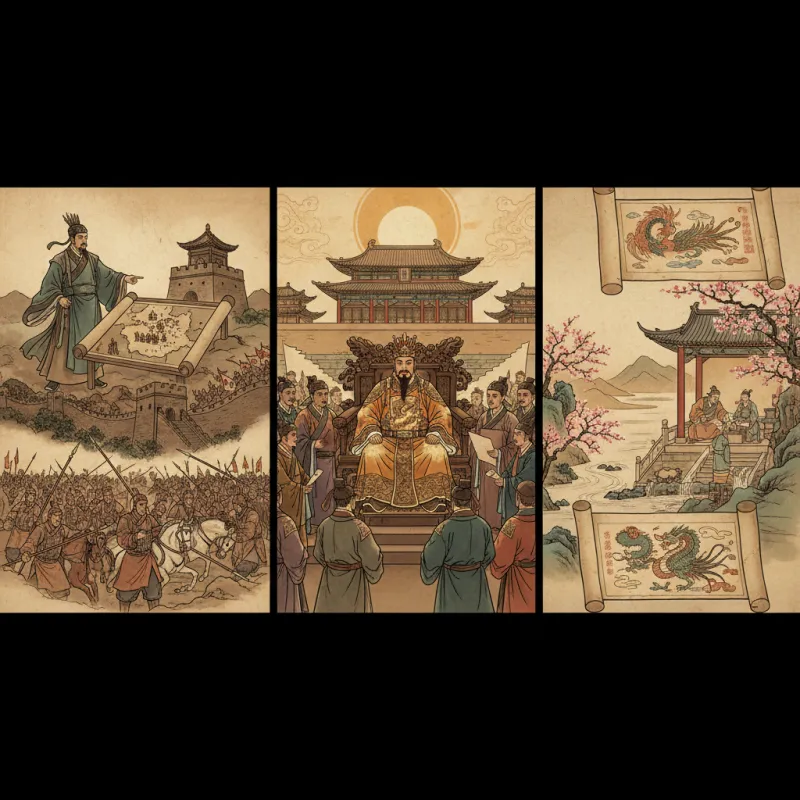
The clash of bronze swords echoed across the Yellow River plains as 400,000 Qin soldiers faced down the combined armies of six rival kingdoms. It was 260 BCE, and the Battle of Changping (长平之战, Chángpíng zhī zhàn) would become the bloodiest confrontation in ancient Chinese history—a slaughter so complete that Qin general Bai Qi (白起) allegedly buried 400,000 surrendered Zhao soldiers alive. This wasn't just warfare; it was the brutal calculus of empire-building that would forge modern China.
The Warring States: When Philosophy Met the Battlefield
The Warring States Period (战国时代, Zhànguó shídài, 475-221 BCE) transformed Chinese warfare from ritualized combat into total war. Seven major kingdoms—Qin, Chu, Zhao, Wei, Han, Yan, and Qi—abandoned the aristocratic chariot battles of earlier eras and embraced mass infantry armies numbering in the hundreds of thousands. This wasn't evolution; it was revolution.
Sun Tzu (孙子, Sūnzǐ) wrote The Art of War during this blood-soaked century, and his maxim "supreme excellence consists of breaking the enemy's resistance without fighting" wasn't philosophical musing—it was survival doctrine. The strategist Sun Bin (孙膑, Sūn Bìn), Sun Tzu's alleged descendant, proved this at the Battle of Guiling (桂陵之战, Guìlíng zhī zhàn) in 353 BCE by feigning retreat and luring the Wei army into a devastating ambush. Deception became an art form, and generals who couldn't master it didn't live long enough to learn.
The period's defining characteristic was its ruthless pragmatism. States adopted Legalist (法家, Fǎjiā) philosophies that prioritized military strength over Confucian virtue. Shang Yang's (商鞅) reforms in Qin created a militarized society where social advancement came through severed enemy heads—literally. Soldiers received ranks and land based on their body count, turning warfare into a grotesque meritocracy that would eventually conquer all of China.
Xiang Yu vs. Liu Bang: The Struggle That Defined Imperial China
The Chu-Han Contention (楚汉之争, Chǔ-Hàn zhī zhēng, 206-202 BCE) reads like a Greek tragedy written by Chinese historians. Xiang Yu (项羽), the aristocratic warrior-king, possessed superhuman strength and tactical brilliance. Liu Bang (刘邦), the peasant-turned-rebel, had neither—but he understood something Xiang Yu never grasped: wars are won by logistics, alliances, and knowing when to retreat.
The Battle of Gaixia (垓下之战, Gāixià zhī zhàn) in 202 BCE showcased this contrast perfectly. Han general Han Xin (韩信) surrounded Xiang Yu's forces and ordered his troops to sing Chu folk songs through the night. Hearing the melodies of home, Xiang Yu's soldiers assumed their homeland had fallen and deserted en masse. This psychological warfare—the famous "Besieged on All Sides" (四面楚歌, sìmiàn chǔgē)—broke Xiang Yu's spirit before the final battle even began. He committed suicide rather than face capture, and Liu Bang founded the Han Dynasty that would rule for four centuries.
The lesson? Charisma and martial prowess matter less than strategic patience and coalition-building. Liu Bang lost nearly every battle against Xiang Yu but won the war by outlasting him. This pattern would repeat throughout Chinese history, where strategic thinking often trumped battlefield heroics.
The Red Cliffs: When Fire Defeated Numbers
The Battle of Red Cliffs (赤壁之战, Chìbì zhī zhàn) in 208-209 CE remains China's most romanticized military engagement, immortalized in the Romance of the Three Kingdoms (三国演义, Sānguó Yǎnyì). Prime Minister Cao Cao (曹操) commanded perhaps 220,000 troops sailing down the Yangtze River to crush the southern kingdoms of Shu and Wu. His opponents, Sun Quan (孙权) and Liu Bei (刘备), fielded maybe 50,000 combined forces. The math suggested annihilation.
Instead, strategists Zhou Yu (周瑜) and Zhuge Liang (诸葛亮) exploited Cao Cao's critical weakness: his northern troops had no naval experience. They chained their ships together to reduce seasickness—a decision that transformed the fleet into a floating tinderbox. When Wu general Huang Gai (黄盖) sailed fire ships into Cao Cao's armada during a southeast wind, the entire northern fleet became an inferno. Cao Cao fled north, and China remained divided for another seventy years.
The battle's cultural impact exceeds its military significance. It established the Three Kingdoms period as China's most beloved historical era, spawning countless novels, operas, and video games. More importantly, it demonstrated that geography and environmental factors could overcome numerical superiority—a lesson that would influence Chinese military philosophy for centuries.
The An Lushan Rebellion: When Empire Nearly Collapsed
The An Lushan Rebellion (安史之乱, Ān-Shǐ zhī luàn, 755-763 CE) doesn't get the romantic treatment of Red Cliffs, but it was far more consequential. General An Lushan (安禄山), a corpulent frontier commander who somehow charmed Emperor Xuanzong (唐玄宗), rebelled with 200,000 battle-hardened troops and nearly toppled the Tang Dynasty. The rebellion killed an estimated 36 million people—roughly one-sixth of the world's population at the time.
The Tang survived, but barely. Emperor Xuanzong fled the capital, his beloved concubine Yang Guifei (杨贵妃) was executed by mutinous troops, and the dynasty never recovered its former glory. The rebellion forced Tang emperors to rely on regional warlords (节度使, jiédùshǐ) who gradually became independent power brokers. This decentralization pattern would plague Chinese dynasties for the next millennium.
What made An Lushan's rebellion so devastating wasn't just military defeat—it was the collapse of the Tang's professional army system. The dynasty had grown complacent, replacing frontier soldiers with palace guards more skilled at ceremony than combat. When real war came, the empire discovered its military was hollow. The lesson resonated through Chinese history: institutional decay invites catastrophe, regardless of cultural sophistication or economic prosperity.
Mongol Conquest: The Exception That Proved Every Rule
The Mongol conquest of China (1205-1279 CE) shattered every assumption about Chinese military superiority. Genghis Khan (成吉思汗, Chéngjísī hán) and his descendants conquered the most populous, technologically advanced civilization on Earth using tactics that Chinese strategists had theoretically mastered: mobility, deception, psychological warfare, and ruthless pragmatism.
The Mongols succeeded because they ignored Chinese military conventions entirely. They didn't besiege cities for months—they diverted rivers to flood them or used Chinese engineers to build siege weapons. They didn't fight honorable pitched battles—they feigned retreats to lure enemies into killing zones. They didn't respect Confucian hierarchy—they promoted based on merit and incorporated conquered peoples into their armies.
The Song Dynasty's (宋朝, Sòng cháo) final stand at Yamen (崖门海战, Yámén hǎizhàn) in 1279 CE was appropriately tragic. Rather than surrender, Prime Minister Lu Xiufu (陆秀夫) carried the eight-year-old emperor on his back and jumped into the sea. Thousands of loyalists followed. The Mongol Yuan Dynasty (元朝, Yuán cháo) ruled China for less than a century, but their conquest exposed a uncomfortable truth: Chinese military theory was sophisticated, but Chinese military practice had grown sclerotic.
The Cultural Legacy: How Warfare Shaped Chinese Identity
Ancient Chinese battles weren't just military events—they were crucibles that forged cultural values still recognizable today. The emphasis on strategic thinking over brute force, the valorization of loyalty even in defeat, the belief that moral authority ultimately trumps military power—these concepts emerged from centuries of warfare and shaped everything from business practices to diplomatic relations.
The Romance of the Three Kingdoms remains China's most influential novel not because of its historical accuracy (it has little) but because it dramatizes these values through unforgettable characters. Zhuge Liang embodies the brilliant strategist who serves a flawed but legitimate ruler. Guan Yu (关羽) represents loyalty unto death, now worshipped as a deity. Cao Cao shows that effectiveness matters more than conventional morality—a controversial position that still sparks debates.
Chinese military history also reveals a persistent tension between Confucian civilian authority and military necessity. Emperors feared successful generals almost as much as foreign invaders, leading to a pattern where brilliant commanders were often executed or marginalized after their victories. This civilian supremacy over the military became a defining feature of Chinese governance, for better and worse.
The Enduring Lessons
Walk through any Chinese bookstore today, and you'll find The Art of War prominently displayed alongside business management texts. This isn't coincidental—ancient Chinese military strategy has been repackaged as corporate wisdom, diplomatic guidance, and life philosophy. The battles themselves are mostly forgotten outside specialist circles, but their strategic principles remain surprisingly relevant.
The epic battles of ancient China teach us that warfare is ultimately about human psychology, resource management, and institutional resilience rather than individual heroism or technological superiority. Xiang Yu was the better warrior, but Liu Bang built the better coalition. Cao Cao had the larger army, but Zhou Yu understood the environment. The Song Dynasty had gunpowder and advanced metallurgy, but the Mongols had adaptability and ruthlessness.
These weren't just Chinese lessons—they were human lessons, written in blood across the Yellow River plains and Yangtze valleys. The generals and emperors are long dead, but their strategies echo through history, reminding us that the art of conflict, whether military or otherwise, remains fundamentally unchanged. We've simply found more sophisticated ways to apply the same ancient principles.
Related Reading
- Battle of Fei River: When 80,000 Defeated 800,000
- The Battle of Red Cliffs: The Most Famous Battle in Chinese History
- The Strategical Brilliance of Chinese Battles: A Journey Through Ancient History
- The Taiping Rebellion: The Deadliest Civil War in History
- The An Lushan Rebellion: The Catastrophe That Changed China Forever
- Ancient Chinese Medicine: A Look into Dynasties and Healing Practices
- Unraveling the Economic Tapestry of Ancient Chinese Dynasties
- The Military Strategies and Key Battles of Ancient Chinese Dynasties