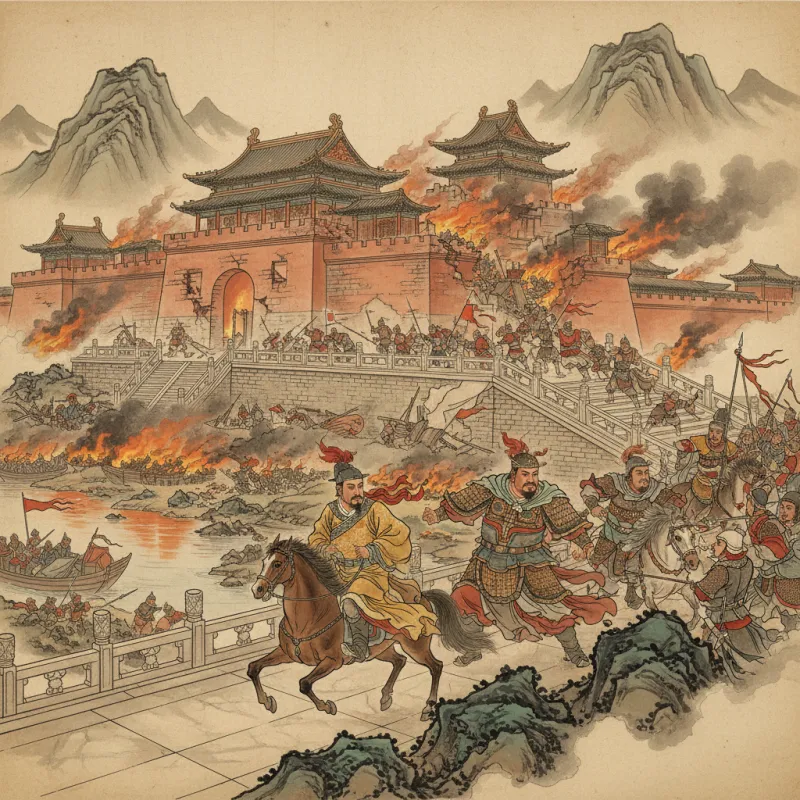
The imperial banquet hall fell silent as An Lushan, a 300-pound general of Sogdian-Turkic descent, performed an elaborate dance for Emperor Xuanzong and his beloved consort Yang Guifei. The year was 751 CE, and the most powerful man in China was laughing at the spectacle of his favorite general — a man who commanded 164,000 troops along the northeastern frontier — cavorting like a court entertainer. Four years later, that same general would march those troops south and ignite a rebellion that would kill an estimated 36 million people, roughly two-thirds of the Tang Dynasty's registered population. The An Lushan Rebellion (安史之乱 Ān Shǐ zhī Luàn) wasn't just a civil war — it was the catastrophic end of China's golden age and possibly the deadliest conflict in human history relative to global population.
The Gilded Rot: How Paradise Bred Disaster
The Tang Dynasty (唐朝 Táng Cháo, 618-907 CE) under Emperor Xuanzong (唐玄宗 Táng Xuánzōng, r. 712-756) had reached heights that made it the envy of the world. Chang'an (长安), the capital, was the largest city on earth with over one million residents. Silk Road trade filled imperial coffers. Poetry flourished under masters like Li Bai and Du Fu. The examination system was producing capable administrators. By every metric, this was China's apex.
But the brilliance concealed structural decay. Xuanzong, who had been an energetic reformer in his youth, grew complacent after meeting Yang Guifei (杨贵妃 Yáng Guìfēi) in 745 CE. She was technically his daughter-in-law — the widow of one of his sons — but Xuanzong was so besotted that he made her his consort and showered her family with positions and wealth. Her cousin Yang Guozhong (杨国忠) became chief minister despite being spectacularly corrupt and incompetent.
Meanwhile, the military system was transforming in dangerous ways. The Tang had originally relied on a militia system of farmer-soldiers, but decades of peace had made this obsolete. The empire increasingly depended on professional frontier armies commanded by regional military governors called jiedushi (节度使 jiédùshǐ). These generals controlled not just troops but also civil administration and tax collection in their regions. They were becoming warlords in all but name.
An Lushan was the most powerful of these jiedushi, commanding three frontier regions simultaneously — an unprecedented concentration of military power. Born to a Sogdian father and Turkic mother, he had risen through the ranks by being an effective commander against the Khitan tribes. He was also a master manipulator who understood court politics better than most native Chinese officials.
The Favorite's Gambit
An Lushan cultivated Emperor Xuanzong with shameless flattery. He claimed Yang Guifei as his adoptive mother and performed the humiliating dance mentioned earlier to entertain the imperial couple. He sent exotic gifts from the frontier. He played the role of the loyal barbarian general so convincingly that Xuanzong ignored repeated warnings from other officials that An Lushan was accumulating dangerous power.
The warnings were prescient. By 755 CE, An Lushan controlled 164,000 of the empire's best troops — nearly 40% of the Tang's total military strength. He had stockpiled weapons and supplies. He had cultivated loyalty among his officers, many of whom were fellow non-Chinese who felt marginalized by the Tang court's increasing xenophobia.
The trigger came when Yang Guozhong, Yang Guifei's cousin and An Lushan's rival at court, began actively plotting to strip An Lushan of his commands. An Lushan decided to strike first. On December 16, 755 CE, he declared rebellion, claiming he was marching to the capital to remove the "evil minister" Yang Guozhong and save the emperor from bad counsel. It was the oldest justification in Chinese political theater, but it worked — many people initially believed him.
The Collapse: When Everything Fell Apart
The speed of the Tang collapse was shocking. An Lushan's veteran frontier troops swept through northern China like a scythe through wheat. The capital's garrison troops, who hadn't seen real combat in decades, were useless. Within weeks, An Lushan had captured Luoyang (洛阳), the eastern capital. By June 756, his forces were approaching Chang'an itself.
Emperor Xuanzong fled west toward Sichuan with a small entourage. At Mawei Station (马嵬驿 Mǎwéi Yì), about 60 miles from the capital, his own guards mutinied. They blamed Yang Guifei and her family for the disaster and demanded blood. Yang Guozhong was killed immediately. The guards then demanded Yang Guifei's death. The 71-year-old emperor, who had abandoned his empire for this woman, was forced to order her strangulation. She was 37 years old.
An Lushan entered Chang'an in July 756 and declared himself emperor of a new dynasty, the Great Yan (大燕 Dà Yān). But his triumph was hollow. He was going blind from diabetes and becoming increasingly paranoid. In January 757, his own son An Qingxu (安庆绪) murdered him and took the throne. The rebellion continued, but it had lost its charismatic leader.
The Long Grind: Eight Years of Devastation
What followed was not a quick reconquest but a grinding, destructive war that lasted until 763 CE. The Tang eventually prevailed, but only by making deals that would haunt the dynasty for the next 150 years.
First, they relied heavily on non-Chinese allies. The Uyghur Khaganate sent cavalry that proved decisive in recapturing Luoyang and Chang'an, but the price was steep — the Uyghurs were allowed to loot both cities and demanded massive tribute payments. The Tang also recruited Tibetan troops, which gave Tibet leverage to seize large chunks of western China.
Second, the Tang had to grant enormous autonomy to the regional generals who helped suppress the rebellion. Many of these generals were former rebels who had switched sides. The jiedushi system, which had enabled An Lushan's rebellion in the first place, became even more entrenched. By the end of the rebellion, these regional warlords were effectively independent rulers who merely acknowledged Tang suzerainty.
The human cost was almost incomprehensible. Census records show the registered population dropped from about 53 million in 754 CE to about 17 million in 764 CE. Even accounting for refugees, administrative collapse, and people fleeing census registration, the death toll was catastrophic. Entire regions were depopulated. The sophisticated irrigation systems of the North China Plain fell into disrepair. Famine and disease followed the armies.
The Aftermath: A Different China
The Tang Dynasty survived the An Lushan Rebellion, but it was a hollow survival. The dynasty would limp along for another 150 years, but it never recovered its former glory. The rebellion marked a fundamental turning point in Chinese history.
Economically, the center of gravity shifted permanently southward. The North China Plain, which had been China's demographic and economic heartland since ancient times, was devastated. The Yangtze River valley and the south, which had been relatively untouched by the fighting, became China's new economic core — a shift that persists to this day.
Politically, the rebellion shattered the Tang's centralized bureaucratic state. The jiedushi warlords became hereditary regional rulers. The late Tang period was characterized by constant low-level warfare between these semi-independent provinces. This fragmentation would culminate in the Five Dynasties and Ten Kingdoms period (907-979 CE) after the Tang's final collapse — a chaotic era that wouldn't end until the Song Dynasty reunified China.
Culturally, the rebellion marked the end of the Tang's cosmopolitan openness. The dynasty had been remarkably tolerant of foreign religions, cultures, and peoples. After the rebellion, xenophobia increased dramatically. Foreign merchants faced restrictions. Buddhism, which had flourished under imperial patronage, faced persecution in the 840s. The confident, outward-looking Tang gave way to a more defensive, inward-looking China.
The military system also transformed. The Tang had relied on professional frontier armies, which proved to be a fatal vulnerability. Later dynasties would be obsessed with preventing any general from accumulating too much power, even at the cost of military effectiveness. This tension between military efficiency and political control would plague Chinese dynasties for the next thousand years, contributing to defeats like those during the Mongol Conquest.
The Lessons: Why It Still Matters
The An Lushan Rebellion offers uncomfortable lessons about how quickly sophisticated civilizations can collapse. The Tang Dynasty in 755 CE seemed invincible — wealthy, cultured, militarily powerful. A decade later, it was a shadow of itself, and the Chinese population had been reduced by two-thirds.
The rebellion also illustrates the danger of concentrating military power in the hands of regional commanders, a problem that would recur throughout Chinese history. The Ming Dynasty would face similar issues with frontier generals in the 17th century, contributing to its fall to the Manchus.
Perhaps most importantly, the rebellion demonstrates how personal failings at the top can have catastrophic consequences. Emperor Xuanzong's infatuation with Yang Guifei, his tolerance of corruption under Yang Guozhong, and his willful blindness to An Lushan's growing power created the conditions for disaster. One man's midlife crisis helped kill 36 million people.
The poets of the time understood what had been lost. Du Fu, who lived through the rebellion, wrote some of Chinese literature's most poignant verses about the destruction. His poem "Spring View" captures the desolation: "The nation is shattered; mountains and rivers remain. Spring comes to the city, but grass and trees grow thick." The physical landscape endured, but the civilization that had made it meaningful was gone.
The An Lushan Rebellion wasn't just a military conflict or a political crisis. It was the end of an age — the moment when China's golden age of cosmopolitan confidence gave way to a more cautious, defensive civilization. The Tang Dynasty before 755 CE and after 763 CE were fundamentally different entities. The rebellion was the hinge on which Chinese history turned, and its effects echo through the centuries that followed.
Related Reading
- The Battle of Changping: 400,000 Buried Alive
- The Battle of Red Cliffs: The Most Famous Battle in Chinese History
- The Epic Battles of Ancient China: Strategies, Emperors, and Cultural Legacy
- The Strategical Brilliance of Chinese Battles: A Journey Through Ancient History
- The Greatest Battles in Chinese History: Wars That Shaped a Civilization
- Exploring the Rich Tapestry of Ancient Chinese History and Culture
- Unveiling the Role of Women in Ancient Chinese Dynasties
- How to Learn Chinese History: A Beginner's Roadmap