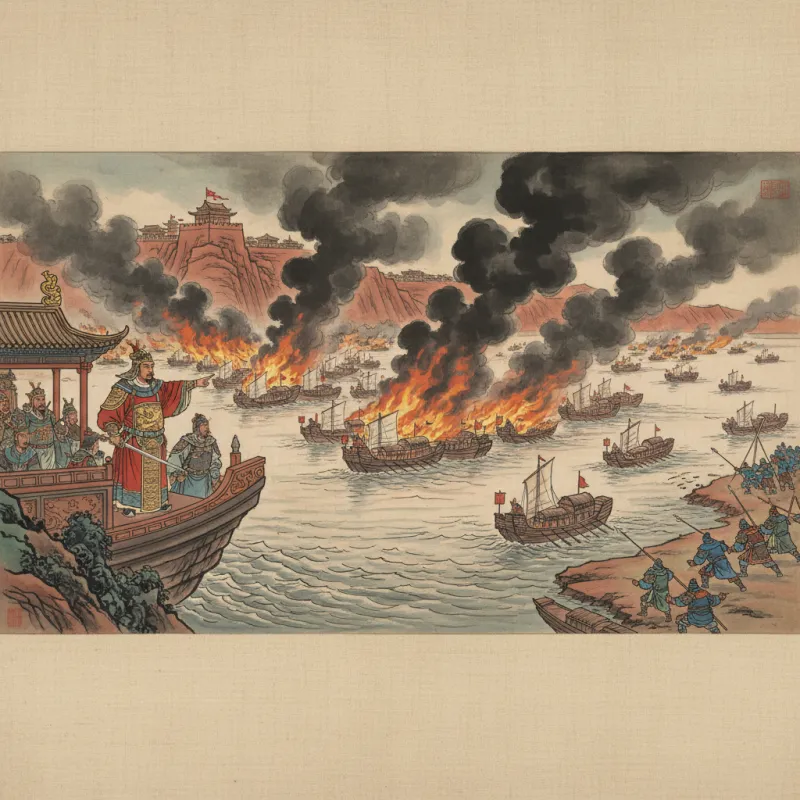
The flames spread faster than anyone expected. What began as a few burning ships drifting toward Cao Cao's fleet became an inferno that consumed hundreds of vessels chained together in the Yangtze River. Soldiers jumped into the winter water to escape the heat. Others burned alive on deck. By dawn, the most powerful warlord in China was fleeing north on horseback, his dream of reunifying the empire reduced to ash and smoke. The Battle of Red Cliffs (赤壁之战 Chìbì zhī Zhàn) in 208 CE didn't just stop an invasion — it created the political fracture that would define Chinese history for the next sixty years.
The Warlord Who Controlled Everything Except the South
Cao Cao (曹操) wasn't supposed to lose. By 208 CE, he had spent thirteen years methodically conquering northern China, defeating rival warlords, absorbing their armies, and establishing administrative control over the Yellow River basin. He held the figurehead Emperor Xian of Han (汉献帝 Hàn Xiàn Dì) at his capital in Xu (许都 Xǔ Dū), giving his military campaigns the veneer of imperial legitimacy. His army numbered somewhere between 220,000 and 800,000 troops — sources vary wildly, but even conservative estimates put his force at overwhelming strength.
The south was fragmented. Liu Bei (刘备), a distant imperial relative with more ambition than territory, had just lost his base in Xinye and was fleeing south with refugees and a small army. Sun Quan (孙权), the young lord of Jiangdong (江东) who had inherited his father's domain in the Yangtze River delta, controlled wealthy territory but lacked military experience. Cao Cao's strategy was straightforward: march south, crush Liu Bei, intimidate Sun Quan into surrender, and reunify China under his control. The Han Dynasty would be restored in everything but name, with Cao Cao as its de facto ruler.
What Cao Cao didn't account for was that desperate enemies make unexpected alliances — and that northern cavalry doesn't know how to fight on water.
The Alliance Nobody Expected
Liu Bei's strategist Zhuge Liang (诸葛亮) understood the mathematics of survival. Liu Bei's army alone couldn't stop Cao Cao. Sun Quan's forces alone probably couldn't either. But together, fighting on terrain that favored southern troops, they might have a chance. Zhuge Liang traveled to Jiangdong to negotiate an alliance, facing skepticism from Sun Quan's advisors who argued that surrender would preserve their wealth and status.
The debate in Sun Quan's court was real. Cao Cao had sent a letter promising generous treatment if Jiangdong submitted peacefully. Many advisors favored capitulation. But Zhou Yu (周瑜), Sun Quan's brilliant young commander, argued for resistance. He pointed out that Cao Cao's northern troops were exhausted from their march south, unfamiliar with naval warfare, and suffering from disease in the unfamiliar southern climate. The Yangtze River was Jiangdong's natural fortress. Zhou Yu convinced Sun Quan to fight.
The alliance was sealed, but it was fragile. Liu Bei contributed perhaps 20,000 troops to the combined force. Sun Quan's army provided the bulk of the soldiers and all of the naval expertise. Zhou Yu took overall command, with Zhuge Liang serving as an advisor. They established their position at Red Cliffs (赤壁 Chìbì), a location on the southern bank of the Yangtze where the river narrows, forcing any northern fleet to pass through a confined channel.
The Fatal Decision to Chain the Ships
Cao Cao's army had a problem: his northern soldiers got seasick. The Yangtze River in winter is choppy, and troops accustomed to fighting on horseback couldn't maintain formation on rocking boats. According to traditional accounts, one of Cao Cao's advisors — possibly Pang Tong (庞统), who may have been a double agent working for Zhou Yu — suggested chaining the ships together to create a stable platform. The vessels would be linked with iron chains and wooden planks, essentially creating a floating fortress that wouldn't pitch and roll with the waves.
It was tactically sound for stability. It was catastrophically vulnerable to fire.
Zhou Yu recognized the opportunity immediately. He had two advantages: wind and a spy. The winter wind on the Yangtze typically blows from north to south, which would push flames away from the allied fleet and toward Cao Cao's position. And Huang Gai (黄盖), one of Sun Quan's veteran commanders, volunteered to defect to Cao Cao's side as a false surrender, bringing ships loaded with flammable materials.
The deception worked because it was plausible. Huang Gai was a respected commander who had served Sun Quan's family for decades. He publicly argued with Zhou Yu about the futility of resistance, was "punished" with a beating, and then sent a letter to Cao Cao offering to surrender and bring supplies. Cao Cao, eager to encourage defections and confident in his overwhelming numbers, accepted.
The Night the River Burned
The attack came at night. Huang Gai's ships approached Cao Cao's fleet flying surrender flags, loaded with oil, dry reeds, and anything else that would burn. When they reached the chained vessels, Huang Gai's men set the ships ablaze and escaped in small boats. The wind, which had shifted to blow from the southeast — either by lucky timing or because Zhou Yu had waited for the right meteorological moment — pushed the burning ships directly into Cao Cao's fleet.
The chains that had stabilized the ships now trapped them. Vessels couldn't maneuver away from the flames. Fire spread from ship to ship along the wooden planks and iron links. Soldiers who jumped into the water faced drowning or hypothermia in the winter river. Those who stayed aboard burned. The fire spread to Cao Cao's camps on the northern shore, where supplies and equipment were stored.
The allied fleet attacked while Cao Cao's forces were in chaos. The battle became a rout. Cao Cao abandoned his fleet and retreated north by land, losing thousands of soldiers to combat, fire, drowning, and disease during the withdrawal. His army, which had seemed invincible weeks earlier, was shattered.
Why This Battle Changed Everything
Red Cliffs didn't just stop an invasion — it created the Three Kingdoms period. Cao Cao never again attempted to conquer the south. He returned to northern China and spent the rest of his life consolidating his power base, eventually establishing the state of Wei (魏 Wèi) in 220 CE. Sun Quan formalized his control over the Yangtze River delta and established the state of Wu (吴 Wú) in 229 CE. Liu Bei, given breathing room by the allied victory, moved west into Sichuan and established the state of Shu Han (蜀汉 Shǔ Hàn) in 221 CE.
The three-way division lasted until 280 CE, when the Jin Dynasty (晋朝 Jìn Cháo) finally reunified China. But those sixty years of division produced some of the most famous figures, stories, and cultural touchstones in Chinese history. The Three Kingdoms period became the setting for Romance of the Three Kingdoms (三国演义 Sānguó Yǎnyì), one of China's Four Great Classical Novels, written by Luo Guanzhong in the 14th century.
The novel transformed Red Cliffs from a historical battle into a cultural myth. Zhuge Liang, who played a supporting role in the actual battle, becomes the mastermind who "borrows arrows" through clever deception and "borrows the east wind" through supernatural means. Zhou Yu, the actual commander, becomes a jealous rival who tries to kill Zhuge Liang out of envy. Cao Cao transforms from a capable administrator and military leader into a villain whose arrogance causes his downfall.
The Battle That Never Stops Being Retold
Every generation of Chinese artists has reimagined Red Cliffs. It appears in operas, paintings, poems, films, television series, and video games. John Woo directed a two-part film epic about the battle in 2008-2009. The strategy game series Dynasty Warriors has featured Red Cliffs scenarios in nearly every installment. Chinese schoolchildren learn about it in history class, then encounter it again in literature class when studying Romance of the Three Kingdoms.
The battle's appeal lies partly in its underdog narrative — the alliance of weaker forces defeating a seemingly invincible enemy through intelligence and courage. But it also represents a recurring theme in Chinese political thought: the danger of overreach. Cao Cao's defeat came not from lack of military strength but from strategic overconfidence. He pushed into unfamiliar terrain, relied on tactics suited for northern plains warfare rather than river combat, and underestimated his opponents' ability to exploit his weaknesses.
The historical site at Red Cliffs in Hubei province remains a tourist destination, though scholars debate whether the battle actually occurred at that exact location or at another site with the same name in nearby Hunan province. The uncertainty doesn't diminish the battle's cultural significance. Red Cliffs exists as much in Chinese imagination as in historical record — a story about how clever strategy can overcome brute force, how alliances can shift the balance of power, and how a single night of fire on the Yangtze River can change the course of history.
The flames that consumed Cao Cao's fleet burned away any possibility of quick reunification. They created space for three kingdoms to emerge, for decades of warfare and diplomacy to unfold, and for stories that would be told for the next eighteen centuries. In Chinese culture, Red Cliffs isn't just a battle — it's a reminder that even the most powerful forces can be defeated when they venture beyond their element, and that sometimes the greatest victories come not from strength but from understanding the terrain, the weather, and the moment when everything aligns for a single, decisive strike.
Related Reading
- The Epic Battles of Ancient China: Strategies, Emperors, and Cultural Legacy
- Zheng He's Voyages: When China Ruled the Seas
- The An Lushan Rebellion: The Catastrophe That Changed China Forever
- The Greatest Battles in Chinese History: Wars That Shaped a Civilization
- The Battle of Changping: 400,000 Buried Alive
- Unraveling the Economic Tapestry of Ancient Chinese Dynasties
- The Yuan Dynasty: When Mongols Ruled China
- Unveiling the Splendor of Ancient Chinese Architecture Across Dynasties