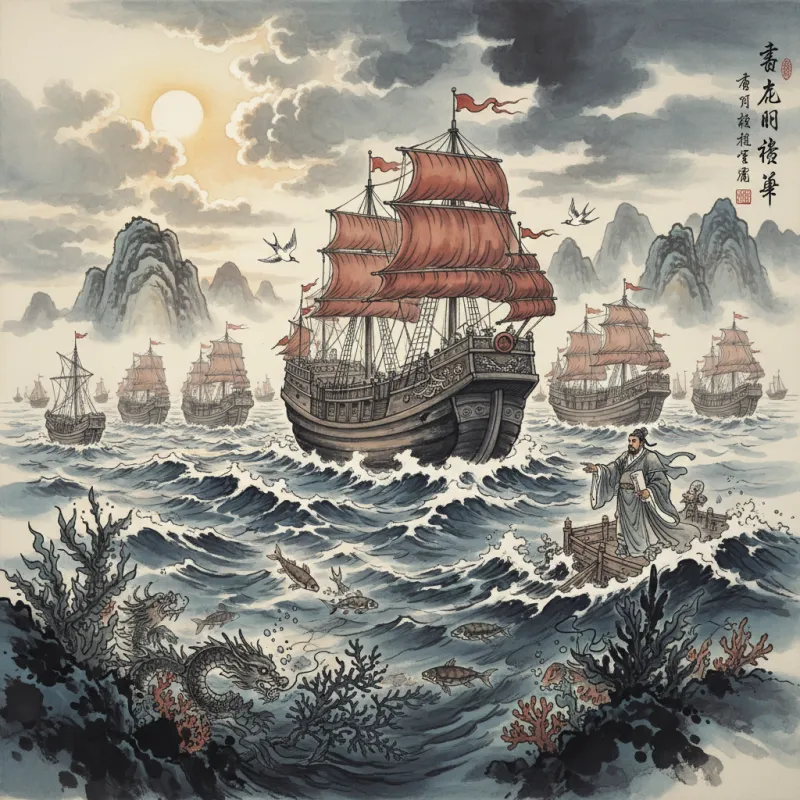
Between 1405 and 1433, while European kingdoms were still hugging their coastlines, a fleet of over 300 ships carrying 28,000 men sailed from China to the edges of the known world. The largest vessels—called "treasure ships" or baochuan (宝船)—stretched 400 feet long, dwarfing Columbus's Santa Maria by a factor of five. This wasn't exploration driven by desperation or trade necessity. This was a demonstration of power so overwhelming that dozens of kingdoms sent tribute to Beijing without a single major battle being fought.
The Eunuch Admiral Who Commanded an Armada
Zheng He (郑和, Zhèng Hé) didn't start life destined for maritime glory. Born Ma He in 1371 in Yunnan province to a Muslim family, his childhood ended violently when Ming forces conquered the region during the final campaigns against Mongol remnants. Captured at age ten, castrated, and pressed into service, he became a servant to Zhu Di (朱棣), the Prince of Yan—a man who would later seize the throne as the Yongle Emperor through a brutal civil war.
What transformed Ma He into Zheng He was loyalty proven in blood. During the Jingnan Campaign, he distinguished himself in combat, and when Zhu Di became emperor in 1402, he rewarded his eunuch general with a new surname and an impossible mission: build a fleet that would make every kingdom from Southeast Asia to East Africa acknowledge Ming supremacy.
By 1405, Zheng He commanded what remains the largest wooden fleet ever assembled. The numbers are staggering: 317 ships in the first voyage alone, including 62 treasure ships that modern scholars still debate—could wooden vessels really reach 400 feet, or were Chinese records exaggerating? Either way, even conservative estimates put them at 200-250 feet, still massive by any standard.
Seven Voyages Across the Known World
The expeditions followed a pattern: overwhelming display, diplomatic exchange, and the occasional military intervention when local rulers proved uncooperative. The first voyage (1405-1407) established the template. Zheng He's fleet sailed to Champa, Java, Sumatra, and Ceylon, distributing gifts, collecting tribute, and making it clear that Ming China expected acknowledgment of its superiority.
The third voyage (1409-1411) showed the iron fist inside the velvet glove. When the Sinhalese king Vira Alakesvara attempted to lure Zheng He into a trap, the admiral responded by marching inland, capturing the king, and bringing him back to Nanjing in chains. The Yongle Emperor eventually released him, but the message was sent: resistance was futile.
The fourth through sixth voyages (1413-1422) pushed even further, reaching Hormuz in the Persian Gulf and multiple ports along the East African coast. Chinese records mention giraffes—called qilin (麒麟), after the mythical Chinese unicorn—brought back as tribute from Malindi in modern-day Kenya. The symbolism was perfect: exotic beasts from the edge of the world, presented to the Son of Heaven.
The seventh and final voyage (1431-1433) came after a decade-long pause. The Yongle Emperor had died in 1424, and his successors were less enthusiastic about expensive maritime adventures. But Zheng He, now in his sixties, made one last journey, reaching at least 20 kingdoms before returning to China, where he likely died shortly after.
The Treasure Ships: Engineering Marvels or Exaggerations?
The baochuan remain controversial. Chinese sources claim the largest measured 44 zhang (丈) long and 18 zhang wide—roughly 444 feet by 180 feet using Ming-era measurements. If accurate, these ships displaced around 20,000 tons, making them larger than any wooden vessel built before the 20th century.
Skeptics point out that wooden ships of that size would face structural problems that Ming-era technology couldn't solve. The largest confirmed wooden warships—like HMS Victoria in the 1850s—barely reached 260 feet and required iron reinforcement. Some scholars suggest the measurements referred to the entire fleet formation, not individual ships, or that the zhang measurement was smaller than assumed.
But even conservative estimates are impressive. Archaeological evidence from the Longjiang shipyard in Nanjing shows rudder posts 36 feet long, suggesting ships of at least 200-250 feet. The fleet definitely included multiple ship types: combat vessels, supply ships, water tankers, and troop transports. The treasure ships, whatever their exact size, were supported by an entire floating city.
The technology was sophisticated. Chinese ships used watertight compartments—a feature European ships wouldn't adopt for centuries. They navigated using detailed charts, compasses, and astronomical observations. The fleet included translators, diplomats, soldiers, and merchants, making it as much a diplomatic mission as a naval expedition.
Why Did China Stop?
This is the question that haunts historians. In 1433, China possessed the world's most advanced navy and had established trade relationships across the Indian Ocean. Then it all stopped. By the 1470s, the treasure ships were rotting in harbors. By 1500, it was illegal to build ocean-going vessels with multiple masts. By 1525, coastal authorities were ordered to destroy such ships and arrest their owners.
The standard explanation points to economics and politics. The voyages were expensive—some estimates suggest they consumed a significant portion of Ming state revenue. The Yongle Emperor's successors faced more pressing concerns: Mongol raids from the north, maintaining the Grand Canal, and factional struggles at court. The Confucian bureaucracy, which had always viewed the eunuch-led expeditions with suspicion, successfully argued for redirecting resources to land-based defense.
But there's a deeper cultural factor. The voyages were never about exploration or colonization in the European sense. They were about tribute and prestige—making the world acknowledge Chinese superiority. Once that was achieved, there was no ideological drive to continue. China didn't need the world; the world needed China. This assumption, which seemed reasonable in 1433, would prove catastrophic by 1839 when British warships arrived during the Opium Wars with very different ideas about trade and power.
The Great Divergence: China and Europe Take Different Paths
The contrast with European exploration is stark. When Portuguese ships reached the Indian Ocean in 1498, they found a thriving trade network that Chinese ships had helped establish—then abandoned. European exploration was driven by commercial desperation (finding routes to Asian spices), religious fervor (spreading Christianity), and political competition (multiple kingdoms racing for advantage). China had none of these motivations.
Some historians argue this was China's great mistake—that continuing the voyages might have led to Chinese colonies in Southeast Asia or East Africa, changing world history. But this assumes Chinese goals matched European ones. The Ming court wanted acknowledgment, not colonies. They wanted tribute, not trade monopolies. The voyages succeeded on their own terms, which is precisely why they stopped.
The irony is that Zheng He's expeditions demonstrated capabilities that would have made Chinese colonization feasible. The fleet could project power across thousands of miles. Chinese merchants were already establishing communities throughout Southeast Asia. The technology existed. What didn't exist was the will, or more precisely, the ideological framework that made such expansion seem necessary or desirable.
Legacy: What Might Have Been
Today, Zheng He is celebrated in China as a symbol of peaceful exploration, contrasted with violent European colonialism. This is partly true—the voyages involved far less bloodshed than Portuguese or Spanish conquests. But it's also sanitized history. Zheng He's fleet intervened militarily multiple times, overthrew rulers, and enforced Chinese interests through overwhelming force when necessary.
The real legacy is more complex. The voyages proved that China could dominate the seas if it chose to. They established trade networks and diplomatic relationships that lasted decades. They demonstrated technological sophistication that Europe wouldn't match for generations. But they also revealed the limits of tributary diplomacy in an increasingly interconnected world.
When European ships arrived in Asian waters a century later, they brought a different model: permanent presence, fortified trading posts, and the willingness to use violence to secure commercial advantage. The Chinese tributary system, which assumed all interactions would be temporary and hierarchical, had no effective response. The Ming Dynasty would eventually fall in 1644, weakened by internal rebellions and external pressures it couldn't adapt to quickly enough.
The Counterfactual Question
What if China had continued the voyages? What if the treasure fleet had rounded Africa and reached Europe in the 1440s? These questions fascinate because they highlight how contingent history is. The decision to stop the voyages wasn't inevitable—it was a choice made by specific people facing specific pressures. Different emperors, different court factions, different economic conditions might have produced different outcomes.
But the deeper question is whether continued voyages would have changed Chinese strategic culture. The expeditions stopped not because China couldn't afford them, but because the ruling elite decided they weren't worth the cost. That calculation reflected values and assumptions that ran deep in Chinese political thought: the centrality of agriculture over commerce, the superiority of civil over military officials, the focus on internal stability over external expansion.
Zheng He's voyages remain one of history's great "what ifs"—a moment when China stood at the edge of global maritime dominance and chose to step back. Whether that was wisdom or folly depends on your perspective. What's undeniable is that for nearly three decades in the early 15th century, Chinese ships ruled the seas, and the world took notice.
Related Reading
- The Greatest Battles in Chinese History: Wars That Shaped a Civilization
- The Battle of Red Cliffs: The Most Famous Battle in Chinese History
- The Taiping Rebellion: The Deadliest Civil War in History
- Battle of Fei River: When 80,000 Defeated 800,000
- The Strategical Brilliance of Chinese Battles: A Journey Through Ancient History
- Spring and Autumn to Warring States: China's Age of Philosophy
- Chinese Philosophy in Five Minutes: Confucius, Laozi, and the Arguments That Shaped a Civilization
- How the Opium Wars Still Shape China Today