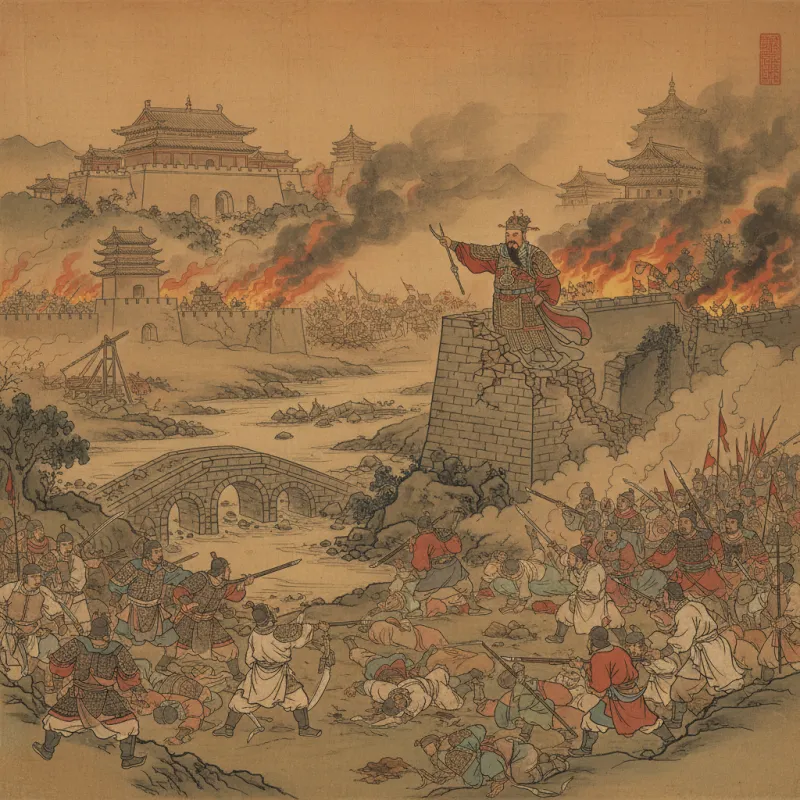
Twenty million dead. Perhaps thirty million. More casualties than World War I. More than the Mongol conquests of China. More than any war in human history until the twentieth century—and it happened while Americans were fighting at Gettysburg and Europeans were reading about it in their newspapers over breakfast. The Taiping Rebellion (太平天国运动, Tàipíng Tiānguó Yùndòng) tore through China for fourteen years, and most of the world has forgotten it ever happened.
The Prophet Who Failed His Exams
Hong Xiuquan (洪秀全) was a Hakka man from Guangdong Province who wanted one thing: to pass the imperial examinations. He failed. Then he failed again. And again. On his fourth failure in 1843, Hong suffered what we'd now call a nervous breakdown. He spent forty days in fevered delirium, experiencing visions that would reshape China's destiny.
In these visions, Hong met an old man with a golden beard who gave him a sword and told him to slay demons. A middle-aged man—the old man's son—helped him in this demon-slaying mission. Hong woke up changed, but didn't understand what he'd seen. Not until 1843, when a Christian missionary tract fell into his hands, did the pieces click into place. The old man was God. The middle-aged man was Jesus Christ. And Hong? He was Jesus's younger brother, sent to establish a Heavenly Kingdom on Earth.
This wasn't metaphorical. Hong genuinely believed he was the literal younger brother of Jesus Christ, tasked with driving the Manchu "demons" from China and establishing God's kingdom. He began preaching, gathering followers, and baptizing converts in Guangxi Province. His message combined Christian theology, Chinese folk religion, and revolutionary politics into something entirely new—and explosively appealing to millions of desperate peasants.
Why China Was Ready to Explode
The Qing Dynasty (清朝, Qīng Cháo) was rotting from within. Population had exploded from 150 million in 1700 to over 400 million by 1850, but arable land hadn't increased proportionally. Peasants were starving. The First Opium War had humiliated the empire and drained its treasury. Corruption riddled the bureaucracy. Natural disasters—floods, droughts, famines—struck with increasing frequency.
Into this powder keg, Hong Xiuquan threw a match. His God Worshipping Society (拜上帝会, Bài Shàngdì Huì) promised equality, land redistribution, and an end to Manchu rule. Women could join—revolutionary in itself—and were promised equal status. Opium, alcohol, tobacco, and foot-binding were banned. Private property would be abolished. Everyone would share equally in the Heavenly Kingdom.
By 1850, Hong had tens of thousands of followers. When Qing forces tried to suppress them, the God Worshippers fought back. They won. And kept winning.
The Heavenly Kingdom
In 1851, Hong declared the establishment of the Taiping Heavenly Kingdom (太平天国, Tàipíng Tiānguó—literally "Heavenly Kingdom of Great Peace"). His ragtag army of peasants, miners, and charcoal workers began their march north. They captured city after city. In 1853, they took Nanjing, the former Ming capital, and made it their capital, renaming it Tianjing (天京, Tiānjīng—"Heavenly Capital").
At its peak, the Taiping Heavenly Kingdom controlled much of southern China and had a population of nearly 30 million. They established a government, minted coins, conducted examinations (based on the Bible rather than Confucian classics), and implemented radical social reforms. Women served as soldiers and administrators. Land was redistributed. The Confucian classics were banned as demonic texts.
But the kingdom was built on contradictions. Hong preached equality while maintaining a harem of dozens of concubines. The leadership fractured into competing factions. Yang Xiuqing (杨秀清), the Eastern King who claimed to channel God's voice, grew so powerful that Hong had him assassinated in 1856, triggering a purge that killed twenty thousand Taiping officials and soldiers in a single night.
The Bloodiest Battles
The siege of Nanjing in 1853 killed hundreds of thousands. The Taiping's capture of Wuchang saw the Yangtze River reportedly run red with blood. When Qing forces recaptured cities, they massacred Taiping supporters wholesale. When Taiping forces took cities, they slaughtered Qing officials and Confucian scholars. The Qing Dynasty's military campaigns became increasingly desperate as the rebellion spread.
The death toll wasn't just from battle. Famine followed the armies. Disease spread through refugee camps. Entire regions were depopulated. Jiangsu Province alone may have lost half its population. The lower Yangtze valley, China's richest agricultural region, became a wasteland.
Modern historians debate whether the Taiping Rebellion or World War II holds the record for deadliest conflict in human history. The uncertainty itself is telling—we're comparing a mid-nineteenth century civil war to a global mechanized conflict, and the civil war might win.
The Turning Point
The Taiping Rebellion might have succeeded if not for a few factors. First, Hong Xiuquan proved to be a terrible administrator. He spent his final years in Nanjing writing religious tracts and expanding his harem while his kingdom crumbled. Second, the leadership's internal conflicts crippled military effectiveness. Third, and most crucially, the Qing found effective commanders.
Zeng Guofan (曾国藩), a Confucian scholar-official, organized the Xiang Army (湘军, Xiāng Jūn), a regional force loyal to him personally rather than to the corrupt Qing military structure. Li Hongzhang (李鸿章) created the similar Huai Army (淮军, Huái Jūn). These forces, combined with Western military advisors and modern weapons, slowly pushed the Taiping back.
The Ever Victorious Army, led first by American adventurer Frederick Townsend Ward and later by British officer Charles Gordon, brought Western military tactics and artillery to the Qing side. The irony was rich: Christian powers helping the Qing suppress a Christian rebellion. But Hong's theology was too heterodox, his kingdom too unstable, and Western commercial interests too tied to the Qing for any other outcome.
The Fall
By 1864, Nanjing was under siege. Hong Xiuquan, still claiming divine authority, ordered his followers to eat "manna"—actually weeds. He died in June 1864, possibly from eating poisonous vegetation, possibly from suicide. His teenage son briefly succeeded him before Qing forces breached the walls in July.
The fall of Nanjing was apocalyptic. Qing forces killed an estimated 100,000 people in the city. Taiping defenders committed mass suicide. The Heavenly Kingdom's last remnants fled west, pursued and destroyed over the following months. By 1866, the rebellion was over.
The Aftermath Nobody Talks About
The Taiping Rebellion didn't just kill millions—it transformed China. The Qing Dynasty survived, but barely. The emperor's authority was permanently weakened. Regional armies loyal to their commanders rather than the throne became the new power centers, setting the stage for the warlord era that would follow the dynasty's collapse in 1912.
The rebellion devastated China's economy and infrastructure. It took decades for the population to recover. The lower Yangtze region, once China's breadbasket, was depopulated and ruined. The Qing government, already weakened by the Opium Wars, never fully recovered its legitimacy or effectiveness.
Yet the rebellion also planted seeds of change. Hong's radical ideas about equality, land reform, and overthrowing the Manchus influenced later revolutionaries, including Sun Yat-sen, who saw Hong as a proto-nationalist hero. The Communist Party later claimed the Taiping as predecessors in peasant revolution, though they downplayed the Christian elements.
Why We Should Remember
The Taiping Rebellion matters not just for its death toll but for what it reveals about historical memory. We remember smaller European wars from the same period in exhaustive detail. We've made dozens of films about the American Civil War. But the deadliest civil war in history remains obscure outside China.
This isn't just about Western bias—though that's part of it. It's about how we construct historical narratives. The Taiping Rebellion doesn't fit neat categories. It was simultaneously a Christian movement and a Chinese peasant uprising, a revolutionary war and a religious crusade, a proto-nationalist rebellion and a millenarian cult. Hong Xiuquan was both a visionary and a madman, a liberator and a tyrant.
Perhaps that complexity is why the rebellion remains understudied. It's easier to teach clear narratives with obvious heroes and villains. The Taiping Rebellion offers neither. Just millions of dead, a dynasty that survived but never recovered, and a failed prophet who believed he was Jesus's younger brother. History doesn't get stranger or more tragic than that.
Related Reading
- The Epic Battles of Ancient China: Strategies, Emperors, and Cultural Legacy
- The Battle of Red Cliffs: The Most Famous Battle in Chinese History
- The An Lushan Rebellion: The Catastrophe That Changed China Forever
- The Battle of Changping: 400,000 Buried Alive
- The Greatest Battles in Chinese History: Wars That Shaped a Civilization
- Zheng He's Treasure Fleet: When China Ruled the Seas
- The Imperial Examination: Meritocracy in Ancient China
- How to Learn Chinese History: A Beginner's Roadmap