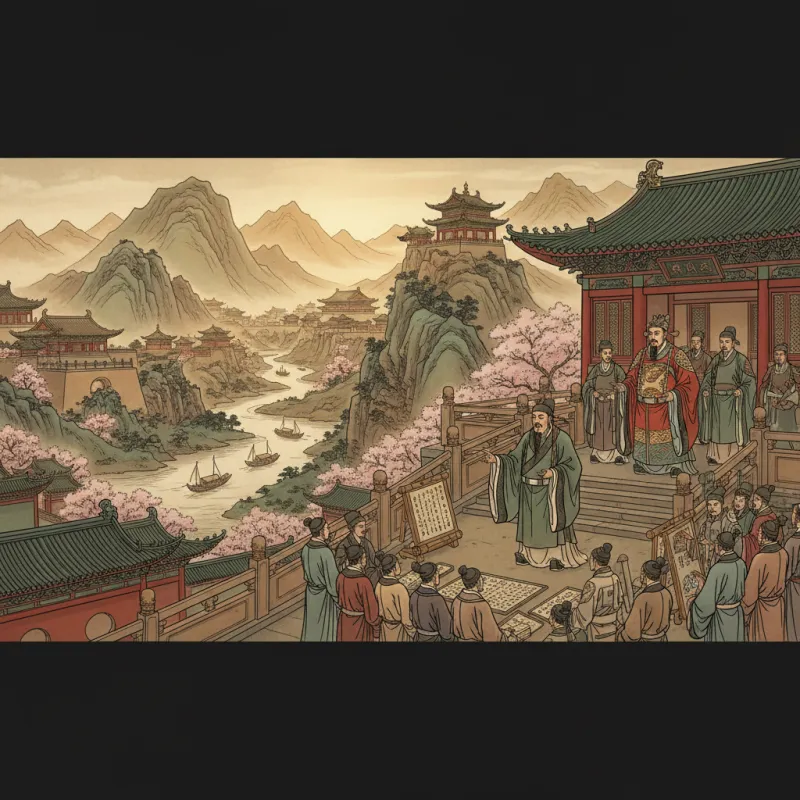
A man in his fifties, dismissed from yet another government post, wandered the dusty roads of ancient China with a ragtag group of disciples. He'd spent decades trying to convince rulers to adopt his vision of ethical governance, and decades watching them ignore him. Most would call this failure. History would call him the most influential philosopher China ever produced.
Kong Fuzi 孔夫子 (551-479 BCE)—known to the West as Confucius—never wrote a book, never ruled a kingdom, never led an army. Yet his ideas about human relationships, moral cultivation, and social harmony would shape Chinese civilization for over two millennia, influencing everything from imperial examination systems to modern business ethics. The man who considered himself a failure in his own lifetime created a philosophical framework so durable that it survived book burnings, dynastic collapses, and even Mao's Cultural Revolution.
The Chaos That Demanded an Answer
Confucius lived during the Spring and Autumn period (770-476 BCE), when the Zhou Dynasty's authority had crumbled into a patchwork of warring states. Imagine a world where your local warlord might be overthrown next week, where ancient rituals meant nothing, where sons murdered fathers for power. This wasn't theoretical chaos—it was Confucius' daily reality in the state of Lu (modern Shandong province).
The old order, based on the Zhou concept of the Mandate of Heaven, had lost its grip. Aristocrats who once performed elaborate ceremonies now treated them as empty theater. Social mobility was increasing, but so was violence. Into this moral vacuum stepped a minor aristocrat's son who believed the solution wasn't new laws or stronger armies, but better people.
Confucius looked backward to move forward. He studied the early Zhou Dynasty (1046-771 BCE), particularly the reigns of King Wen and the Duke of Zhou, as a golden age when rulers governed through moral example rather than force. This wasn't nostalgia—it was a radical proposal that ethical cultivation could restore social order. As he famously said in the Analects (论语 Lúnyǔ): "Guide them with government orders, regulate them with punishments, and the people will seek to evade the law and be without shame. Guide them with virtue, regulate them with ritual, and they will have a sense of shame and become upright."
Ren: The Revolutionary Heart of Confucian Thought
At the core of Confucius' philosophy sits ren 仁, a character combining the radical for "person" with the number "two"—a visual reminder that humanity is fundamentally relational. Usually translated as "benevolence" or "humaneness," ren is actually untranslatable in its full depth. It's the quality that makes you fully human, the capacity to feel for others and act on that feeling.
When a student asked about ren, Confucius replied: "Do not impose on others what you do not wish for yourself." This negative formulation of the Golden Rule—sometimes called the Silver Rule—is more demanding than it sounds. It's not just about being nice; it's about constant self-examination and empathy. Before every action, you must imagine yourself on the receiving end.
But ren wasn't meant to be abstract. Confucius grounded it in specific relationships: parent-child, ruler-subject, husband-wife, elder-younger, friend-friend. These Five Relationships (五伦 wǔlún) weren't equal partnerships—Confucius lived in a hierarchical world—but they were reciprocal. A father must be loving for a son to be filial. A ruler must be just for subjects to be loyal. This reciprocity was revolutionary: it placed moral obligations on the powerful, not just the powerless.
Li: When Ritual Becomes Second Nature
If ren is the internal compass, li 礼 is its external expression. Often translated as "ritual" or "propriety," li encompasses everything from state ceremonies to how you greet your neighbor. For Confucius, these weren't arbitrary social conventions—they were the accumulated wisdom of generations, the choreography of a harmonious society.
Critics then and now dismiss this as rigid formalism. They miss the point. Confucius didn't want people mechanically following rules; he wanted li to become so internalized that proper behavior felt natural. Think of a master musician who's practiced scales for years—the technique disappears into artistry. That's what Confucius envisioned for social interaction.
He drew a sharp distinction between genuine li and empty performance. When asked about ritual, he said: "Ritual, ritual! Does it mean just jade and silk? Music, music! Does it mean just bells and drums?" The physical objects matter only if they express authentic feeling. A funeral performed with expensive offerings but no grief is worse than useless—it's a lie.
This emphasis on sincerity connects to another key concept: xiao 孝 (filial piety). For Confucius, the family was the training ground for all other relationships. Learn to respect your parents genuinely, and you'll know how to respect your ruler, your teachers, your elders. The concept of filial piety would become so central to Chinese culture that it sometimes overshadowed Confucius' more nuanced teachings.
The Junzi: Confucius' Vision of the Ideal Person
Confucius didn't believe in equality of outcome, but he did believe in equality of potential. Anyone, regardless of birth, could become a junzi 君子—often translated as "gentleman" or "superior person," though "exemplary person" captures it better. This was radical in an age when nobility was hereditary.
The junzi cultivates virtue through study, self-reflection, and practice. He (and Confucius unfortunately focused on men) speaks carefully, acts deliberately, and constantly examines his own conduct. He's not a saint—Confucius himself admitted to flaws—but he's always working on himself. "The junzi is distressed by his own lack of ability, not by the failure of others to recognize him," Confucius taught.
Contrast this with the xiaoren 小人 (small person or petty person), who seeks profit over righteousness, blames others for his failures, and changes his principles to suit circumstances. The junzi understands righteousness (yi 义); the xiaoren understands only profit. The junzi is easy to serve but hard to please; the xiaoren is hard to serve but easy to please.
This wasn't just personal ethics—it was a political program. Confucius believed that if rulers were junzi, their moral example would transform society. "The virtue of the junzi is like wind; the virtue of the small person is like grass. When the wind blows, the grass must bend." Place good people in power, and goodness spreads naturally.
The Analects: Conversations That Built a Civilization
Confucius never wrote a systematic treatise. What we have is the Analects (论语 Lúnyǔ), compiled by his disciples after his death—a collection of conversations, brief sayings, and occasional descriptions of the Master's behavior. It's fragmentary, sometimes contradictory, often cryptic. It's also one of the most influential books ever written.
The Analects reads like eavesdropping on a brilliant teacher. A student asks about governance; Confucius replies, "Lead them with virtue, regulate them with ritual." Another asks about filial piety; the answer varies depending on who's asking. This isn't inconsistency—it's pedagogical genius. Confucius tailored his teaching to each student's needs and capacities.
Some passages are profound: "Learning without thought is labor lost; thought without learning is perilous." Others are surprisingly personal: "At fifteen, I set my heart on learning. At thirty, I stood firm. At forty, I had no doubts. At fifty, I knew the will of Heaven. At sixty, my ear was attuned. At seventy, I could follow my heart's desire without transgressing what was right." This autobiographical sketch shows that even Confucius saw moral development as a lifelong journey.
The text's influence on Chinese culture cannot be overstated. For centuries, every educated person memorized it. The imperial examination system that selected government officials for over a millennium was based largely on Confucian texts. Emperors quoted it to justify their rule. Rebels quoted it to challenge them.
When Philosophy Becomes State Ideology
Confucius died thinking he'd failed. His wandering years had produced no political conversions. His home state of Lu never implemented his ideas. He returned home at 68, spent his final years teaching, and died at 73, disappointed but not bitter.
Then something remarkable happened. His disciples spread his teachings. During the Warring States period (475-221 BCE), Confucianism competed with other schools—Daoism, Legalism, Mohism—in what's called the Hundred Schools of Thought. When the Qin Dynasty (221-206 BCE) unified China, the Legalist-influenced emperor Qin Shi Huang famously burned Confucian books and buried scholars alive.
But Confucianism survived. The Han Dynasty (206 BCE-220 CE) adopted it as official state ideology under Emperor Wu. This was both triumph and tragedy. Confucius' ideas gained institutional power but also became rigid orthodoxy. The emphasis on hierarchy and obedience to authority—always present but balanced by reciprocal obligations—was amplified. The dynamic philosophy became static dogma.
Over centuries, Neo-Confucian scholars like Zhu Xi (1130-1200 CE) during the Song Dynasty reinterpreted the tradition, adding metaphysical elements Confucius never discussed. The examination system turned Confucian texts into objects of rote memorization rather than living wisdom. By the late Qing Dynasty, many reformers blamed Confucianism for China's inability to modernize.
The Modern Confucius: Dead, Revived, or Transformed?
The 20th century was brutal to Confucius' legacy. The May Fourth Movement (1919) blamed traditional culture for China's weakness. Mao Zedong's Cultural Revolution (1966-1976) targeted Confucianism as feudal poison, destroying temples and persecuting scholars. It seemed Confucius might finally be buried for good.
Yet here we are in the 21st century, and Confucius is back. The Chinese government, once his enemy, now promotes "Confucius Institutes" worldwide. Business leaders cite Confucian values of harmony and hierarchy. Scholars debate whether Confucianism is compatible with democracy, human rights, and gender equality.
This revival is complicated. Some see authentic wisdom being rediscovered; others see authoritarian governments cherry-picking ideas to justify control. Both are probably right. Confucius' emphasis on social harmony and respect for authority can support either benevolent governance or oppressive conformity, depending on who's interpreting.
What's undeniable is that Confucian ideas—whether acknowledged or not—continue shaping how hundreds of millions of people think about family, education, work, and society. The emphasis on education as moral cultivation, the respect for teachers, the sense that individual identity is inseparable from social relationships—these aren't just Chinese characteristics; they're Confucian inheritances.
The Teacher Who Never Stopped Teaching
Walk through any Chinese temple dedicated to Confucius, and you'll see his image: a dignified old man in scholar's robes, often holding a scroll. It's a sanitized version of the historical figure—the frustrated job-seeker, the demanding teacher, the man who loved music and good food, who joked with his students and mourned his son's death.
The real Confucius was more interesting than the icon. He was pragmatic enough to accept that not everyone could be a sage, idealistic enough to believe that trying mattered. He was conservative in valuing tradition, radical in insisting that virtue, not birth, made someone noble. He was humble about his own achievements—"I am simply one who loves the past and is diligent in investigating it"—yet confident that his teachings could transform the world.
Did they? China became the most enduring civilization in human history, maintaining cultural continuity for over two millennia despite invasions, revolutions, and upheavals. Confucian values spread to Korea, Japan, Vietnam, and beyond, shaping East Asian culture broadly. The emphasis on education, family, and social harmony that characterizes these societies owes much to the wandering teacher from Lu.
But Confucianism also contributed to rigid hierarchies, the subordination of women, and resistance to change. Like any powerful idea, it could be used for good or ill. Confucius himself would probably say that's the point—ideas don't implement themselves. They require people of virtue to apply them wisely.
The man who died thinking he'd failed left behind something more durable than any kingdom: a way of thinking about what it means to be human in relationship with other humans. Not bad for someone who never held high office, never commanded armies, and never claimed to have all the answers. "I transmit but do not create," Confucius said. "I trust in and love the ancient ways." In transmitting those ways, he created something entirely new—a vision of the ethical life that continues to challenge and inspire, 2,500 years after his death.
Related Reading
- The Silk Road: Bridge Between East and West
- Famous Trials That Changed Chinese Law
- Daily Life in Ancient China: What Ordinary People Actually Did All Day
- Ancient Chinese Dynasties and Emperors: Legal Systems, Battles, and Cultural Legacy