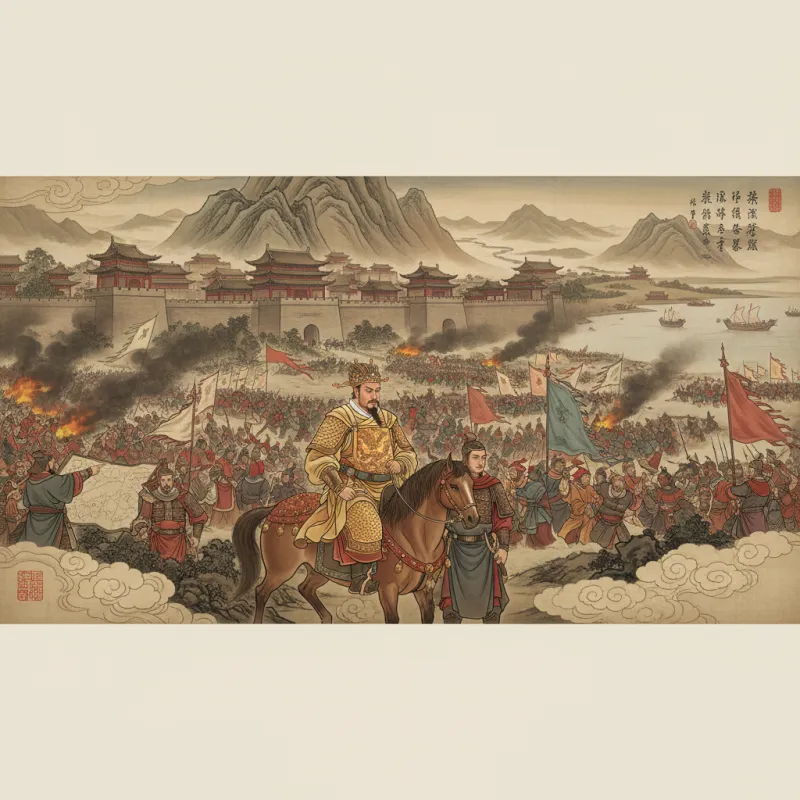
The night sky over the Yangtze River turned crimson as thousands of ships erupted in flames. Cao Cao, the most powerful warlord in China, watched his dream of unifying the empire burn before his eyes. It was 208 CE, and the Battle of Red Cliffs (赤壁之战, Chìbì zhī zhàn) was about to become the most retold military disaster in Chinese history — not because it was the bloodiest or most strategically complex, but because it proved that in Chinese warfare, cleverness trumps numbers every single time.
Why Chinese Battles Are Different
Western military history celebrates Thermopylae and Waterloo for their tactical brilliance and decisive outcomes. Chinese military history does something stranger: it turns battles into moral lessons. The greatest Chinese battles aren't just remembered — they're studied, dramatized, and argued over. They appear in the Romance of the Three Kingdoms, in Peking opera, in strategy games, and in business school case studies. When a Chinese CEO talks about "borrowing arrows with straw boats," everyone in the room knows they're referencing a stratagem from Red Cliffs. The battles shaped not just borders, but how an entire civilization thinks about conflict, deception, and power.
This is because Chinese military philosophy, codified in texts like Sun Tzu's Art of War (孙子兵法, Sūnzǐ Bīngfǎ), emphasizes winning without fighting. The best victories come from outsmarting your opponent, not outmuscling them. The battles that became legendary are the ones that proved this principle in spectacular fashion.
The Battle of Red Cliffs: Fire on the Water
Red Cliffs wasn't the largest battle in Chinese history, but it's certainly the most famous. In 208 CE, Cao Cao controlled the north with an army estimated at 220,000 men (though the Romance of the Three Kingdoms inflates this to 800,000 for dramatic effect). He marched south to crush the last independent warlords: Sun Quan in the southeast and Liu Bei in the west. If Cao Cao succeeded, he would unify China under his rule.
The allied forces of Sun Quan and Liu Bei had perhaps 50,000 men. They were doomed — except for one problem. Cao Cao's northern troops had no experience with naval warfare, and the battle would be fought on the Yangtze River. The allied commander Zhou Yu (周瑜, Zhōu Yú) exploited this weakness brilliantly. He sent a fake defector, Huang Gai, to Cao Cao's fleet with ships supposedly loaded with supplies. Instead, they were filled with oil-soaked kindling. When the ships reached Cao Cao's fleet, Huang Gai's men set them ablaze and jumped overboard. The fire spread through Cao Cao's tightly packed ships, which he had chained together to reduce seasickness among his landlubber troops.
The result was catastrophic. Cao Cao's fleet burned, his army retreated in chaos, and the dream of immediate unification died. China would remain divided for another 70 years, entering the Three Kingdoms period that would become the most romanticized era in Chinese history. Every Chinese person knows this battle, even if they've never opened a history book, because it's been retold in every medium imaginable.
The Battle of Julu: The Gambler's Victory
In 207 BCE, during the collapse of the Qin Dynasty, a rebel general named Xiang Yu (项羽, Xiàng Yǔ) faced an impossible situation. The Qin army had besieged the city of Julu, and Xiang Yu led a relief force to break the siege. But the Qin forces vastly outnumbered him, and other rebel armies had already tried and failed to break through.
Xiang Yu did something insane. He ordered his men to destroy their cooking pots and sink their boats after crossing the river. This is the origin of the Chinese idiom "破釜沉舟" (pò fǔ chén zhōu) — "break the cauldrons and sink the boats" — meaning to commit fully with no possibility of retreat. His soldiers, knowing they would either win or die, fought with desperate ferocity. They shattered the Qin army in nine consecutive engagements, breaking the siege and effectively ending Qin military power.
The psychological warfare here is quintessentially Chinese. Xiang Yu didn't win through superior tactics or equipment. He won by manipulating his own soldiers' psychology, turning desperation into a weapon. This battle established Xiang Yu as the most feared warrior of his generation, though he would later lose the empire to the more cunning Liu Bang in a conflict that demonstrates another principle of Chinese warfare: the clever strategist beats the mighty warrior.
The Battle of Fei River: When Panic Defeats an Army
The Battle of Fei River (淝水之战, Féishuǐ zhī zhàn) in 383 CE is the ultimate example of psychological warfare. The Former Qin Dynasty, ruling northern China, invaded the south with an army of nearly one million men (likely an exaggeration, but certainly several hundred thousand). The Eastern Jin Dynasty could muster only 80,000 defenders. The outcome seemed predetermined.
The Jin commander Xie Xuan (谢玄, Xiè Xuán) sent a message to the Qin commander Fu Jian, suggesting that the Qin army pull back slightly from the river to allow the Jin forces to cross, where they could fight a "proper" battle. Incredibly, Fu Jian agreed, thinking he could crush the Jin army mid-crossing. But when the Qin army began to retreat, someone in the rear ranks started a rumor that the front lines were collapsing. Panic spread. The orderly retreat became a rout. The Jin army, seeing the chaos, attacked. The massive Qin army disintegrated, and Fu Jian barely escaped with his life.
This battle gave Chinese military thought the concept of "草木皆兵" (cǎo mù jiē bīng) — "every bush and tree seems like an enemy" — describing the paranoia that can destroy an army from within. The Qin didn't lose because they were outfought. They lost because they defeated themselves, which in Chinese military philosophy is the most shameful kind of defeat.
The Battle of Guandu: The Logistics War
The Battle of Guandu (官渡之战, Guāndù zhī zhàn) in 200 CE pitted Cao Cao against Yuan Shao, two warlords competing for control of northern China. Yuan Shao had more troops, more territory, and more resources. Cao Cao was outnumbered roughly four to one. But Cao Cao understood something Yuan Shao didn't: battles are won before they're fought.
Cao Cao learned that Yuan Shao's army depended on a massive supply depot at Wuchao. He personally led a lightning raid on the depot, burning it to the ground. Yuan Shao's army, suddenly without food or supplies, collapsed. The battle itself was almost anticlimactic — Yuan Shao's forces surrendered or deserted en masse.
This battle exemplifies the Chinese emphasis on logistics and intelligence over brute force. Sun Tzu wrote that "the general who wins a battle makes many calculations in his temple before the battle is fought." Cao Cao won at Guandu not through battlefield heroics but through understanding his enemy's vulnerabilities and striking at the foundation of their power. It's the same principle that would later inform Chinese strategic thinking about warfare and statecraft.
The Battle of Changping: The Massacre That Haunts History
Not all famous Chinese battles are celebrated. The Battle of Changping (长平之战, Chángpíng zhī zhàn) in 260 BCE is remembered with horror. The state of Qin, which would later unify China, faced the state of Zhao in a battle that lasted three years. The Qin general Bai Qi (白起, Bái Qǐ) used deception to surround the Zhao army, cutting off their supplies. After 46 days of siege, the Zhao army surrendered.
What happened next shocked even the brutal standards of the Warring States period. Bai Qi ordered the execution of 400,000 Zhao prisoners of war. The number is likely exaggerated, but even if it was half that, it remains one of the largest massacres in ancient history. The battle broke Zhao's military power permanently and paved the way for Qin's eventual unification of China.
Chinese historians have debated this battle for over two millennia. Was Bai Qi a brilliant strategist or a war criminal? The answer is probably both. The battle demonstrates the dark side of Chinese military pragmatism — the willingness to do whatever it takes to win, even if it means committing atrocities. It's a reminder that the elegant stratagems and clever deceptions of Chinese military history were deployed in service of very real violence.
Why These Battles Still Matter
These battles aren't just historical curiosities. They're living parts of Chinese culture, constantly reinterpreted for new contexts. Business leaders study Red Cliffs to learn about alliance-building. Politicians reference Fei River when discussing the dangers of overconfidence. The idioms and lessons from these battles permeate everyday Chinese language and thought.
More importantly, these battles reveal a consistent pattern in Chinese strategic thinking: the belief that intelligence, deception, and psychological warfare are more valuable than raw military power. This isn't just ancient history — it's a worldview that continues to shape how China approaches conflict, competition, and statecraft today. When you understand why Red Cliffs is more famous than battles ten times larger, you understand something fundamental about Chinese civilization: it values the clever over the strong, the subtle over the obvious, and the long game over the quick victory.
Related Reading
- The An Lushan Rebellion: The Catastrophe That Changed China Forever
- The Epic Battles of Ancient China: Strategies, Emperors, and Cultural Legacy
- The Strategical Brilliance of Chinese Battles: A Journey Through Ancient History
- The Taiping Rebellion: The Deadliest Civil War in History
- Battle of Fei River: When 80,000 Defeated 800,000
- Legalism: The Philosophy That Built an Empire
- The Role of Trade in Shaping Ancient Chinese Dynasties and Culture
- The Yuan Dynasty: When Mongols Ruled China