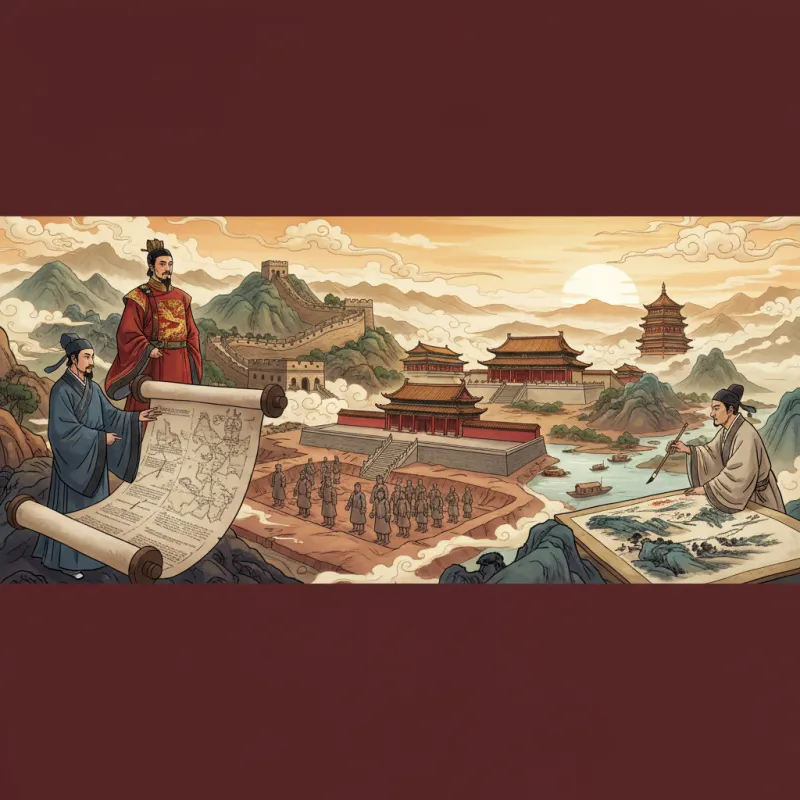
Five thousand years. That's the number you'll hear repeated endlessly when Chinese history comes up — a proud, round figure that sounds impressive but does absolutely nothing to help you actually learn it. The truth is messier and more useful: Chinese history isn't a single story you need to memorize from beginning to end. It's a vast library where you get to choose which book to open first.
Forget Chronology, Find Your Entry Point
The worst way to approach Chinese history is the way most textbooks present it: starting with the semi-mythical Xia Dynasty (夏朝, Xià Cháo) around 2070 BCE and marching forward through every dynasty until you collapse somewhere around the Tang. This is the equivalent of learning European history by beginning with the Sumerians and expecting to stay engaged through three thousand years of incremental change.
Instead, pick a period that genuinely interests you. Fascinated by the Mongol conquests? Start with the Yuan Dynasty (元朝, Yuán Cháo, 1271-1368). Love palace intrigue and imperial drama? The Qing Dynasty (清朝, Qīng Cháo, 1644-1912) offers centuries of it. Interested in philosophy and warfare? The Warring States period (戰國時代, Zhànguó Shídài, 475-221 BCE) is your playground.
Everything in Chinese history connects eventually. Once you understand one period deeply, the threads leading backward and forward become visible. The Tang Dynasty (唐朝, Táng Cháo) makes more sense when you know what came after it. The fall of the Ming (明朝, Míng Cháo) illuminates the rise of the Qing. You're building a web, not climbing a ladder.
Use Stories as Scaffolding
Chinese historical records are extraordinarily detailed, but they're also dense and often assume cultural knowledge you don't have yet. This is where historical fiction, biography, and narrative history become essential tools. They give you the human-scale stories that make the dates and dynasty names stick.
Start with accessible narratives. For the Three Kingdoms period (三國, Sānguó, 220-280 CE), the 14th-century novel Romance of the Three Kingdoms (三國演義, Sānguó Yǎnyì) by Luo Guanzhong is historical fiction, not history — but it introduces you to the major players, the geography, and the political dynamics in a way that makes the actual historical records comprehensible later. Think of it as training wheels.
For the Song Dynasty (宋朝, Sòng Cháo, 960-1279), Jacques Gernet's Daily Life in China on the Eve of the Mongol Invasion drops you into the streets of Hangzhou and shows you what ordinary life looked like. Suddenly the dynasty isn't just dates and emperor names — it's a place where people ate specific foods, wore specific clothes, and worried about specific problems.
Biographies work too. Jonathan Spence's Emperor of China: Self-Portrait of K'ang-hsi uses the Kangxi Emperor's own writings to build a portrait of Qing governance. You learn the dynasty through one person's eyes, which is infinitely more memorable than a textbook chapter.
Learn the Dynasty Cycle Framework
Chinese historians traditionally viewed history through the lens of the dynastic cycle (朝代循環, cháodài xúnhuán): dynasties rise through virtue and military strength, reach a peak of prosperity and cultural achievement, decline through corruption and internal weakness, and fall to rebellion or invasion. Then the cycle begins again with a new dynasty claiming the Mandate of Heaven (天命, tiānmìng).
This framework is somewhat simplistic — real history is always more complicated — but it's genuinely useful as a mental model. It helps you understand why Chinese historical writing focuses so heavily on the moral character of rulers, why the founding and final years of dynasties get disproportionate attention, and why certain patterns repeat across centuries.
The cycle also explains the Chinese concept of 治亂興衰 (zhì luàn xīng shuāi) — order, chaos, rise, and decline. When you read about the late Tang, the late Ming, or the late Qing, you'll notice similar patterns: eunuch power, factional court politics, peasant rebellions, border troubles. These aren't coincidences. They're structural problems that recur when centralized bureaucratic empires reach certain breaking points.
Understanding this framework doesn't mean accepting it uncritically. Modern historians debate its validity constantly. But knowing it helps you read Chinese sources on their own terms and understand what the writers thought they were documenting.
Master the Major Dynasties First
You don't need to memorize all the dynasties, but you should know the big ones that shaped Chinese civilization and left lasting cultural marks. These are your anchor points:
Qin (秦, Qín, 221-206 BCE): Brutal, short-lived, but foundational. Unified China, standardized writing and measurements, built much of the Great Wall, and established the imperial system that lasted two millennia. The first emperor, Qin Shi Huang (秦始皇), is one of history's most consequential figures.
Han (漢, Hàn, 206 BCE - 220 CE): The dynasty so influential that "Han" became the ethnic term for the Chinese majority. Established Confucianism as state ideology, expanded the empire dramatically, and created the civil service examination system's precursor. When Chinese people today call themselves 漢人 (Hànrén), they're referencing this dynasty.
Tang (唐, Táng, 618-907): The golden age everyone references. Cosmopolitan, culturally confident, militarily powerful. Poetry, painting, and Buddhism all flourished. The capital Chang'an (長安, Cháng'ān, modern Xi'an) was the world's largest city. This is the period foreigners often mean when they romanticize "ancient China."
Song (宋, Sòng, 960-1279): Militarily weaker than the Tang but economically and culturally sophisticated. Invented or perfected gunpowder, printing, paper money, and the compass. Neo-Confucianism emerged here. The Song is when China became recognizably "modern" in many ways — urbanized, commercialized, bureaucratically complex.
Ming (明, Míng, 1368-1644): The last ethnic Han dynasty before the Manchu conquest. Built the Forbidden City, sent Zheng He's (鄭和) treasure fleets across the Indian Ocean, and produced the blue-and-white porcelain that became globally iconic. Also increasingly isolationist and conservative in its later years.
Qing (清, Qīng, 1644-1912): The last imperial dynasty, ruled by Manchus rather than Han Chinese. Expanded China to its greatest territorial extent, but also presided over the "century of humiliation" when Western powers and Japan carved out concessions and spheres of influence. The Qing's fall marks the end of imperial China and the beginning of the modern era.
Learn these six deeply, and you'll have the framework to understand everything else. The periods between them — the fragmentation after the Han, the chaos between Tang and Song — become comprehensible as transitions rather than confusing gaps.
Use Maps and Timelines Constantly
Chinese geography is not intuitive if you didn't grow up with it. The Yellow River (黃河, Huáng Hé) and Yangtze River (長江, Cháng Jiāng) aren't just rivers — they're civilizational dividing lines. The North China Plain, the Sichuan Basin, the Guangdong coast — these regions have distinct histories, dialects, and cultures.
Keep a good historical atlas handy. Watch how borders expand and contract. Notice that "China" in 200 BCE looked nothing like "China" in 1800 CE. Understand that when the Tang controlled Central Asia, they were managing a multicultural empire, not a homogeneous nation-state. Geography explains why certain dynasties fell (they couldn't defend the northern border) and why others thrived (they controlled the Grand Canal and the rice-producing south).
Timelines help too, but not the kind that list every emperor. Instead, create thematic timelines: when did major technologies appear? When did Buddhism arrive and how did it spread? When did China's population explode? These patterns matter more than memorizing that Emperor X reigned from year Y to year Z.
Read Primary Sources in Translation
Once you have basic orientation, start reading actual Chinese historical texts in translation. You don't need to read classical Chinese (though learning some basic characters helps). Good translations exist for most major works.
Records of the Grand Historian (史記, Shǐjì) by Sima Qian (司馬遷) is the foundational text — China's first comprehensive history, written around 100 BCE. It's surprisingly readable and full of vivid character sketches and moral judgments. Burton Watson's translation is excellent.
For philosophy that shaped historical thinking, read the Analects (論語, Lúnyǔ) of Confucius and some Daoist texts like the Daodejing (道德經). You don't need to become a sinologist, but understanding what Confucian virtue meant or why Daoism offered an alternative worldview helps you grasp why historical actors made certain choices.
For later periods, read translated memoirs, poetry, and essays. The Song Dynasty poet Su Shi (蘇軾, also known as Su Dongpo) wrote about politics, exile, and daily life. Qing Dynasty scholars left detailed observations about their world. These voices make history three-dimensional.
Connect to Modern China
Chinese history didn't end in 1912. The Republican period, the Communist revolution, and the People's Republic are all part of the same continuous story. Modern Chinese politics constantly references historical precedents — sometimes explicitly, sometimes through coded language.
When Xi Jinping talks about the "Chinese Dream" (中國夢, Zhōngguó Mèng) or "national rejuvenation," he's invoking a narrative about China's historical greatness and its modern restoration. Understanding the Qing Dynasty's decline and the subsequent century of foreign intervention explains why sovereignty and territorial integrity remain such sensitive issues. The Cultural Revolution's impact on traditional culture makes more sense when you know what that traditional culture consisted of.
You're not learning dead history. You're learning the foundation of how 1.4 billion people understand their place in the world.
Build Your Own Reading List
There's no single correct path through Chinese history. Your route will depend on your interests, your background knowledge, and what you find compelling. But here's a practical approach:
Pick one dynasty that interests you. Read one good narrative history of that period. Then read one primary source from that era in translation. Then read one biography of a major figure from that time. By then, you'll have questions — about what came before, what came after, why certain institutions existed, how certain ideas developed. Follow those questions. They're your roadmap.
Avoid the trap of thinking you need to "finish" Chinese history before moving on to something else. You'll never finish. The field is too vast, the sources too numerous, the scholarly debates too ongoing. Instead, aim for functional literacy: enough knowledge to read a newspaper article about Chinese politics and catch the historical references, enough context to visit a museum and understand what you're looking at, enough framework to have an informed conversation.
The goal isn't mastery. It's engagement. Chinese history is endlessly fascinating once you find your way in. The five-thousand-year timeline stops being intimidating and starts being an invitation — there's always another story to discover, another connection to make, another perspective to consider. You just need to pick a door and walk through it.
Related Reading
- The Chinese Diaspora: How Chinese Culture Spread Worldwide
- How the Opium Wars Still Shape China Today
- The Cultural Revolution: What Actually Happened
- 10 Ways Ancient China Changed the Modern World
- Chinese Architecture: Forbidden Cities, Pagodas, and Garden Design
- Unraveling the Economic Tapestry of Ancient Chinese Dynasties
- The Silk Road Was Not About Silk: What Actually Traveled Between China and the West