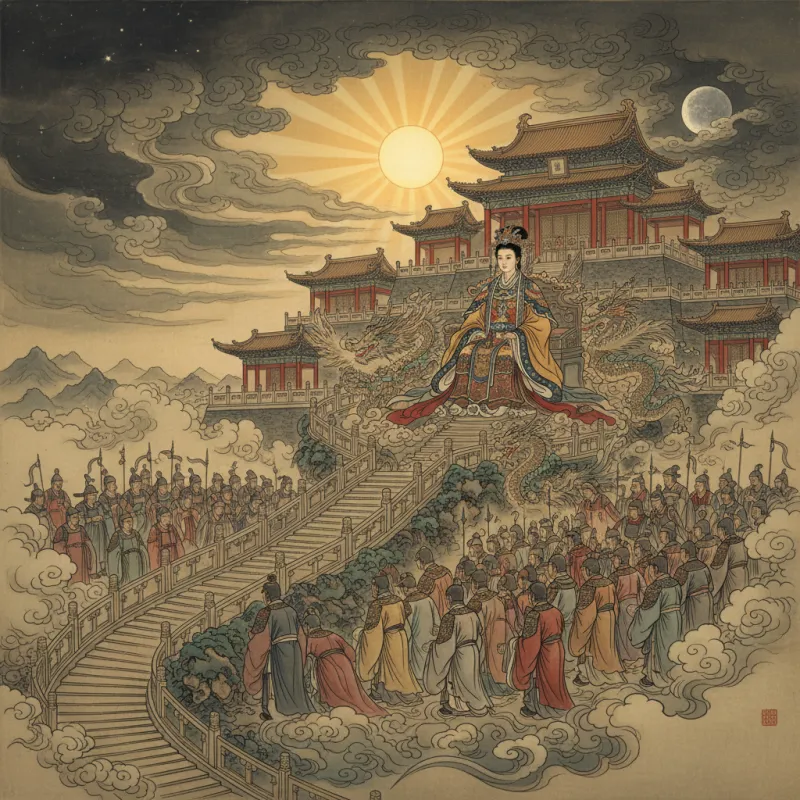
In 637 CE, a fourteen-year-old girl named Wu Zhao entered the Forbidden City as a cairen (才人) — the fifth and lowest rank of imperial concubine, essentially a glorified servant expected to fade into the background of palace life. Sixty-three years later, she would sit on the Dragon Throne as the sole ruling emperor of China, having eliminated rivals, deposed her own sons, and founded her own dynasty. The question isn't whether Wu Zetian (武则天) was ruthless — she absolutely was. The question is how someone starting from the bottom of a rigidly hierarchical system designed to keep women powerless managed to seize absolute authority in the most male-dominated civilization on earth.
The Concubine Who Refused to Disappear
Wu Zhao's entry into palace life came through her father's connections — he'd been a supporter of the Tang founder, Li Yuan. But connections only got you through the door. Emperor Taizong (唐太宗), one of China's most capable rulers, barely noticed her during his reign. She spent thirteen years as a low-ranking concubine, and when Taizong died in 649 CE, Wu should have followed standard protocol: head shaved, sent to a Buddhist convent, forgotten by history.
She had other plans. Before Taizong's death, Wu had already caught the eye of his son, the crown prince Li Zhi. After a respectable mourning period, Li Zhi — now Emperor Gaozong (唐高宗) — violated both Confucian propriety and Buddhist taboos by retrieving Wu from the convent and installing her in his own harem. It was scandalous. It was also brilliant strategy on Wu's part. She'd identified the future power center and positioned herself there while her rivals assumed she was finished.
The Empress Who Wasn't Supposed to Exist
Within five years, Wu had maneuvered from returned concubine to huanghou (皇后) — empress consort. The sitting empress, Wang, had made a fatal miscalculation: she'd supported bringing Wu back to court, thinking Wu would help her against a rival concubine, Consort Xiao. Instead, Wu systematically destroyed them both.
The most infamous story — likely true, given its appearance in official histories — involves Wu's infant daughter. When Empress Wang visited Wu's quarters and played with the baby, Wu allegedly strangled her own child after Wang left, then blamed the empress for the murder. Whether this actually happened or was later propaganda, it reveals something crucial: Wu understood that in a system where women had no formal power, you had to be willing to do absolutely anything to survive. Empress Wang and Consort Xiao were both executed in 655 CE, their hands and feet cut off, their bodies thrown into wine vats. Wu had learned that half-measures were fatal.
As empress consort, Wu didn't play the traditional role of quiet supporter. When Emperor Gaozong suffered from debilitating illnesses — possibly stroke-related — Wu began attending state meetings behind a screen, then gradually moved from advisor to de facto co-ruler. The phrase "two saints" (二圣 èr shèng) emerged to describe their joint rule, an unprecedented arrangement that scandalized Confucian officials but proved remarkably effective administratively.
The Regent Who Became Emperor
Gaozong died in 683 CE, and Wu's son Li Xian became Emperor Zhongzong (唐中宗). He lasted six weeks. When he suggested giving his father-in-law a significant government position, Wu had him deposed and exiled. She installed another son, Li Dan, as Emperor Ruizong (唐睿宗), but everyone understood he was a puppet. Wu was now huangtaihou (皇太后) — empress dowager — and held absolute power as regent.
For seven years, Wu ruled through her son while systematically eliminating opposition. She revived the ku li (酷吏) system — networks of secret police and informers that made the Tang court a place of constant paranoia. Officials who opposed her faced torture, execution, or forced suicide. She was particularly brutal toward the Li family — the Tang imperial clan — executing dozens of princes and princesses who might challenge her authority. The message was clear: the Tang Dynasty existed at her pleasure.
In 690 CE, Wu stopped pretending. She forced Emperor Ruizong to abdicate, declared the Tang Dynasty ended, and proclaimed herself huangdi (皇帝) — emperor — of a new dynasty, the Zhou (周朝 Zhōu Cháo). Not empress. Not regent. Emperor. She took the reign name Shengshen (聖神) and became the only woman in 3,000 years of Chinese imperial history to officially hold the title.
The Zhou Dynasty That History Tried to Forget
Wu Zetian's Zhou Dynasty lasted fifteen years (690–705 CE), and despite later historians' attempts to portray it as a disaster, it was actually a period of relative stability and effective governance. She expanded the imperial examination system, promoting officials based on merit rather than aristocratic birth — a policy that weakened the old Tang nobility who opposed her. She patronized Buddhism extensively, commissioning the massive Longmen Grottoes and using Buddhist texts that prophesied a female world-ruler to legitimize her reign.
Her religious policy was shrewd politics. Confucianism explicitly subordinated women; Buddhism was more flexible. By elevating Buddhism and demoting Confucian officials, Wu created an ideological framework where female rule wasn't just possible but divinely ordained. She even invented new Chinese characters, including one for her own name that combined elements meaning "sun" and "moon" above "sky" — literally placing herself above heaven.
The brutality continued throughout her reign. The ku li system remained active, and Wu showed no mercy to perceived threats. But she also proved to be a capable administrator, maintaining the Tang's territorial integrity, managing the economy effectively, and keeping the bureaucracy functioning. The empire didn't collapse under female rule, which was itself a revolutionary demonstration.
The Ending She Couldn't Control
Wu Zetian's downfall came not from external enemies but from age and palace intrigue. By 705 CE, she was eighty years old and increasingly dependent on two brothers, the Zhang brothers, who served as her favorites and possibly lovers. Court officials, led by minister Zhang Jianzhi, staged a coup, killed the Zhang brothers, and forced Wu to abdicate in favor of her son Zhongzong — the same son she'd deposed twenty-two years earlier.
She died ten months later, in December 705 CE. Her final instruction was telling: she asked to be buried as "empress of the Tang" rather than emperor of the Zhou, and requested that her tombstone be left blank, without inscription. Whether this was genuine humility, political calculation to protect her legacy, or recognition that history would judge her harshly, we'll never know. The blank stele at her tomb in Qianling remains one of Chinese history's most provocative monuments.
The Legacy That Won't Stay Buried
Traditional Chinese historians treated Wu Zetian as a cautionary tale — proof that female rule led to chaos and immorality. The Old Book of Tang and New Book of Tang portrayed her as a murderous usurper who violated natural order. Confucian scholars used her reign to argue against any female political involvement, citing her as evidence that women in power brought disaster.
But the actual historical record is more complicated. Wu's reign wasn't notably more violent than other periods of dynastic transition — she was just more visible as a woman. Her administrative reforms strengthened the examination system and reduced aristocratic privilege, changes that benefited the Tang Dynasty when it was restored. The empire she handed back to her son was stable, prosperous, and intact.
Modern reassessments have been kinder, recognizing Wu as a skilled politician who navigated an impossible situation. She couldn't have risen through official channels — they were closed to women. She couldn't have ruled gently — her enemies would have destroyed her. She had to be more ruthless, more calculating, and more willing to break every rule than any male emperor because she was operating in a system designed to prevent her existence.
Wu Zetian proved that a woman could rule China as effectively as any man, which is precisely why Confucian historians spent centuries trying to erase that lesson. Her blank tombstone has become a symbol: history tried to silence her, but her achievement speaks louder than any inscription. In a civilization that told women they couldn't hold power, she seized the Dragon Throne and held it for fifteen years. That's not just remarkable — it's revolutionary.
The fact that no other woman managed to replicate her achievement in the next 1,200 years of imperial history doesn't diminish what she accomplished. It reveals how extraordinary the circumstances had to be, and how exceptional the woman had to be, to break through barriers that weren't just social customs but fundamental organizing principles of Chinese civilization. Wu Zetian didn't just rule China — she proved it was possible, and that possibility, once demonstrated, could never be completely erased.
Related Reading
- The Real Mulan: History, Legend, and the Disney Version
- The Four Great Beauties of Ancient China: History and Legend
- Women Who Changed Chinese History: Warriors, Empresses, and Rebels
- Wu Zetian: How China's Only Female Emperor Seized and Kept Power
- Chinese Women Who Changed History (And Were Erased From It)
- The Imperial Examination: Meritocracy in Ancient China
- Exploring Ancient Agricultural Practices in Chinese Dynasties
- Unraveling the Economic Tapestry of Ancient Chinese Dynasties