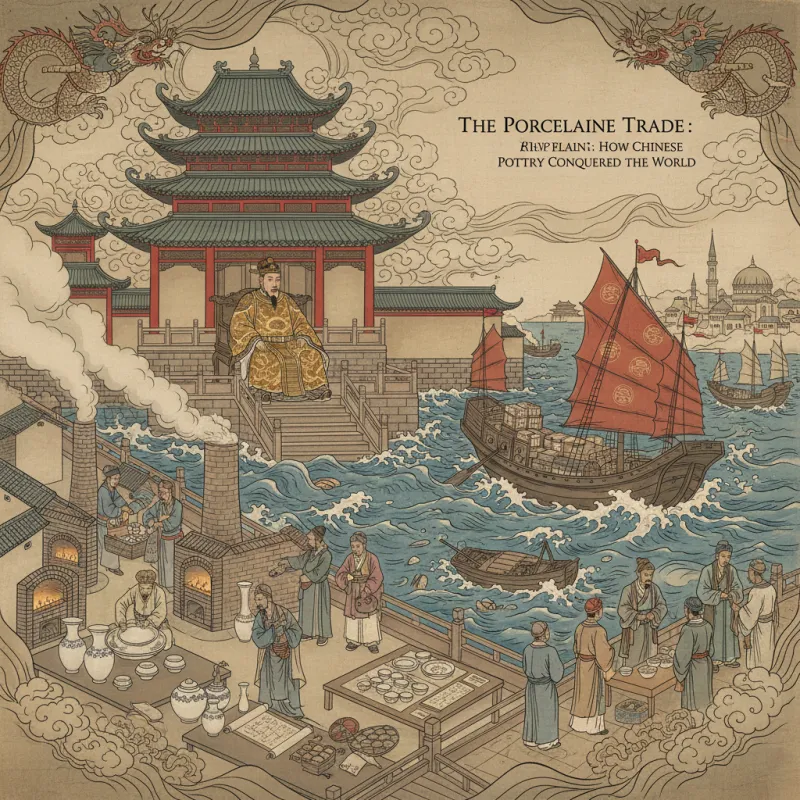
When Marco Polo returned to Venice in 1295 carrying samples of translucent white ceramics that rang like bells when struck, his fellow merchants thought he'd brought back pieces of the moon. These weren't crude earthenware plates — they were impossibly thin, luminous as eggshells, and decorated with cobalt blue designs so intricate they seemed painted by spirits. Europe had nothing remotely comparable. For the next four centuries, Chinese porcelain would be worth more per ounce than silver, spark industrial espionage operations across three continents, and literally give its name to an entire nation in the English language.
The Alchemy That Changed Commerce
The secret wasn't magic — it was geology and fire. Chinese potters in Jingdezhen (景德镇 Jǐngdézhèn), a city in Jiangxi Province that would become the porcelain capital of the world, had discovered something European ceramicists couldn't replicate: the perfect marriage of kaolin clay (高岭土 gāolǐngtǔ) and petuntse stone (瓷石 císhí). When fired together at temperatures exceeding 1,260°C — hot enough to melt copper — these materials vitrified into a substance that was simultaneously stone-hard and glass-smooth.
The Tang Dynasty (618-907 CE) produced the earliest true porcelain, but it was during the Song Dynasty (960-1279 CE) that Chinese potters elevated the craft to an art form. Song celadons, with their jade-green glazes, became so prized that Korean and Japanese potters spent generations trying to decode their secrets. The Yuan Dynasty (1271-1368 CE) introduced cobalt blue decoration imported from Persia, creating the iconic blue-and-white porcelain that would define Chinese ceramics in the Western imagination.
By the Ming Dynasty (1368-1644 CE), Jingdezhen employed over a million workers in its kilns. The city operated like a massive factory town centuries before the Industrial Revolution, with specialized workshops handling each stage of production — clay preparation, throwing, glazing, painting, firing. Emperor Hongwu established imperial kilns that produced pieces so fine they were described as "thin as paper, white as jade, bright as a mirror, resonant as a bell."
The Silk Road's Ceramic Cousin
Long before European ships reached Chinese ports, porcelain traveled westward along the Silk Road. Arab merchants were the first middlemen in this lucrative trade, carrying Chinese ceramics to the Middle East and Mediterranean markets from the 9th century onward. The Abbasid Caliphate's elite developed such an appetite for Chinese porcelain that potters in Iraq and Persia began producing their own imitations using tin-glazed earthenware — the ancestors of Italian maiolica and Dutch Delft.
But these were pale shadows of the real thing. True porcelain remained a Chinese monopoly, and the inability to replicate it drove prices to astronomical levels. A single Ming vase could cost as much as a European estate. When Portuguese traders established direct maritime contact with China in 1517, they found a product that European aristocrats would pay almost any price to obtain.
The Porcelain Fever
The 17th century saw what can only be described as porcelain mania sweep through European courts. Augustus the Strong, Elector of Saxony, was so obsessed with Chinese porcelain that he traded a regiment of 600 soldiers to the King of Prussia for 48 large vases. He eventually amassed a collection of over 20,000 pieces, housing them in a dedicated "Japanese Palace" in Dresden.
The Dutch East India Company (VOC) became the primary conduit for this trade, shipping millions of pieces from Chinese ports to Amsterdam between 1602 and 1682. The company's records show they transported over 43 million pieces of Chinese porcelain to Europe during their operational lifetime — an average of one piece for every two Europeans alive at the time.
This wasn't just about wealthy collectors. Chinese porcelain fundamentally changed European dining culture. Before porcelain, Europeans ate from wooden trenchers or crude pottery. The arrival of Chinese ceramics introduced the concept of matching dinner services, individual place settings, and the aesthetic pleasure of dining. The tea ceremony culture that developed in 18th-century Europe was entirely dependent on Chinese porcelain teaware.
The Great Ceramic Heist
The Chinese guarded their porcelain secrets with the intensity of nuclear codes. Revealing manufacturing techniques was punishable by death. Foreign merchants were confined to specific trading ports and never allowed near Jingdezhen. But where there's a monopoly worth fortunes, there's industrial espionage.
The breakthrough came in 1708 when Johann Friedrich Böttger, a German alchemist imprisoned by Augustus the Strong, accidentally discovered the European formula for porcelain while trying to create gold. His success led to the establishment of the Meissen factory in 1710 — Europe's first true porcelain manufactory. The secret was out, though Meissen guards were instructed to shoot anyone attempting to leave with knowledge of the process.
France established Sèvres in 1740, England created several manufactories including Wedgwood, and suddenly Europe had its own porcelain industry. But here's the twist: even after Europeans could make porcelain, they continued importing Chinese pieces in massive quantities. Chinese porcelain wasn't just about the material — it was about the designs, the cultural cachet, the exotic appeal of objects that had traveled halfway around the world.
The Canton System and Customization
By the 18th century, Chinese porcelain production had evolved to serve Western tastes specifically. The Canton system (1757-1842) concentrated foreign trade in Guangzhou, where Chinese merchants worked with European traders to produce "export porcelain" designed for Western markets. These pieces often featured European coats of arms, Christian religious scenes, or designs copied from European prints — Chinese craftsmanship in service of Western aesthetics.
The most fascinating examples are "Jesuit porcelain" pieces decorated with European religious imagery painted by Chinese artists who had never seen a European church. The results are sometimes theologically confused but artistically stunning — Madonna and child figures with distinctly Asian facial features, crucifixion scenes surrounded by Chinese cloud motifs.
This customization worked both ways. Chinese potters created pieces specifically for Islamic markets with Arabic calligraphy, for Southeast Asian markets with local design preferences, and for Japanese markets with their own aesthetic requirements. Jingdezhen became a global design hub, producing culturally specific ceramics for dozens of different markets simultaneously.
The Decline and Legacy
The 19th century brought challenges to Chinese porcelain dominance. The Taiping Rebellion (1850-1864) devastated Jingdezhen, destroying many kilns and scattering skilled craftsmen. European porcelain manufactories had matured, producing high-quality pieces at competitive prices. The rise of industrial ceramics and bone china in England offered cheaper alternatives for middle-class consumers.
But Chinese porcelain never truly lost its prestige. Today, Ming and Qing Dynasty pieces command record prices at auction — a 15th-century blue-and-white jar sold for $21.6 million in 2011. Modern Jingdezhen has revived as a center for both traditional craftsmanship and contemporary ceramic art, with artists from around the world coming to work in its kilns.
The linguistic legacy persists too. When English speakers set a table with "china," they're unconsciously acknowledging a millennium of Chinese technological supremacy. It's the ultimate brand success story — a product so dominant that it became synonymous with the civilization that created it. The economic impact of Chinese innovations extended far beyond porcelain, but few products achieved such complete cultural penetration.
The Enduring Mystery
Despite centuries of study, some aspects of historical Chinese porcelain remain mysterious. Modern scientists using electron microscopes and spectrographic analysis still can't fully explain why certain Song Dynasty glazes achieved their particular luminosity, or how Ming potters created specific shades of copper-red that have never been successfully replicated. The knowledge was passed master to apprentice, and when those lineages broke during periods of upheaval, some secrets were lost forever.
Perhaps that's fitting. Chinese porcelain conquered the world not just through superior technology, but through an element of irreducible mystery — the sense that these objects contained something beyond mere craft, something that touched on alchemy, on transformation, on the human desire to create beauty that transcends utility. When you hold a piece of Chinese porcelain, you're holding an object that once drove empires to trade fortunes, inspired industrial espionage, and changed how civilizations ate, drank, and understood the possibilities of human creation.
That's not just successful pottery. That's cultural conquest through beauty — the most enduring kind.
Related Reading
- The Grand Canal: China Greatest Engineering Project
- Ancient Chinese Currency: From Cowrie Shells to Paper Money
- The Tea Trade: How a Chinese Plant Reshaped the World
- Chinese Porcelain: The Luxury Good That Changed World Trade
- The Imperial Examination: Meritocracy in Ancient China
- Exploring the Philosophical Legacy of China’s Ancient Dynasties
- Crime and Punishment in Imperial China