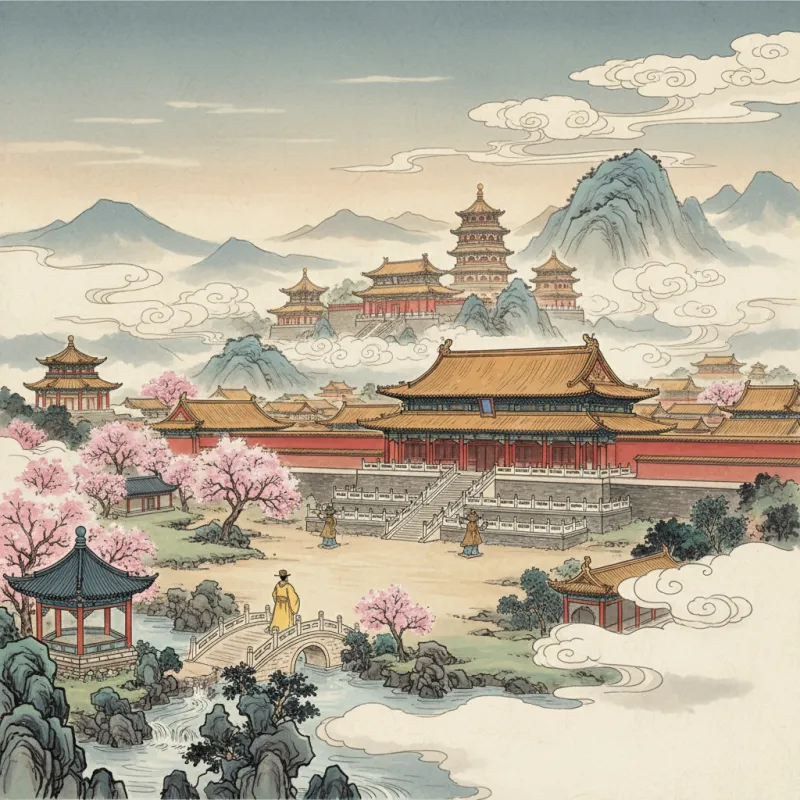
The Forbidden City contains 9,999 rooms — one fewer than heaven itself. This wasn't an accident of construction or a failure of ambition. Chinese emperors deliberately built their palaces with this symbolic restraint, acknowledging that even the Son of Heaven must defer to cosmic order. That single missing room tells you everything about how Chinese architecture thinks: buildings aren't just shelters or monuments to power, they're physical manifestations of philosophy, encoding ideas about hierarchy, harmony, and humanity's place in the universe into every beam, courtyard, and roof tile.
Why China Built With Wood While Europe Built With Stone
Walk through the ruins of ancient Rome and you'll find stone arches standing after two millennia. Walk through China and you'll find... almost nothing from before the Ming Dynasty. This isn't because Chinese civilization is younger — it's because China made a deliberate choice to build with timber (木构架 mùgòujià) rather than stone. The oldest surviving wooden structure in China, Nanchan Temple's main hall, dates only to 782 CE, yet Chinese architectural principles are far older.
This wasn't a matter of available materials. China had plenty of stone and knew how to work it — the Great Wall proves that. But timber-frame construction offered something stone couldn't: flexibility. Wooden buildings could absorb earthquakes through their interlocking bracket systems (斗拱 dǒugǒng), could be disassembled and rebuilt elsewhere, and most importantly, could be repaired and renewed indefinitely. The Japanese have rebuilt Ise Grand Shrine every twenty years for over a millennium using the same design. The building is simultaneously ancient and new.
The dougong bracket system represents one of humanity's most elegant structural solutions. These interlocking wooden brackets sit atop columns, distributing the roof's weight while allowing the structure to flex during earthquakes. No nails, no glue — just precisely cut wood fitting together like a three-dimensional puzzle. Master carpenters could adjust a building's proportions by changing bracket complexity without altering the basic structure. This modular thinking extended to entire buildings: imperial architecture used standardized components that could be combined like LEGO blocks, documented in the 1103 CE building manual Yingzao Fashi (营造法式).
The Courtyard: Architecture as Social Diagram
Chinese buildings don't stand alone — they organize themselves around courtyards (四合院 sìhéyuàn). A traditional Beijing courtyard house arranges four buildings around a central open space, with the main hall facing south (always south — more on that in a moment), side wings for family members, and a gate building controlling access. This wasn't just practical design; it was Confucian social hierarchy made physical.
The patriarch occupied the north-facing main hall, the position of honor. Sons and their families took the side wings, with the eldest son on the east (the yang side, associated with sunrise and growth). Daughters-in-law lived in the west wing. Servants stayed near the gate. You could read a family's entire social structure just by knowing who slept where. When a son married, the family might add another courtyard behind the first, creating a chain of connected spaces that grew with the family tree.
The Forbidden City takes this principle and scales it to imperial proportions: a series of courtyards growing progressively more exclusive as you move north, from the outer court where officials conducted business to the inner court where the emperor lived. Each gate and courtyard marked a threshold of power. By the time you reached the emperor's private quarters, you'd passed through multiple layers of architectural hierarchy, each one reinforcing the distance between heaven's representative and ordinary mortals.
Feng Shui: When Architecture Becomes Cosmology
Every major Chinese building faces south. This isn't coincidence or convenience — it's 风水 (fēngshuǐ), literally "wind-water," the practice of orienting buildings to harmonize with cosmic forces. The south-facing orientation captures maximum sunlight in winter while avoiding harsh northern winds. But feng shui goes far deeper than practical meteorology.
Traditional feng shui positions buildings within a landscape of symbolic forces: mountains to the north (representing the protective Black Tortoise), a water source to the south (the Red Phoenix), hills to the east (Azure Dragon), and west (White Tiger). The ideal site nestles in a valley with mountains behind and water in front — exactly how Beijing's Forbidden City sits, backed by Coal Hill and facing south toward the imperial canal system.
Modern skeptics dismiss feng shui as superstition, but it encoded genuine environmental wisdom. Buildings positioned according to feng shui principles typically enjoy good drainage, protection from harsh weather, and pleasant microclimates. The "superstition" worked because it crystallized centuries of observation about how buildings interact with their environment. When Chinese gardens incorporated feng shui principles, they created spaces that felt psychologically comfortable even if visitors didn't know why.
Pagodas: Buddhism's Vertical Ambition
Chinese architecture generally spreads horizontally — even imperial palaces rarely exceed two stories. Then Buddhism arrived from India in the first century CE and brought the stupa, a dome-shaped monument housing sacred relics. Chinese architects looked at this foreign form and thought: what if we made it taller? Much taller.
The pagoda (塔 tǎ) represents Chinese architecture's most dramatic vertical gesture. These multi-tiered towers adapted the Indian stupa into something distinctly Chinese, combining Buddhist symbolism with native timber-frame construction. The oldest surviving pagoda, Songyue Temple's brick tower from 523 CE, rises twelve sides and fifteen stories. Later wooden pagodas like Fogong Temple's Sakyamuni Pagoda (built 1056) stand 67 meters tall using nothing but interlocking wooden brackets — no nails, no screws, surviving earthquakes that toppled modern concrete buildings.
Pagodas served multiple functions beyond housing relics. They marked important sites, demonstrated a monastery's wealth and prestige, and according to feng shui principles, could "fix" a landscape's energy. A town with poor feng shui might build a pagoda to balance its cosmic forces. The fact that pagodas also served as watchtowers and landmarks was almost incidental to their symbolic purpose.
The Roof: Where Status Lives
If you want to understand a Chinese building's importance, look up. Roof design communicated status more clearly than any other architectural element. The number of roof tiers, the curve of the eaves, the color of the tiles, even the decorative figures marching along the roof ridges — all followed strict hierarchical rules.
Imperial buildings wore yellow glazed tiles (黄琉璃瓦 huáng liúlíwǎ), a color reserved for the emperor. Temples used green or blue. Commoners made do with gray. The Forbidden City's golden roofs weren't decorative excess — they were legal requirements, visible declarations of imperial authority. Only one non-imperial building in Beijing wore yellow tiles: the library housing the Confucian classics, because even emperors deferred to the sage's wisdom.
Those upturned eaves that make Chinese roofs instantly recognizable? They served practical and symbolic purposes. The curve extended the roof's reach, providing better rain protection and more shade. But they also gave buildings a sense of lightness, making heavy timber structures appear to float. Some scholars argue the upturned corners represent tent architecture from China's nomadic past; others see them as purely aesthetic evolution. Either way, they became so distinctly Chinese that Japanese and Korean architecture adopted them as markers of cultural sophistication.
The decorative figures along roof ridges weren't random ornaments. They followed strict rules: the more figures, the more important the building. The Hall of Supreme Harmony in the Forbidden City displays ten figures (the maximum), starting with a man riding a phoenix and followed by a dragon, phoenix, lion, and other mythical creatures. Each figure had protective significance, guarding the building against fire, evil spirits, and cosmic imbalance.
Gardens: Nature Perfected
Chinese gardens don't try to dominate nature — they try to distill it. A classical Chinese garden (园林 yuánlín) creates an idealized landscape in miniature, compressing mountains, forests, and lakes into a space you can walk across in minutes. This isn't landscaping; it's landscape philosophy.
The key principle: 借景 (jièjǐng), "borrowed scenery." A garden designer positions buildings, walls, and plantings to frame views of distant mountains or nearby trees, incorporating elements beyond the garden's boundaries into its composition. A moon gate (circular doorway) might frame a single perfect view of a gnarled pine tree. A pavilion window could capture a distant pagoda, making it part of the garden's experience.
Suzhou's classical gardens, built by retired officials and wealthy merchants during the Ming and Qing dynasties, perfected this art. The Humble Administrator's Garden (拙政园 Zhuōzhèng Yuán) uses water, rocks, and pavilions to create constantly shifting perspectives. Walk ten steps and the view transforms completely. The garden reveals itself gradually, never all at once — the opposite of Versailles's grand vistas where you can see everything from a single viewpoint.
Rocks deserved special attention. Chinese garden designers prized 太湖石 (tàihú shí), limestone from Lake Tai, eroded into fantastic shapes by water. A single perfect rock could cost more than a building. These weren't decorations — they were miniature mountains, allowing scholars to contemplate wilderness without leaving the city. The practice connected to Daoist philosophy, which saw nature as the ultimate teacher and sought to maintain harmony with natural forces rather than conquering them.
What We Lost and What Remains
The timber-frame tradition that made Chinese architecture flexible also made it vulnerable. Fire, war, and deliberate destruction erased most ancient buildings. The Forbidden City dates only to the Ming Dynasty (1420 CE), rebuilt after earlier palaces burned. Most "ancient" Chinese buildings are actually Qing Dynasty reconstructions of earlier designs. We know Song Dynasty architecture primarily through paintings and the Yingzao Fashi building manual, not surviving structures.
This creates a strange situation: Chinese architectural principles are ancient, but most physical examples are relatively recent. It's like knowing Shakespeare's plays but having only 20th-century performances to watch. The principles survived even when the buildings didn't, passed down through builder's guilds, architectural manuals, and the modular construction system that allowed craftsmen to recreate traditional forms using standardized components.
Modern China faces a choice about this heritage. Some cities preserve traditional courtyard houses and classical gardens. Others demolish them for high-rises and shopping malls. Beijing has lost most of its hutongs (胡同 hútòng), the narrow alleys lined with courtyard houses that once defined the city. What remains often becomes tourist attractions rather than living neighborhoods, preserved but no longer evolving.
Yet the principles endure. Contemporary Chinese architects like Wang Shu (who won the Pritzker Prize in 2012) incorporate traditional materials and spatial concepts into modern buildings. His Ningbo History Museum uses recycled tiles and bricks from demolished traditional buildings, creating a structure that's simultaneously contemporary and rooted in Chinese architectural thinking. The question isn't whether to preserve old buildings — it's whether to preserve the ideas those buildings embodied.
Related Reading
- Chinese Art and Calligraphy: The Four Arts Every Scholar Had to Master
- Chinese Painting: Mountains, Mist, and Empty Space
- Chinese Opera: A Thousand Years of Drama
- Chinese Calligraphy: The Art of Writing as High Culture
- The Cultural Revolution: What Actually Happened
- The Silk Road Was Not a Road (And Other Things You Got Wrong)
- Exploring the Rich Tapestry of Ancient Chinese History and Culture