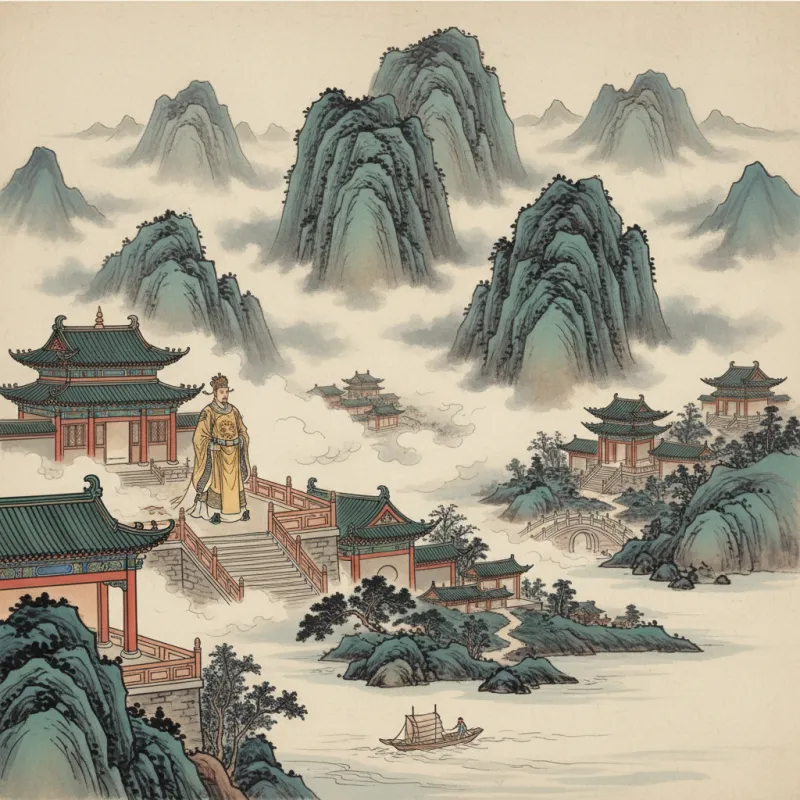
Stand before Early Spring by Guo Xi, painted in 1072, and you'll notice something unsettling: the mountain seems to breathe. Not through movement—the rocks and pines are perfectly still—but through the mist that wraps around its peaks and valleys, appearing and disappearing like breath itself. That mist, rendered as blank silk, occupies nearly as much space as the painted elements. A Renaissance master would have called it unfinished. Guo Xi would have called it essential.
The Revolutionary Emptiness
Chinese painting's defining characteristic isn't what it shows—it's what it deliberately leaves out. The concept of 留白 (liúbái, "leaving white") transforms empty space from absence into presence, from nothing into everything. This isn't minimalism for aesthetic effect. It's a visual manifestation of Daoist philosophy, where emptiness (虚 xū) contains infinite potential, and the uncarved block holds more truth than the finished sculpture.
The practice emerged during the Tang Dynasty (618-907 CE), but reached its philosophical maturity in the Song Dynasty (960-1279 CE), when literati painters—scholar-officials who painted for personal cultivation rather than commercial sale—codified the principles that would define Chinese painting for the next millennium. Wang Wei (701-761 CE), poet and painter, famously declared that "there are paintings in poems and poems in paintings," establishing the inseparability of visual and literary arts that would become a hallmark of Chinese aesthetic theory.
But 留白 isn't simply blank space. It's charged space. In Fan Kuan's Travelers Among Mountains and Streams (early 11th century), the mist that obscures the middle distance doesn't just separate foreground from background—it creates a sense of vast, unknowable depth. The viewer's eye travels up the monumental cliff face, loses itself in the fog, then discovers tiny human figures at the base, dwarfed by nature's immensity. The empty space makes you feel the mountain's scale in a way that complete rendering never could.
Mountains and Water: The Eternal Subject
Chinese landscape painting is called 山水画 (shānshuǐhuà, "mountain-water painting"), and this pairing is no accident. Mountains represent the yang principle—solid, permanent, masculine, reaching toward heaven. Water embodies yin—fluid, changing, feminine, flowing toward earth. Together they form a complete cosmology, a microcosm of the universe itself.
The Northern Song masters—Fan Kuan, Guo Xi, Li Cheng—painted mountains as if they were living beings with personalities and moods. Guo Xi's treatise The Lofty Message of Forests and Streams (林泉高致 Línquán Gāozhì) describes mountains in spring as "smiling and seductive," in summer as "rich with moisture," in autumn as "bright and clear," in winter as "withdrawn and sleeping." This wasn't poetic fancy—it was serious aesthetic theory. A painter who couldn't capture a mountain's qi (气, vital energy) had failed at the most fundamental level.
The Song Dynasty approach emphasized 全景山水 (quánjǐng shānshuǐ, "total view landscape"), where massive mountains dominate the composition, often viewed from a low vantage point that emphasizes their overwhelming presence. These weren't portraits of specific locations—they were idealized visions of nature as it should be, nature perfected through the artist's understanding of cosmic principles. The goal wasn't realism but truth, and truth required leaving space for the viewer's imagination to complete the picture.
The Scholar's Brush: Tools and Technique
Chinese painting's distinctive aesthetic emerges partly from its tools, which haven't changed substantially in two thousand years. The "Four Treasures of the Study" (文房四宝 wénfáng sìbǎo)—brush, ink, paper, and inkstone—impose certain constraints that became aesthetic virtues.
The brush, typically made from animal hair bound to a bamboo handle, holds a surprising amount of water and ink. A single stroke can transition from dark to light, thick to thin, wet to dry, creating the modulated lines that give Chinese painting its characteristic vitality. Unlike oil painting, where mistakes can be painted over, ink on absorbent paper or silk is permanent. Every stroke is a commitment, a moment of truth. This technical reality reinforced the philosophical emphasis on spontaneity and authenticity—the painting should capture the artist's state of mind in the moment of creation.
Ink itself comes in infinite gradations. The painter grinds an ink stick against an inkstone with water, controlling the concentration to produce everything from dense black to the palest gray. The "five colors of ink" (墨分五色 mò fēn wǔ sè) aren't literal colors but tonal values that can suggest depth, atmosphere, texture, and light without any pigment beyond carbon black. When Song Dynasty painters did use color, they often applied it sparingly, allowing ink to dominate—a practice called 水墨画 (shuǐmòhuà, "water-ink painting").
The technique of 皴法 (cūnfǎ, "texture strokes") deserves special mention. These are the repeated, rhythmic marks that build up the surface of rocks and mountains, suggesting their geological character. Different masters developed different 皴法: 披麻皴 (pīmá cūn, "hemp-fiber texture strokes") for southern mountains with their softer, more eroded forms; 斧劈皴 (fǔpī cūn, "axe-cut texture strokes") for the harder, more angular northern peaks. These weren't arbitrary stylistic choices—they reflected genuine observation of how different types of stone weather and fracture, translated into brush language.
The Shift to Intimacy: Yuan and Ming Developments
The Mongol conquest that established the Yuan Dynasty (1271-1368) paradoxically liberated Chinese painting. Many scholar-officials refused to serve the foreign rulers, retreating to private life where they painted for personal expression rather than official patronage. The result was a dramatic shift in scale and subject matter.
The Four Great Masters of the Yuan—Huang Gongwang, Wu Zhen, Ni Zan, and Wang Meng—abandoned the monumental landscapes of the Song for more intimate, personal visions. Ni Zan's paintings are almost aggressively empty: a few sparse trees, a distant mountain, vast expanses of blank paper suggesting water and sky. His Rongxi Studio (1372) reduces landscape to its absolute essentials—three horizontal registers (foreground trees, empty middle, distant hills) with nothing but emptiness between them. It's the visual equivalent of a Zen koan, and just as deliberately frustrating to anyone seeking conventional beauty.
This wasn't nihilism—it was refinement to the point of transcendence. Ni Zan famously said he painted "merely to sketch the exceptional exhilaration in my breast," not to achieve likeness. The painting became a record of the artist's inner state, with empty space representing not just mist or water but the artist's own sense of detachment from a world under foreign rule. The personal became political through absence rather than presence.
The Ming Dynasty (1368-1644) saw the codification of these developments into schools and styles. The Wu School, centered in Suzhou, emphasized the literati amateur ideal—painting as personal cultivation rather than professional craft. Shen Zhou, Wen Zhengming, and their followers created works of studied casualness, where apparent spontaneity masked years of training and deep knowledge of past masters. They painted gardens, not wilderness; intimate gatherings, not cosmic vistas. The empty space in their works suggests the cultivated void of the scholar's studio, where one could retreat from official duties to pursue poetry, painting, and philosophical contemplation.
The Living Tradition
Chinese painting's principles didn't fossilize into museum pieces. They evolved, adapted, and continue to influence contemporary art in ways both obvious and subtle. The 20th century brought Western techniques and perspectives, creating productive tensions between tradition and innovation.
Zhang Daqian (1899-1983) mastered traditional techniques so thoroughly that his forgeries of ancient masters fooled experts, then used that knowledge to create wildly experimental works incorporating Western abstraction while maintaining Chinese painting's essential spirit. His late splashed-ink landscapes push 留白 to new extremes, with vast washes of color punctuated by minimal brushwork, suggesting mountains and mist through pure abstraction.
The concept of meaningful emptiness has influenced Western artists too, from the Abstract Expressionists who discovered Asian art in the 1950s to contemporary minimalists. But there's a crucial difference: Western empty space tends toward the void, while Chinese empty space remains full of potential. It's the difference between nothing and not-yet-something, between absence and presence-in-waiting.
Why It Still Matters
Understanding Chinese painting's use of empty space means understanding a different relationship between art and reality. Western painting, from the Renaissance through Impressionism, sought to capture what the eye sees—light, color, perspective, the optical truth of a moment. Chinese painting sought to capture what the mind knows—the essential nature of things, the qi that animates all existence, the relationship between human consciousness and the natural world.
The empty space in a Chinese landscape isn't a technical device or stylistic quirk. It's a philosophical statement about the nature of reality itself. In Daoist thought, the Dao (道, the Way) that can be named is not the eternal Dao. Similarly, the mountain that can be completely painted is not the true mountain. The mist, the blank silk, the deliberate incompleteness—these aren't failures of representation but acknowledgments of representation's limits. They invite the viewer to complete the painting through contemplation, to bring their own experience and understanding to the empty spaces.
This has profound implications for how we think about art's purpose. If a painting's goal is to capture optical reality, then photography has made painting obsolete. But if a painting's goal is to create a space for contemplation, to suggest rather than state, to leave room for the viewer's imagination—then Chinese painting's ancient principles remain as relevant as ever. In our age of information overload and constant stimulation, the deliberate emptiness of 留白 offers something increasingly rare: permission to pause, to breathe, to let the mind wander through spaces the artist has left open.
The next time you encounter a Chinese landscape painting, don't rush to fill the empty spaces with interpretation. Let them remain empty. Let them breathe. That's not a bug in the system—it's the whole point. The mist that obscures the mountain's peak isn't hiding anything. It's revealing everything that matters: the space between things, the pause between breaths, the silence that makes music possible. In Chinese painting, as in Chinese philosophy, emptiness isn't the opposite of fullness. It's the condition that makes fullness possible.
Related Reading
- Chinese Opera: A Thousand Years of Drama
- Chinese Architecture: Forbidden Cities, Pagodas, and Garden Design
- Chinese Calligraphy: The Art of Writing as High Culture
- Chinese Art and Calligraphy: The Four Arts Every Scholar Had to Master
- Ancient Chinese Fashion: What People Really Wore Through the Dynasties
- The Kangxi Emperor: China's Longest-Reigning and Greatest Ruler
- Zheng He's Treasure Fleet: When China Ruled the Seas