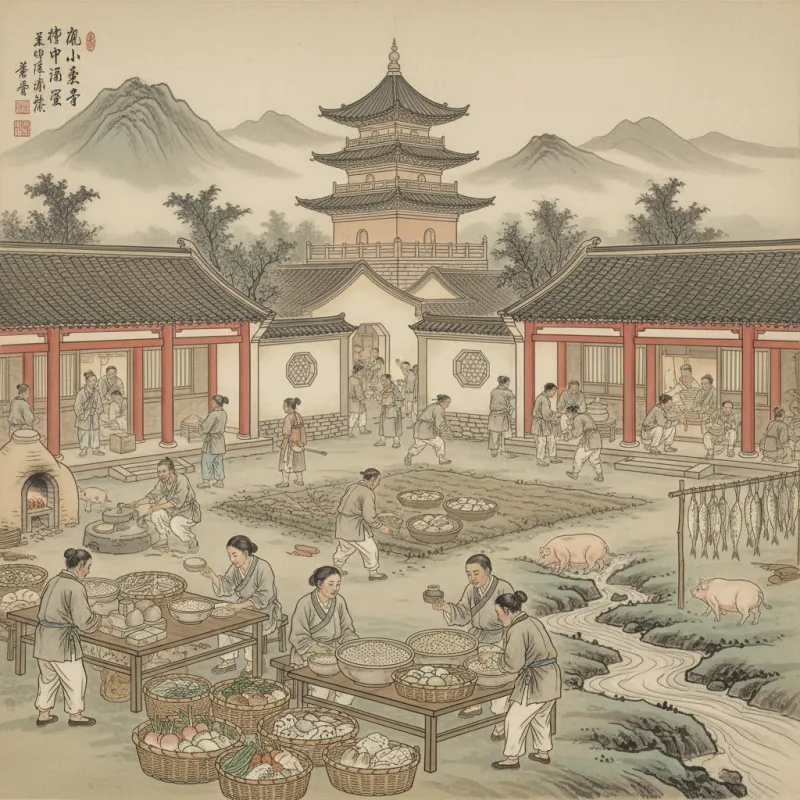
The next time you see a lavish spread of Peking duck, sweet and sour pork, and eight-treasure rice at a Chinese restaurant, remember this: for 4,000 years, almost nobody in China ate like that. Not even close.
Grain, Grain, and More Grain
Walk into a peasant household in Tang Dynasty China, and you'd find their entire diet summarized in one word: 粟 (sù) — foxtail millet. In the Yellow River valley, where Chinese civilization began, this humble grain dominated every meal. Rice, now synonymous with Chinese food, was a southern luxury that northern farmers rarely tasted.
The typical farmer ate millet porridge for breakfast. Then millet porridge for dinner. That was it — two meals a day, both centered on boiled grain. The Song Dynasty (960-1279 CE) introduced the radical innovation of three daily meals, but the content remained depressingly similar. As the agricultural manual Qimin Yaoshu (齐民要术) from 544 CE makes clear, the goal wasn't culinary variety but survival: maximize grain yield, minimize waste.
Southern farmers had it slightly better with rice, but "better" is relative. They ate rice porridge (粥, zhōu) so thin you could see your reflection in it. The phrase "adding water to make the porridge go further" appears repeatedly in historical records, a polite way of describing hunger.
The Meat Paradox
Here's something that puzzled me when I first studied Chinese food history: why does the character for "home" (家, jiā) literally show a pig under a roof? If pigs were so central to household identity, why do historical records show peasants eating meat only a few times per year?
The answer reveals the brutal economics of pre-modern agriculture. Yes, families raised pigs — but as living savings accounts, not food sources. A pig ate kitchen scraps and converted them into valuable protein and fat. But that pig was far too valuable to eat casually. You sold it for cash, or slaughtered it for New Year's, weddings, or ancestor worship. The rest of the year, you ate vegetables.
When Mencius (372-289 BCE) described his ideal society, he promised that "those who are seventy can eat meat." Seventy! That's how rare meat was — a reward for reaching old age. The Book of Rites (礼记, Lǐjì) specified that commoners could eat meat only during sacrificial ceremonies. Breaking this rule wasn't just rude; it was transgressive, a violation of cosmic order.
Even in the relatively prosperous Ming Dynasty (1368-1644), the average person consumed perhaps 5-10 pounds of meat per year. Compare that to modern China, where annual meat consumption exceeds 130 pounds per person. The difference isn't just quantitative — it's a completely different relationship with food.
Vegetables: The Actual Daily Diet
So what did people actually eat alongside their grain? Vegetables, but not the colorful stir-fries you're imagining. Think pickled cabbage, preserved radishes, and whatever greens survived the season.
Cabbage (白菜, báicài) was the undisputed king of Chinese vegetables, so important that families buried it in underground pits to survive winter. The phrase "half a year's cabbage" appears in northern folk songs — that's how long preserved cabbage had to last. Radishes, turnips, and gourds filled out the rotation.
Soybeans (大豆, dàdòu) provided crucial protein, but rarely as the tofu we know today. Tofu production required fuel, time, and skill — luxuries for most farmers. Instead, they ate fermented soybeans, soybean paste, and during desperate times, soybean leaves. The Bencao Gangmu (本草纲目), Li Shizhen's 1578 medical encyclopedia, lists dozens of ways to prepare soybeans, most of them designed to make the beans digestible and filling rather than delicious.
Wild vegetables supplemented cultivated crops. Shepherd's purse, amaranth, and various bitter greens appear constantly in local gazetteers. These weren't trendy foraged ingredients — they were famine foods that people ate when grain ran short. The line between "wild vegetable" and "weed" was mostly about desperation.
The Condiment That Made It Bearable
If you could bring one ingredient back from ancient China, make it 酱 (jiàng) — fermented soybean paste. This thick, salty, funky condiment was the secret weapon that made bland grain and vegetables edible.
Every household made jiàng, and every household's version tasted different. The basic process involved fermenting soybeans with salt, wheat, and time — lots of time. Good jiàng aged for months or years, developing complex umami flavors that transformed simple porridge into something approaching satisfying.
The importance of jiàng shows up in unexpected places. When Confucius listed things he wouldn't eat, he included "food without the proper jiàng." Not "without jiàng" — without the proper jiàng. Even the sage needed his condiments correctly matched to his dishes.
Salt itself was precious, often government-controlled and heavily taxed. The salt monopoly funded dynasties and sparked rebellions. When people couldn't afford salt, they couldn't make jiàng, and their food became almost inedible. This wasn't a minor inconvenience — it was a crisis that could topple governments.
When Disaster Struck
The line between "normal diet" and "famine diet" was terrifyingly thin. A bad harvest, a flood, a drought — any of these could push millions into starvation. And when that happened, people ate things that haunt the historical record.
The Jiuhuang Bencao (救荒本草), a 1406 manual on famine foods, catalogs 414 wild plants that could keep you alive. Some were nutritious. Many were barely digestible. The book includes preparation instructions like "boil three times, changing the water each time, to remove bitterness" — a polite way of saying "this might poison you otherwise."
Tree bark, grass roots, clay mixed with grain husks — these appear in famine accounts with numbing regularity. The phrase "易子而食" (yì zǐ ér shí), "exchanging children to eat," shows up in histories of severe famines. I won't elaborate. You understand.
This context makes the Chinese cultural obsession with food make sudden, terrible sense. When your grandparents survived famines, when your great-grandparents ate tree bark, when food security was never guaranteed — of course you develop elaborate food culture, preservation techniques, and rituals around eating. It's not just culture. It's trauma.
The Great Divergence
Something remarkable happened during the Song Dynasty (960-1279 CE). Agricultural productivity soared. New rice varieties from Champa (modern Vietnam) allowed double-cropping. Markets expanded. Cities grew. And for the first time, significant numbers of ordinary people began eating three meals a day, with some variety beyond grain and pickles.
This wasn't universal — peasants still struggled — but the gap between elite and common diets began to narrow. Restaurants appeared, serving workers and merchants. Street food culture emerged. The dishes we now consider "traditional Chinese cuisine" started taking recognizable form.
But here's what's crucial: this Song Dynasty transformation affected maybe 10-20% of the population, mostly urban. The vast majority of Chinese people continued eating simple grain-based diets until the 20th century. My own grandmother, born in 1920s rural Shandong, ate meat perhaps once a month until the 1980s. This isn't ancient history.
The elaborate regional cuisines, the sophisticated cooking techniques, the famous dishes — these existed, but they were elite culture. When we talk about "Chinese food history," we're usually talking about how the literate, wealthy minority ate and wrote about eating. The silent majority left fewer records, but they were the ones who actually fed China.
What This Means for Understanding Chinese Food
The next time someone romanticizes "traditional Chinese diet," ask which tradition they mean. The imperial banquet tradition? The scholar-official tradition? Or the tradition of making millet porridge stretch across two meals while saving your one pig for New Year's?
This matters because modern Chinese food culture carries both legacies. The reverence for ingredients, the "waste nothing" philosophy, the preservation techniques, the emphasis on texture over pure flavor — these come from centuries of scarcity, not abundance. The elaborate banquet culture, the regional pride, the sophisticated techniques — these come from the elite tradition that most people only glimpsed at festivals.
Understanding what ordinary people actually ate doesn't diminish Chinese culinary achievement. If anything, it makes it more impressive. Chinese cuisine developed its sophistication not despite scarcity but because of it. When you have limited ingredients, you get creative. When meat is rare, you learn to make vegetables sing. When fuel is expensive, you develop quick cooking methods like stir-frying.
The food on your table tonight, whether you're in Beijing or Brooklyn, carries echoes of both traditions — the peasant's ingenuity and the emperor's excess. But for most of history, for most people, Chinese food was simple, grain-based, and designed for one purpose: survival.
That's not the story we usually tell. But it's the one that fed a civilization.
Related Reading
- Daily Life in Ancient China: What Ordinary People Actually Did All Day
- The Imperial Examination: The World's First Standardized Test
- What Did Ancient Chinese People Eat? A Dynasty-by-Dynasty Food History
- Ancient Chinese Fashion: What People Really Wore Through the Dynasties
- Famous Trials That Changed Chinese Law
- Unveiling the Splendor of Ancient Chinese Architecture Across Dynasties
- Exploring the Rich Tapestry of Ancient Chinese History and Culture