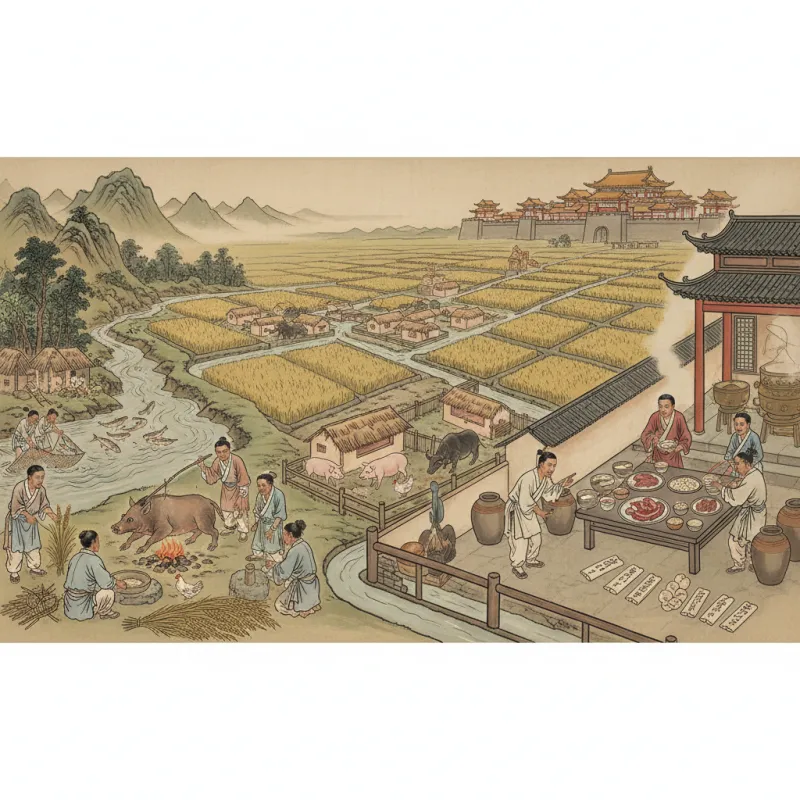
Picture a Zhou Dynasty nobleman sitting down to dinner in 800 BCE. His servants bring out steamed millet, a bowl of fermented vegetables, and if he's lucky, a small portion of dog meat. No rice — that's still a southern luxury. No soy sauce — it won't be invented for another few centuries. No tea — that's considered medicine, not a beverage. The meal that defined "Chinese food" for this aristocrat would be almost unrecognizable to anyone familiar with Chinese cuisine today.
The Neolithic Foundation: Millet, Not Rice
Here's what most people get wrong: ancient Chinese civilization wasn't built on rice. It was built on millet. Two types, actually — 粟 (sù, foxtail millet) and 黍 (shǔ, broomcorn millet). Archaeological evidence from sites like Cishan and Peiligang shows that northern Chinese communities were cultivating millet as early as 8,000 BCE, thousands of years before rice cultivation became widespread.
Rice was a southern crop, grown in the Yangtze River valley, and it took centuries for it to spread north. During the Shang Dynasty (1600-1046 BCE), oracle bone inscriptions mention both millet and rice, but millet remained the staple grain for the Yellow River civilizations that formed the political and cultural core of early China. The wealthy ate refined millet cakes. The poor ate millet porridge. Everyone ate millet.
The early Chinese also cultivated wheat and barley, introduced from Central Asia around 2500 BCE, but these grains initially played supporting roles. Wheat wouldn't become a major staple until much later, when the technology for grinding it into flour and making noodles developed during the Han Dynasty.
Zhou to Han: The Age of Fermentation
By the Zhou Dynasty (1046-256 BCE), Chinese cuisine had developed its first sophisticated preservation techniques. Without refrigeration, fermentation became essential. The character 醢 (hǎi) appears frequently in Zhou texts, referring to fermented meat and fish pastes that served as condiments. These weren't delicate seasonings — they were pungent, funky, and absolutely crucial for adding flavor to bland grain-based meals.
The Zhou aristocracy ate meat, but not as much as you'd think. Ritual texts like the 礼记 (Lǐjì, Book of Rites) describe elaborate banquets featuring the "eight delicacies," including dishes like roasted suckling pig and turtle soup, but these were ceremonial foods for special occasions. Daily meals for even wealthy families centered on grains, with small amounts of meat or fish as flavoring rather than the main event.
Vegetables were limited to what could be grown locally: gourds, various types of cabbage, bamboo shoots, and wild greens. The Chinese had mastered pickling and fermentation techniques that would later evolve into dishes like 泡菜 (pàocài, pickled vegetables) and the precursors to modern 酸菜 (suāncài, sour cabbage).
The Han Dynasty (206 BCE - 220 CE) marked a turning point. This was when 酱 (jiàng), fermented soybean paste, first appeared — the ancestor of modern soy sauce. The Han also saw the introduction of new crops through Silk Road trade: grapes, pomegranates, sesame, and coriander all arrived during this period. Zhang Qian's famous diplomatic missions to Central Asia in the 2nd century BCE didn't just open trade routes for silk; they fundamentally transformed Chinese agriculture and cuisine.
Tang Dynasty: When Chinese Food Got Interesting
The Tang Dynasty (618-907 CE) was when Chinese cuisine started resembling something modern eaters might recognize. This was the golden age of Chinese cosmopolitanism, when Chang'an (modern Xi'an) was the world's largest city and foreign merchants brought ingredients, cooking techniques, and culinary ideas from across Asia.
Dairy products, rare in earlier Chinese cuisine, became fashionable among the Tang elite. 酥 (sū), a type of butter or ghee, appears in Tang poetry and medical texts. The Tang aristocracy developed a taste for 酪 (lào, yogurt-like fermented milk products), influenced by contact with Turkic and Mongolian peoples. This dairy enthusiasm didn't last — later dynasties would largely abandon these foods, and lactose intolerance would become the norm among Han Chinese populations.
Tea drinking transformed from a medicinal practice to a social ritual during the Tang. Lu Yu's 茶经 (Chájīng, The Classic of Tea), written around 760 CE, codified tea preparation into an art form. But Tang-era tea was nothing like modern tea — they ground tea leaves into powder, mixed it with salt, ginger, and other ingredients, and boiled it into a thick, soup-like beverage.
The Tang also saw significant advances in cooking technology. Better iron production meant more households could afford metal cooking vessels. Steaming, boiling, and roasting remained the primary cooking methods, but the groundwork was being laid for the stir-frying revolution that would come later.
Song Dynasty: The Stir-Fry Revolution
The Song Dynasty (960-1279 CE) was when Chinese cooking techniques made their great leap forward. This wasn't about new ingredients — it was about new methods. The widespread availability of cheap iron woks, combined with better fuel efficiency from improved stove designs, made high-heat cooking accessible to ordinary families for the first time.
Stir-frying — 炒 (chǎo) — emerged as the defining Chinese cooking technique during this period. It was fast, fuel-efficient, and perfect for the increasingly urbanized Song society where people lived in crowded cities and couldn't spend hours tending cooking fires. The technique also preserved the texture and color of vegetables better than boiling or steaming, creating dishes that were more visually appealing and texturally diverse.
Song cities like Kaifeng and Hangzhou developed China's first true restaurant culture. The 东京梦华录 (Dōngjīng Mènghuá Lù, Dreams of Splendor of the Eastern Capital) describes the food scene in Kaifeng with mouthwatering detail: restaurants specializing in different regional cuisines, street food vendors selling snacks at all hours, and a level of culinary sophistication that wouldn't be matched in Europe for centuries.
Rice finally overtook millet as China's primary staple during the Song, thanks to new fast-ripening rice varieties introduced from Southeast Asia. These varieties allowed two or even three harvests per year in southern China, dramatically increasing food production and supporting population growth. For more on how daily life evolved during this transformative period, see Ancient Chinese Housing: From Caves to Courtyard Homes.
Yuan to Ming: The Mongolian Interlude and American Arrivals
The Mongol conquest brought the Yuan Dynasty (1271-1368 CE) and another wave of culinary influence from the steppes. Mongolian preferences for meat, dairy, and simple preparation methods influenced northern Chinese cuisine. Lamb and mutton, which had been relatively uncommon in Han Chinese cooking, became more prominent. The Mongols also introduced distilled liquor — 烧酒 (shāojiǔ, literally "burned wine") — which would eventually evolve into modern 白酒 (báijiǔ).
But the real revolution came during the Ming Dynasty (1368-1644 CE), when the Columbian Exchange brought New World crops to China. Chili peppers arrived in the 16th century and within a few generations had become integral to Sichuan and Hunan cuisines. Imagine: the dishes that define these regions today — 麻婆豆腐 (Mápó Dòufu, Mapo Tofu), 宫保鸡丁 (Gōngbǎo Jīdīng, Kung Pao Chicken) — couldn't have existed before 1570 or so.
Tomatoes, potatoes, corn, sweet potatoes, peanuts, and tobacco all arrived during the Ming. Sweet potatoes in particular became crucial for feeding China's growing population, as they could be grown on marginal land unsuitable for rice or wheat. By the Qing Dynasty, these American crops had become so thoroughly integrated into Chinese agriculture that many people assumed they were native.
What the Common People Actually Ate
All this talk of dynasty-by-dynasty culinary evolution obscures a harsh reality: for most of Chinese history, most Chinese people ate a monotonous diet that hovered just above subsistence level. The elaborate dishes described in historical texts and the sophisticated restaurant culture of Song cities were enjoyed by a tiny elite.
The typical peasant family ate grain — millet in the north, rice in the south — for breakfast, lunch, and dinner. A little pickled vegetable. Maybe some wild greens gathered from the roadside. Meat a few times a year, during festivals. Cooking oil was expensive, so most food was boiled or steamed. Protein came from soybeans, processed into 豆腐 (dòufu, tofu), which was invented during the Han Dynasty and became the poor person's meat substitute.
Famine was a constant threat. Chinese historical records document hundreds of famines, some killing millions. During the worst famines, people ate tree bark, grass, and clay. The Chinese term 易子而食 (yì zǐ ér shí, "exchanging children to eat") appears in famine accounts, a euphemism too horrible to translate directly.
This context matters when we talk about Chinese food history. The cuisine celebrated today — the regional specialties, the elaborate preparation techniques, the diverse ingredients — represents the accumulated knowledge of millennia, but also the luxury of living in an era of relative abundance that most of our ancestors never experienced.
The Regional Cuisines Emerge
The concept of distinct regional Chinese cuisines — 菜系 (càixì) — is actually quite modern, mostly codified during the Qing Dynasty (1644-1912 CE) and Republican era. But the regional differences they describe have much deeper roots.
Southern Chinese cuisine, centered on Guangdong, developed around abundant seafood, rice, and a climate that allowed year-round vegetable cultivation. The Cantonese saying "we eat everything with four legs except tables, and everything that flies except airplanes" reflects a culinary culture that prized freshness and diversity.
Sichuan cuisine's famous heat comes from the marriage of New World chili peppers with native 花椒 (huājiāo, Sichuan peppercorn), creating the distinctive 麻辣 (málà, numbing-spicy) flavor profile. But Sichuan's culinary sophistication predates the chili pepper — the region's humid climate and abundant salt production had already created a culture of complex flavoring and preservation techniques.
Northern cuisines, shaped by wheat cultivation and colder climates, developed around noodles, dumplings, and preserved foods. The northern preference for stronger, saltier flavors reflects both climate (you need more salt when you sweat less) and the historical importance of preserved foods during long winters.
Eastern coastal cuisines, particularly around Jiangsu and Zhejiang, emphasized freshwater fish, delicate seasonings, and precise knife work. This was the cuisine of the scholar-official class, refined and subtle, where the quality of ingredients mattered more than bold flavoring. Understanding these regional variations helps explain the diversity of Ancient Chinese Clothing Styles Across Different Regions.
The Meal That Built a Civilization
Chinese food history isn't just about what people ate — it's about how food shaped Chinese civilization. The labor-intensive nature of rice cultivation required cooperation and created the foundation for China's emphasis on collective social organization. The importance of grain storage and distribution made hydraulic engineering and bureaucratic administration essential, driving the development of the imperial state.
The Chinese approach to food — emphasizing balance, medicinal properties, and the relationship between diet and health — reflects deeper philosophical traditions. The concept of 食疗 (shíliáo, food therapy), the idea that food and medicine share the same source, has roots in texts like the 黄帝内经 (Huángdì Nèijīng, Yellow Emperor's Inner Canon) from the Han Dynasty.
Today's Chinese cuisine, in all its regional diversity and global popularity, represents thousands of years of agricultural innovation, cultural exchange, and culinary creativity. But it also represents something more fundamental: the human drive to transform necessity into art, to take the basic requirement of eating and elevate it into one of life's great pleasures. The ancient Chinese, working with limited ingredients and simple tools, understood this. Every bowl of millet, every fermented vegetable, every carefully prepared festival meal was an act of civilization-building, one bite at a time.
Related Reading
- Daily Life in Ancient China: What Ordinary People Actually Did All Day
- The Imperial Examination: The World's First Standardized Test
- Ancient Chinese Fashion: What People Really Wore Through the Dynasties
- What Ordinary People Ate in Ancient China (It Was Not What You Think)
- 10 Ways Ancient China Changed the Modern World
- Crime and Punishment in Imperial China
- The Ming Dynasty: Zheng He and China's Age of Exploration