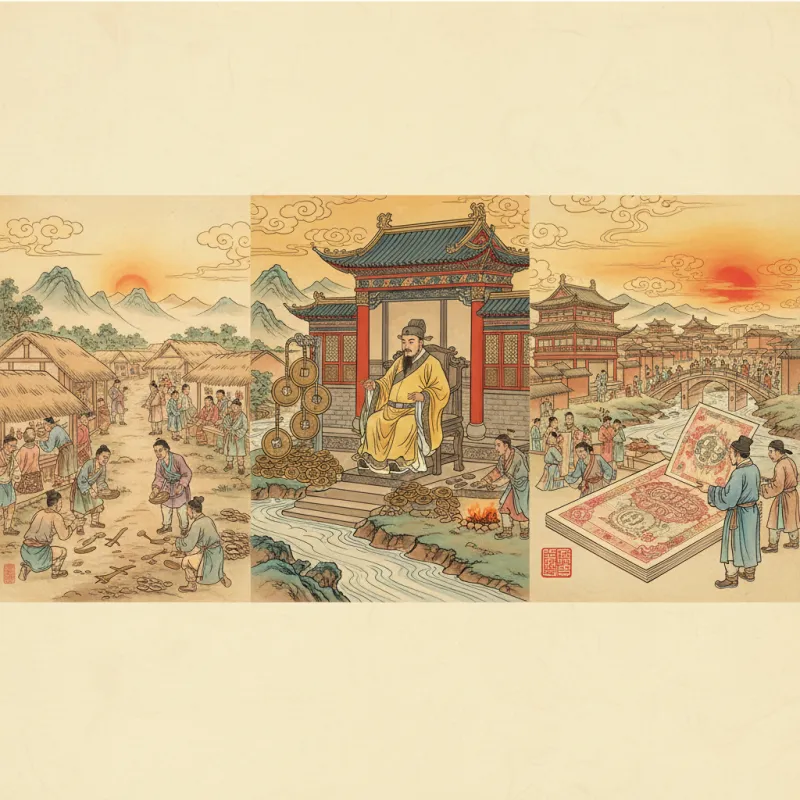
A merchant in 11th-century Sichuan province faces a problem: he needs to transport payment for a shipment of tea across hundreds of miles of bandit-infested roads. His payment weighs over 500 pounds — not in silver, but in iron coins. The solution his government offers him seems like magic: a piece of printed paper that represents his money, redeemable at his destination. He's holding the world's first paper currency, and Europe won't figure this out for another 700 years.
Cowrie Shells: China's First Universal Currency
Long before the Shang Dynasty (商朝 Shāng Cháo, c. 1600–1046 BCE) minted anything resembling a coin, cowrie shells served as China's primary medium of exchange. These weren't random shells picked up from any beach — they were specific species of Monetaria moneta and Monetaria annulus, imported from distant tropical waters of the Indian Ocean and South China Sea. Their appeal was practical: naturally standardized in size, difficult to counterfeit, durable enough to survive years of handling, and beautiful enough to be desirable.
The linguistic legacy of cowrie currency runs deep in Chinese. The character 貝 (bèi), a pictograph of a cowrie shell, appears in nearly every Chinese word related to wealth, trade, and value: 財 (cái, wealth), 貨 (huò, goods), 購 (gòu, to purchase), 貧 (pín, poor), and 貴 (guì, expensive). Even today, when Chinese speakers write about money, they're unconsciously referencing a monetary system that predates the pyramids of Giza.
Archaeological evidence from Shang Dynasty tombs reveals the scale of cowrie wealth. Elite burials contain thousands of shells, with some tombs holding over 6,000 cowries. By the late Shang period, demand outstripped supply so dramatically that craftsmen began producing imitation cowries from bone, stone, and bronze — perhaps history's first counterfeiting crisis.
Bronze Money: Spades, Knives, and Circles
The transition from shells to metal currency during the late Zhou Dynasty (周朝 Zhōu Cháo, 1046–256 BCE) produced some of the strangest-looking money ever created. Rather than jumping straight to round coins, Chinese states minted bronze currency shaped like the tools and weapons of daily life.
Spade money (布币 bù bì) dominated the central plains, taking the form of miniature agricultural spades with a hollow handle and flat blade. These weren't symbolic — they evolved from actual bronze spades that had served as valuable trade goods. Over time, they shrank and stylized, becoming purely monetary objects inscribed with the name of the issuing state or city. The state of Qin alone produced dozens of varieties, each slightly different in size and weight.
Knife money (刀币 dāo bì) circulated primarily in the eastern states of Qi and Yan. These bronze pieces, shaped like small knives with a ring at the handle, bore inscriptions indicating their place of origin and sometimes their value. The most prized specimens today are the "Ming knives" (明刀 míng dāo) from the state of Yan, named for the character 明 prominently cast on their blades.
But the real innovation came with round coins pierced by a square hole — a design that would dominate Chinese currency for over 2,000 years. The state of Qin standardized these "cash coins" (方孔钱 fāng kǒng qián) during its unification of China in 221 BCE. The round shape represented heaven, the square hole represented earth, and the practical benefit was undeniable: you could string hundreds of coins together on a cord for easy transport and counting. The standard string held 1,000 coins, called a guàn (贯).
Imperial Standardization and the Cash Coin Dynasty
When Emperor Qin Shi Huang (秦始皇 Qín Shǐ Huáng) unified China, he didn't just standardize the writing system and measurements — he revolutionized currency. The bàn liǎng (半两) coin, weighing half a Chinese ounce, became the empire's sole legal tender. Every other form of currency — spades, knives, cowries — was abolished. This monetary unification was as important as building the Great Wall; it created a truly national economy for the first time in Chinese history.
The Han Dynasty (汉朝 Hàn Cháo, 206 BCE–220 CE) refined this system with the wǔ zhū (五铢) coin, literally "five grains," referring to its weight. This coin was so successful that it remained in production, with interruptions, for over 700 years — one of the longest-running currency designs in human history. The wǔ zhū's longevity speaks to its practical design: heavy enough to have real value, light enough for everyday transactions, and standardized enough to prevent easy counterfeiting.
But the cash coin system had a fundamental problem: it required enormous quantities of copper. During the Tang Dynasty (唐朝 Táng Cháo, 618–907 CE), the government operated 99 mints producing millions of coins annually, yet chronic shortages persisted. Merchants hoarded copper coins, melted them down for bronze work, or exported them to neighboring countries where they were worth more. The Silk Road trade networks drained Chinese copper across Asia, with Tang coins found as far west as East Africa.
The Paper Money Revolution
The invention of paper money wasn't a sudden breakthrough — it emerged from practical necessity in Song Dynasty (宋朝 Sòng Cháo, 960–1279 CE) Sichuan, where the government minted iron coins instead of copper. Iron coins were worth so little that buying a single bolt of silk required carrying dozens of pounds of metal. Merchants developed a workaround: they deposited their iron coins with trusted agents and received paper certificates of deposit called jiāozǐ (交子).
By 1024 CE, the Song government recognized the genius of this system and took it over, issuing the world's first government-backed paper currency. The notes were sophisticated for their time: printed with multiple colors and intricate designs to prevent counterfeiting, stamped with official seals, and redeemable for copper or iron coins at government offices.
The innovation spread rapidly. By the 13th century, the Yuan Dynasty (元朝 Yuán Cháo, 1271–1368 CE) under Kublai Khan operated an entirely paper-based monetary system. Marco Polo, visiting China in the 1270s, was astounded. He devoted an entire chapter of his travels to describing how the Great Khan "causes the bark of trees, made into something like paper, to pass for money all over his country." Europeans reading his account thought he was lying or delusional — the idea of paper money seemed like alchemy.
But the Yuan Dynasty's paper money experiment revealed the dark side of fiat currency: inflation. With no commodity backing and no restraint on printing, the government issued more and more notes to fund military campaigns and palace construction. By the 1350s, Yuan paper money had lost over 90% of its value. The resulting economic chaos contributed to the dynasty's collapse.
The Ming Retreat and Qing Conservatism
The Ming Dynasty (明朝 Míng Cháo, 1368–1644 CE), having witnessed the Yuan's paper money disaster, initially attempted their own paper currency called dà míng bǎo chāo (大明宝钞, "Great Ming Treasure Note"). But they repeated the same mistakes: overprinting, no commodity backing, and mandatory acceptance laws that merchants evaded whenever possible. By the mid-15th century, the Ming government quietly abandoned paper money and returned to silver and copper coins.
This retreat from paper currency lasted for centuries. The Qing Dynasty (清朝 Qīng Cháo, 1644–1912 CE) operated primarily on a bimetallic system of silver ingots for large transactions and copper cash coins for daily purchases. Silver flowed into China through maritime trade with European merchants, creating a complex exchange rate system between silver taels and copper cash that fluctuated with market conditions.
The Qing system worked reasonably well until the 19th century, when massive silver outflows to pay for opium imports created a currency crisis. The government's inability to manage this crisis — combined with military defeats and internal rebellions — ultimately contributed to the dynasty's fall and China's tumultuous transition to modernity.
Legacy: From Ancient Innovation to Modern Finance
China's monetary history reveals a pattern of bold innovation followed by conservative retreat. The same culture that invented paper money in the 11th century abandoned it by the 15th, returning to metal coins for another 400 years. The same government that created sophisticated credit instruments and banking networks also imposed rigid controls that stifled financial development.
Yet the innovations endured. The concept of paper money, once dismissed by Europeans as Chinese fantasy, became the foundation of modern finance. The cash coin's design — round with a square hole — influenced currency design across East Asia, from Japan to Vietnam. Even the linguistic legacy persists: when modern Chinese speakers discuss cryptocurrency or digital payments, they still use characters derived from cowrie shells.
The archaeological record continues to surprise us. In 2016, researchers discovered a Song Dynasty paper money printing plate in Sichuan — physical evidence of the world's first paper currency production. In 2019, a hoard of over 2 million Tang Dynasty coins was unearthed in Jiangxi province, still strung together on their original cords after 1,200 years.
Perhaps the most remarkable aspect of ancient Chinese currency isn't any single innovation, but the sheer duration and scale of monetary experimentation. From cowrie shells to paper notes, from spade money to silver taels, Chinese civilization spent three millennia developing, refining, and sometimes abandoning monetary technologies. Some experiments failed spectacularly. Others succeeded beyond imagination, shaping the financial systems we use today.
That merchant in 11th-century Sichuan, clutching his paper certificate instead of 500 pounds of iron coins, was participating in a revolution he couldn't fully comprehend. He was holding the future of money itself — even if it would take the rest of the world seven centuries to catch up.
Related Reading
- The Grand Canal: China Greatest Engineering Project
- The Porcelain Trade: How Chinese Pottery Conquered the World
- Chinese Porcelain: The Luxury Good That Changed World Trade
- The Tea Trade: How a Chinese Plant Reshaped the World
- What Ordinary People Ate in Ancient China (It Was Not What You Think)
- Exploring Ancient Agricultural Practices in Chinese Dynasties
- Ancient Chinese Law: When Justice Was Personal and Punishment Was Public