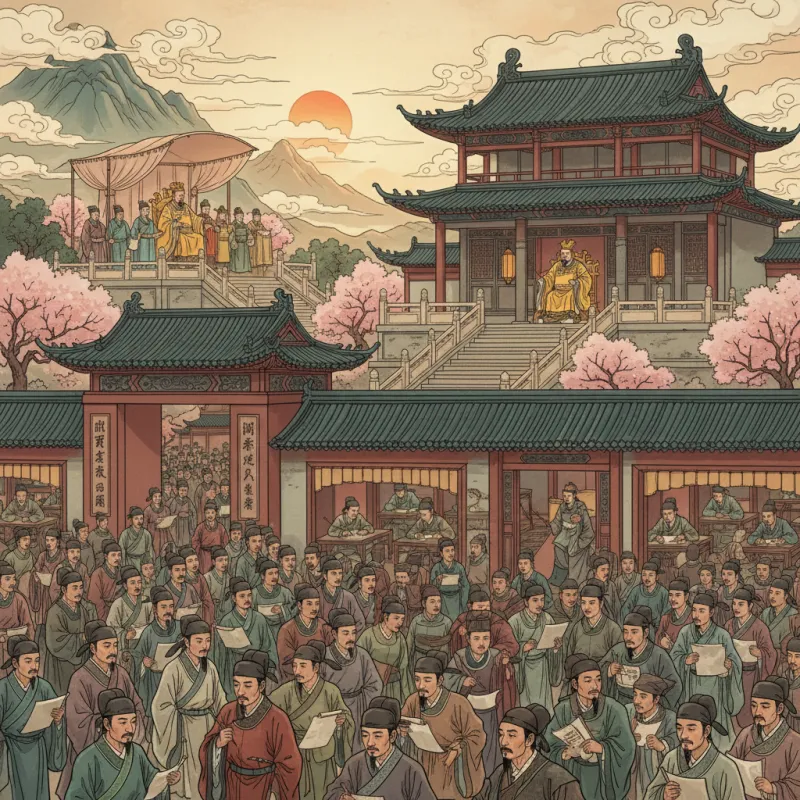
For over a thousand years, the fate of China's brightest minds hinged on three days locked in a tiny cell, armed with nothing but a brush, ink, and the weight of their family's hopes. The Imperial Examination system, or Keju (科举, kējǔ), wasn't just a test—it was the most ambitious social experiment in human history, a mechanism that promised any peasant's son could theoretically become a minister if he could master the Confucian classics and compose the perfect eight-legged essay.
The Revolutionary Promise
When Emperor Wen of Sui established the first iteration of the examination system in 587 CE, he did something radical: he suggested that merit, not bloodline, should determine who governed the empire. This wasn't entirely altruistic—the Sui emperors needed to break the stranglehold of aristocratic families who had dominated politics for centuries. But the implications were staggering. In medieval Europe, a peasant had about as much chance of becoming a duke as a fish had of climbing a tree. In China, that same peasant could, in theory, study his way into the imperial court.
The system truly crystallized during the Tang Dynasty (618-907 CE), when Empress Wu Zetian—China's only female emperor and a woman who understood power politics better than most—expanded the examinations dramatically. She knew that scholars who owed their positions to her reforms would be more loyal than hereditary aristocrats. The Song Dynasty (960-1279 CE) perfected the machinery: standardized testing procedures, anonymous grading to prevent favoritism, and multiple levels of examinations that filtered candidates from county to provincial to palace levels.
The Grueling Reality
The romantic notion of meritocracy crashes hard against the brutal reality of the examination experience. Candidates spent years, often decades, memorizing the Four Books and Five Classics, the foundational texts of Confucianism. We're talking about hundreds of thousands of characters committed to memory—not just rote memorization, but deep understanding that allowed candidates to quote passages, analyze meanings, and compose essays in the rigid baguwen (八股文, bāgǔwén) or "eight-legged essay" format.
The provincial and metropolitan examinations took place in examination compounds that resembled prisons more than schools. Each candidate occupied a cell roughly three feet wide and four feet deep—barely enough room to sit, stand, or lie down. They remained there for three days and two nights, producing essays under the watchful eyes of guards. Cheating was rampant despite draconian punishments. Candidates smuggled in tiny books written on silk underwear, hired ringers to take tests in their place, or bribed corrupt officials. Some examination cells still stand in places like Nanjing, and visiting them today evokes a claustrophobic dread.
The statistics tell a sobering story. During the Ming and Qing dynasties, pass rates for the highest level jinshi (进士, jìnshì) degree hovered around 1-2%. Thousands of men took the examinations repeatedly throughout their lives, growing old in pursuit of a dream that would never materialize. The Chinese literary canon is filled with bitter examination failures—Pu Songling, author of the supernatural classic Strange Tales from a Chinese Studio, failed the provincial examination repeatedly and channeled his frustration into stories about fox spirits and wronged scholars.
The Social Earthquake
Despite its flaws, the Keju system fundamentally restructured Chinese society. It created a scholar-official class, the shidafu (士大夫, shìdàfū), whose identity centered on literary cultivation and Confucian ethics rather than martial prowess or inherited titles. This had profound consequences. Unlike European nobility who glorified warfare, Chinese elites idealized the refined scholar who could compose poetry, practice calligraphy, and debate philosophical texts.
The examination system also created China's first true national culture. A scholar in Guangdong and a scholar in Beijing studied the same texts, wrote in the same style, and shared the same cultural references. This unified elite culture helped hold together an empire of staggering diversity. When you read about the Confucian values that shaped Chinese civilization, you're really reading about values that the examination system drilled into generations of officials.
But let's not romanticize this too much. The system was never truly meritocratic. Preparing for the examinations required years of study, which meant families needed wealth to support a non-working son. Poor families occasionally pooled resources to sponsor a promising boy, but the system heavily favored the already-privileged. Women were entirely excluded—though some, like the poet Xue Tao of the Tang Dynasty, demonstrated that female scholars could match or exceed their male counterparts if given the chance.
The Intellectual Straitjacket
By the Ming Dynasty (1368-1644 CE), the examination system had calcified into something its founders might not have recognized. The eight-legged essay format became so rigid that it strangled creativity. Essays had to follow a precise structure: opening, amplification, preliminary exposition, initial argument, central argument, final argument, and conclusion. Deviation meant failure. The content focused almost exclusively on interpreting Confucian texts according to the orthodox commentaries of Zhu Xi, a Song Dynasty philosopher whose neo-Confucian synthesis became the only acceptable framework.
This intellectual monoculture had costs. While Europe experienced the Scientific Revolution, Chinese scholars were perfecting their calligraphy and debating the finer points of ritual propriety. Practical knowledge—mathematics, engineering, medicine—carried little prestige because it wasn't tested. The examination system created brilliant literary scholars but did little to encourage the technical innovation that would prove crucial in the modern era.
The System's Collapse and Legacy
The Qing Dynasty (1644-1912 CE) maintained the examination system even as China faced unprecedented challenges from Western imperialism. Reformers recognized that training officials to write eight-legged essays about Confucian virtue wasn't preparing them to negotiate with British gunboats or understand industrial technology. The system was finally abolished in 1905, a victim of China's desperate modernization efforts.
Yet the examination system's ghost haunts China to this day. The modern gaokao (高考, gāokǎo), China's college entrance examination, echoes the old Keju in its high stakes, its emphasis on memorization, and its promise of social mobility through academic achievement. Millions of Chinese students still spend years preparing for a single test that will determine their futures. The pressure is immense, the competition brutal, and the belief that education is the path to success remains deeply embedded in Chinese culture.
The Imperial Examination system was never the pure meritocracy it claimed to be. It excluded women, favored the wealthy, and enforced intellectual conformity. But it also represented something remarkable: a millennium-long commitment to the idea that governance should be entrusted to the educated rather than the well-born. In a world where most societies handed power to whoever had the sharpest sword or the most prestigious ancestors, China tried something different. The experiment had profound flaws, but it shaped one of history's most enduring civilizations and left a legacy that continues to influence how Chinese society thinks about education, merit, and opportunity.
Related Reading
- The Silk Road: Bridge Between East and West
- Confucius: Teachings That Shaped a Civilization
- Ancient Chinese Fashion: What People Really Wore Through the Dynasties
- Delving into Ancient China: A Journey Through Dynasties, Emperors, and Cultural Treasures
- Chinese Calligraphy: The Art of Writing as High Culture