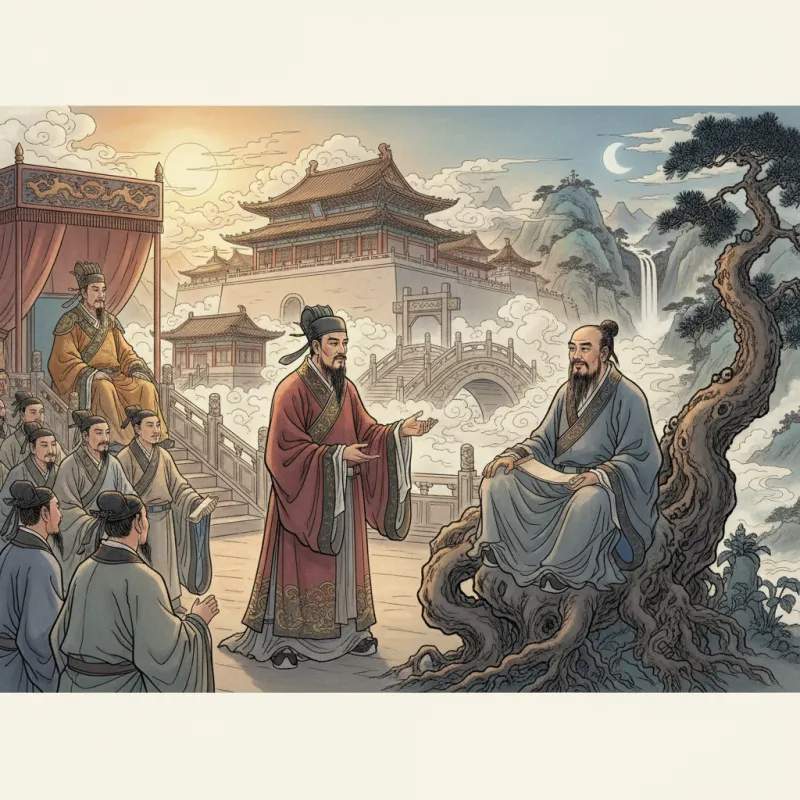
Two old men meet on a dusty road in ancient China. One believes civilization can be saved through education and ritual. The other thinks civilization itself is the disease. Their conversation — if it even happened — would become one of the most consequential philosophical debates in human history, shaping how a quarter of humanity would think about government, morality, and the meaning of a good life for the next 2,500 years.
This is the story of Confucius versus Laozi, and why their disagreement still matters.
The Chaos That Made Them
To understand why these two men thought so differently, you need to picture the world they lived in. The Spring and Autumn period (春秋时代 Chūnqiū Shídài, 770-476 BCE) was a time when the old certainties were dying. The Zhou dynasty (周朝 Zhōu Cháo) still technically ruled, but its power was a polite fiction. Real authority had fractured into dozens of warring states, each with its own army, its own ambitions, and its own ideas about legitimacy.
Confucius (孔子 Kǒngzǐ, 551-479 BCE) watched this chaos and concluded that what China needed was a return to order — not through military conquest, but through moral education and the restoration of proper social relationships. He spent years wandering from court to court, trying to convince rulers to adopt his vision of ethical governance. Mostly, they ignored him.
Laozi (老子 Lǎozǐ), if he existed as a historical figure at all, looked at the same chaos and reached the opposite conclusion. The problem wasn't that people had abandoned the old ways. The problem was that they'd invented "ways" in the first place. All these rules, hierarchies, and moral systems were artificial constructs that separated humans from their natural state. The solution wasn't more civilization — it was less.
Confucius: The Architecture of Virtue
Confucius believed in structure. Not the rigid, oppressive kind, but something more like the framework of a well-designed building — necessary, supportive, and ultimately liberating because it allows you to do things you couldn't do otherwise.
His system rested on a few key concepts. First, ren (仁 rén), often translated as "benevolence" or "humaneness," but really meaning something closer to "becoming fully human through ethical relationships." You couldn't cultivate ren alone on a mountain. You needed other people, and you needed to treat them right.
Second, li (礼 lǐ) — ritual, propriety, the proper way of doing things. This is the part of Confucianism that modern readers often find suffocating. All those rules about bowing, about who sits where, about how to conduct a funeral or a wedding. But Confucius didn't see li as arbitrary etiquette. He saw it as a technology for encoding wisdom. When you perform a ritual correctly, you're not just going through motions — you're embodying values that took generations to refine.
Third, xiao (孝 xiào) — filial piety, the duty children owe to parents. This was the foundation of Confucian social order. If people learned to respect their parents, they'd learn to respect their teachers, their rulers, and ultimately the entire social hierarchy. The family was a training ground for citizenship.
The Confucian vision was fundamentally optimistic about human potential. Anyone could become a junzi (君子 jūnzǐ), a "gentleman" or "superior person," through education and self-cultivation. You weren't born into virtue — you built it, brick by brick, through study, practice, and constant self-examination. The Analects (论语 Lúnyǔ), the collection of Confucius's sayings compiled by his disciples, reads like a manual for this construction project.
Laozi: The Wisdom of Water
Laozi's Daodejing (道德经 Dàodéjīng), the foundational text of Daoism, reads like a deliberate inversion of everything Confucius stood for. Where Confucius built systems, Laozi dissolved them. Where Confucius prescribed action, Laozi recommended wuwei (无为 wúwéi) — often translated as "non-action," but better understood as "action without forcing."
The central concept is dao (道 dào) — "the Way." But unlike Confucius's way, which was a path you could learn and follow, Laozi's Dao was something more fundamental and less graspable. It was the pattern underlying all patterns, the source from which everything flows. "The Dao that can be spoken is not the eternal Dao," the Daodejing begins, immediately establishing that we're dealing with something beyond language and logic.
Laozi loved paradoxes. The softest thing in the world (water) overcomes the hardest (stone). The greatest fullness seems empty. The highest virtue doesn't try to be virtuous. These weren't just poetic flourishes — they were attempts to point toward a different way of understanding reality, one that recognized the limitations of human knowledge and the dangers of human ambition.
The Daoist critique of Confucianism was devastating in its simplicity: all your rules and rituals are the problem. When you create a concept of "virtue," you simultaneously create "vice." When you establish hierarchies, you create resentment. When you try to improve people through education, you make them self-conscious and artificial. The more you try to fix things, the more you break them.
Better to be like water, which doesn't try to be anything but itself, yet accomplishes everything. Better to be like an uncarved block (pu 朴 pǔ), retaining your original simplicity rather than being shaped into something "useful" by society's demands.
The Legendary Meeting
Did Confucius and Laozi actually meet? The historical evidence is thin, but the story is too good not to tell. According to Records of the Grand Historian (史记 Shǐjì) by Sima Qian (司马迁 Sīmǎ Qiān), Confucius traveled to Luoyang to consult Laozi about ritual matters. Laozi, who supposedly worked as the keeper of the Zhou dynasty archives, was unimpressed.
"The men you talk about are long dead, and their bones have turned to dust," Laozi allegedly told Confucius. "Only their words remain. When a gentleman's time comes, he rides in a carriage; when his time is past, he makes his way as best he can. I have heard that a good merchant hides his wealth and appears to have nothing, and that a gentleman of perfect virtue appears to be a fool. Get rid of your pride and your many desires, your affected manner and your excessive ambitions. These are of no use to you."
Confucius reportedly left shaken, telling his disciples: "I know that birds can fly, fish can swim, and animals can run. But for the runner there are traps, for the swimmer nets, and for the flyer arrows. As for the dragon, I cannot know how it rides the wind and clouds into heaven. Today I have seen Laozi, and he is like a dragon."
Whether this meeting happened or not, the story captures something true about the relationship between these two philosophical traditions. Confucianism was comprehensible, practical, teachable. Daoism was elusive, paradoxical, resistant to systematization. One was a ladder you could climb; the other was a cloud you could only point at.
How China Chose Both
Here's what's fascinating: China never really chose between them. Instead, Chinese civilization developed a kind of philosophical ambidexterity, using Confucianism for public life and Daoism for private retreat.
During the Han dynasty (汉朝 Hàn Cháo, 206 BCE - 220 CE), Emperor Wu (汉武帝 Hàn Wǔdì) made Confucianism the official state ideology. The civil service examination system, which would last for two millennia, was based on Confucian texts. If you wanted power, prestige, or influence, you studied the Analects and the other Confucian classics. You learned to write in the formal, allusive style that demonstrated your mastery of the tradition. You internalized the values of hierarchy, duty, and social harmony.
But when those same officials retired — or when they were exiled, which happened frequently in the dangerous game of court politics — many turned to Daoism. They wrote poetry about mountains and rivers, practiced meditation, and cultivated the art of wuwei. The same person who spent decades enforcing Confucian order might spend their final years as a Daoist recluse, drinking wine and writing about the futility of human ambition.
This wasn't hypocrisy. It was a recognition that different situations call for different approaches. As the saying went: "Confucian in office, Daoist in retirement." Or as the scholar Fung Yu-lan put it, Confucianism taught you how to live in society, while Daoism taught you how to transcend it.
The tension between these two philosophies shows up everywhere in Chinese culture. In landscape painting, where tiny human figures are dwarfed by vast mountains and mists — a Daoist sensibility. In the examination system that selected those painters — pure Confucianism. In the poetry of Du Fu (杜甫 Dù Fǔ), with its Confucian concern for social justice. In the poetry of Li Bai (李白 Lǐ Bái), with its Daoist celebration of wine, nature, and spontaneity. For more on how these philosophical traditions influenced Chinese artistic expression, see The Golden Age of Tang Poetry.
The Debate Continues
The Confucius-Laozi debate didn't end in ancient China. It kept recurring, in new forms, throughout Chinese history.
During the Song dynasty (宋朝 Sòng Cháo, 960-1279), Neo-Confucian thinkers like Zhu Xi (朱熹 Zhū Xī) tried to incorporate Daoist and Buddhist insights into a revitalized Confucianism. They developed concepts like li (理 lǐ, "principle" — a different character from the li meaning "ritual") and qi (气 qì, "vital energy") that owed as much to Daoist cosmology as to Confucian ethics.
In the 20th century, the debate took on new urgency. Reformers blamed Confucianism for China's weakness and backwardness, arguing that its emphasis on hierarchy and tradition had prevented China from modernizing. The May Fourth Movement of 1919 called for "Mr. Science" and "Mr. Democracy" to replace the old Confucian order. Mao Zedong's Cultural Revolution explicitly targeted Confucius as a symbol of feudal oppression.
But Daoism didn't fare much better under communism. Its mysticism and individualism were incompatible with Marxist materialism and collective action. Both traditions were suppressed, their temples destroyed, their texts burned.
Yet they survived. Today, the Chinese government promotes Confucius Institutes around the world, reclaiming Confucius as a symbol of Chinese civilization. Meanwhile, Daoist practices like taiji (太极 tàijí) and qigong (气功 qìgōng) have spread globally, often divorced from their philosophical roots but still carrying something of Laozi's emphasis on natural flow and effortless action.
Why It Still Matters
The Confucius-Laozi debate isn't just ancient history. It's a living question that every society has to answer: How much structure do we need? How much freedom? When should we intervene, and when should we let things unfold naturally?
These questions show up in debates about education (should we teach character and values, or let children develop naturally?), about government (should the state actively shape society, or get out of the way?), about technology (should we regulate AI development, or let innovation proceed unimpeded?), and about personal life (should we plan and optimize, or go with the flow?).
The genius of Chinese civilization was recognizing that these aren't either-or questions. You need both structure and spontaneity, both cultivation and naturalness, both Confucius and Laozi. The trick is knowing when to apply which approach — and that's a wisdom that can't be taught, only learned through experience.
In the end, maybe Laozi was right that the Dao that can be spoken is not the eternal Dao. But Confucius was also right that we need to speak it anyway, to try to articulate our values and pass them on to the next generation. The tension between these two impulses — to name and to remain silent, to act and to refrain from acting, to build and to let be — is not a problem to be solved but a creative friction that generates insight.
That's why, 2,500 years later, we're still arguing about it. And why we probably always will be. For more on how these philosophical traditions influenced Chinese governance, see The Mandate of Heaven: How Chinese Emperors Justified Their Rule.
Related Reading
- The Hundred Schools of Thought: China's Golden Age of Philosophy
- Mohism: The Lost Philosophy of Universal Love
- Chinese Philosophy in Five Minutes: Confucius, Laozi, and the Arguments That Shaped a Civilization
- Legalism and the Qin Dynasty: When Ruthless Efficiency Built an Empire
- Exploring the Philosophical Legacy of China’s Ancient Dynasties
- Delving into Ancient China: A Journey Through Dynasties, Emperors, and Cultural Treasures
- Ancient Chinese Medicine: A Look into Dynasties and Healing Practices
- How Buddhism, Islam, and Christianity Traveled the Silk Road