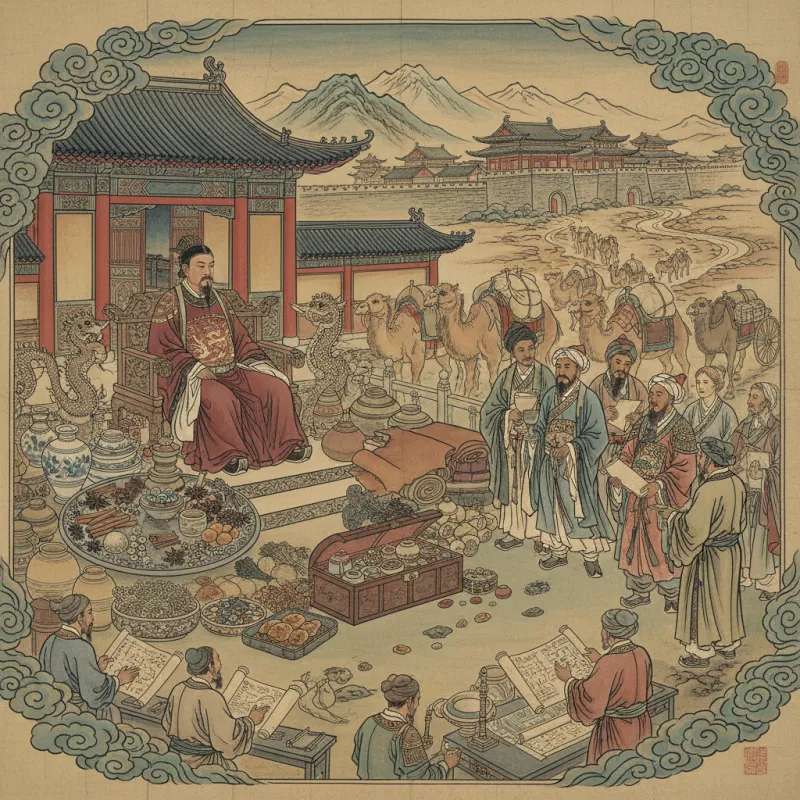
The German geographer who named the Silk Road in 1877 made the same mistake modern marketers make: he picked the sexiest product to sell the story. Ferdinand von Richthofen called it the 丝绸之路 (Sīchóu zhī Lù, Silk Road) because silk sounded exotic and luxurious, not because it was the most important thing moving along those routes. The merchants who actually traveled these paths for two millennia never called them anything special — they were just roads, and silk was just one item on a very long manifest that included religions, technologies, diseases, and ideas that would reshape civilizations on both ends.
If we're being honest about what mattered most, we should probably call it the "Buddhism Highway" or the "Glassware Express" or maybe the "Plague Route." But those don't have the same ring.
The Westbound Cargo: More Than Fancy Fabric
Yes, Chinese silk was prestigious. Roman senators passed sumptuary laws trying to stop their citizens from bankrupting themselves on the stuff. Pliny the Elder complained that Roman gold was flowing to China for "transparent clothing" that let women parade around practically naked. The markup was astronomical — silk that cost 100 denarii in China could sell for 12,000 in Rome.
But silk was a luxury good, which means it was economically significant without being culturally transformative. The Roman Empire didn't fundamentally change because wealthy women wore silk stolas instead of wool. What did change Rome — and everywhere else along the route — were the other things moving west.
Paper technology arrived in the Islamic world around 751 CE after the Battle of Talas, when Arab forces captured Chinese papermakers. Within a century, paper mills were operating in Baghdad, and within two centuries, the entire Islamic intellectual tradition had shifted from expensive parchment to affordable paper. This wasn't just a cost reduction — it was a knowledge revolution. More books meant more scholars, more correspondence, more bureaucratic records, more scientific treatises. The Islamic Golden Age ran on Chinese paper.
Gunpowder formulas traveled west by the 13th century, reaching Europe by the 14th. This wasn't a luxury good or a cultural curiosity — it was a military technology that would end the age of castles and knights and fundamentally restructure European warfare and politics. The Ming Dynasty's decision to share (or fail to protect) this technology arguably did more to shape world history than all the silk ever exported.
Printing technology, porcelain techniques, and the compass all followed similar paths. These weren't commodities — they were capabilities. They didn't just make people wealthier; they made civilizations more powerful.
The Eastbound Cargo: Glass, Grapes, and Gods
The flow going the other direction was equally transformative, and equally not about silk.
Glass was the Roman Empire's answer to Chinese porcelain — a prestige material that demonstrated technical sophistication. But while Romans saw glass as functional (they made windows and bottles), Chinese artisans treated imported Roman glass as a semi-precious material, incorporating it into jewelry and decorative objects. The technology eventually transferred, but the cultural meaning shifted completely.
Grapes and wine arrived in China during the Han Dynasty (206 BCE - 220 CE), brought by Zhang Qian's diplomatic missions to Central Asia. The Chinese already had alcohol — they'd been fermenting millet and rice for millennia — but grape wine was exotic, associated with the Western Regions (西域, Xīyù), and became fashionable among the elite. More importantly, grapes themselves became a major crop in certain regions, changing agricultural patterns and diets.
But the most consequential eastbound cargo was Buddhism. This wasn't a trade good at all — it was an idea system that traveled along trade routes because merchants and monks used the same roads. Buddhism entered China during the Han Dynasty, probably in the 1st century CE, and by the Tang Dynasty (618-907 CE) it had become so thoroughly integrated into Chinese culture that it's now considered one of the "Three Teachings" (三教, Sānjiào) alongside Confucianism and Daoism.
The transformation wasn't simple or unidirectional. Chinese Buddhism became something quite different from Indian Buddhism — it absorbed Daoist concepts, developed new schools like Chan (禅, Chán, later Zen in Japan), and created entirely new scriptures. The Buddhist influence on Chinese philosophy reshaped everything from art to governance to funeral practices. No amount of silk could have done that.
The Biological Exchange: Crops, Horses, and Plagues
Trade routes don't just move goods and ideas — they move living things, both intentionally and accidentally.
Horses were perhaps the most strategically important commodity moving east. The Han Dynasty was desperate for the "heavenly horses" (天马, Tiānmǎ) of Ferghana in Central Asia — larger, stronger animals than the native Chinese breeds. Emperor Wu of Han (汉武帝, Hàn Wǔdì, r. 141-87 BCE) launched military campaigns specifically to secure access to these horses, which were essential for cavalry warfare against the Xiongnu confederation. The Chinese traded silk for horses not because silk was valuable, but because horses were necessary for survival.
Agricultural crops moved in both directions. Alfalfa came to China from Persia, providing better fodder for those precious horses. Peaches and apricots went west from China. Carrots, cucumbers, and sesame arrived from Central Asia and the Middle East. These exchanges literally changed what people ate and how they farmed.
And then there were the diseases. The Antonine Plague (165-180 CE) that devastated the Roman Empire may have originated in China and traveled west along trade routes. The Plague of Justinian (541-549 CE) possibly followed similar paths. The Black Death (1347-1353) almost certainly did, moving from Central Asia to Europe along Silk Road networks. These pandemics killed millions and toppled governments. Silk never did that.
The Information Superhighway of the Ancient World
What we call the Silk Road was really an information network that happened to carry physical goods. Ideas traveled faster and farther than merchandise because they didn't require pack animals or protection from bandits — they just needed people talking to each other.
Mathematical concepts moved along these routes. The decimal system and the concept of zero traveled from India to the Islamic world to Europe. Chinese mathematical texts influenced Islamic scholars, who influenced European mathematicians. Astronomical observations and calendrical systems were shared and compared. Medical knowledge circulated — Chinese acupuncture texts reached Persia, Persian ophthalmology reached China.
Artistic styles blended and evolved. The Greco-Buddhist art of Gandhara (in modern Pakistan and Afghanistan) shows Greek sculptural techniques applied to Buddhist subjects. Tang Dynasty tomb figurines show clear Persian influences in clothing and facial features. Islamic geometric patterns influenced Chinese decorative arts. These weren't simple copies — they were creative syntheses that produced entirely new aesthetic traditions.
Musical instruments traveled and transformed. The pipa (琵琶, pípa), now considered quintessentially Chinese, originated in Persia. The erhu (二胡, èrhú) has Central Asian ancestors. These instruments didn't just add new sounds to Chinese music — they enabled new musical forms and emotional expressions.
The Myth of the Single Route
Another problem with calling it "the Silk Road" (singular) is that there was never one road. There were dozens of routes, shifting over time based on political stability, water availability, and bandit activity. Some went north of the Taklamakan Desert, some went south. Some crossed the Pamir Mountains, others skirted them. Maritime routes along the coast were just as important as overland routes, especially after the Song Dynasty (960-1279 CE) when Chinese maritime technology advanced.
The maritime Silk Road connected Chinese ports to Southeast Asia, India, the Persian Gulf, and East Africa. Zheng He's treasure voyages (1405-1433 CE) in the Ming Dynasty demonstrated the scale of these maritime networks, though they came late in the game. Arab and Persian merchants had been sailing these routes for centuries, carrying not just goods but also Islam, which spread through maritime Southeast Asia largely via trade networks.
Different goods dominated different routes at different times. The northern routes through the steppes were better for horses and furs. The southern routes through oases were better for heavier goods. Maritime routes could carry bulk commodities like ceramics that would be impractical overland. The "Silk Road" was really a complex, adaptive network that responded to changing conditions and demands.
What We Get Wrong About Ancient Trade
Modern people tend to imagine ancient trade as primitive and limited, but the Silk Road networks were sophisticated, well-organized, and operated at impressive scales. Merchants didn't usually travel the entire distance from China to Rome — goods passed through many hands, with different merchants specializing in different segments. This created a complex credit and trust system that functioned across cultures and languages.
Caravanserais (roadside inns) were spaced at regular intervals, providing security and services. Banking systems allowed merchants to deposit money in one city and withdraw it in another, avoiding the need to carry large amounts of cash. Commercial contracts and partnership agreements were standardized enough to be enforceable across different legal systems. This wasn't primitive barter — it was sophisticated international commerce.
The volume was also larger than most people assume. During the Tang Dynasty, Chang'an (modern Xi'an) was probably the world's largest city, with a population over one million, and it was genuinely cosmopolitan. Persian merchants, Arab traders, Indian monks, Central Asian musicians, and people from dozens of other cultures lived and worked there. The city had Zoroastrian fire temples, Nestorian Christian churches, and Manichaean monasteries alongside Buddhist temples and Daoist shrines. This wasn't occasional exotic contact — it was sustained, large-scale interaction.
Why the Name Stuck
So why do we still call it the Silk Road if silk wasn't the most important thing traveling it? Partly because Richthofen's name caught on before anyone thought to question it, and partly because "Silk Road" sounds romantic and evocative in a way that "Eurasian Trade Route Network" doesn't.
But there's also something revealing about the choice. Silk was visible, tangible, and obviously valuable — you could see it, touch it, and price it. The other things that traveled these routes — religious ideas, technological knowledge, artistic influences, disease vectors — were harder to quantify and track. They didn't show up in customs records or merchant inventories. They transformed civilizations slowly, over generations, in ways that weren't always obvious to the people experiencing them.
Calling it the Silk Road is like calling the internet the "Email Network" — technically accurate for one function, but missing the bigger picture entirely. The Silk Road was the ancient world's version of globalization, connecting distant civilizations and enabling exchanges that shaped everything from warfare to worship, from agriculture to art. Silk was just the most photogenic part of a much larger story.
The merchants who traveled these routes knew this. They dealt in silk, yes, but also in glass, spices, horses, gems, metals, and a hundred other commodities. More importantly, they carried stories, techniques, beliefs, and ideas. They were the human links in a network that connected the Mediterranean to the Pacific, and they understood that the real value wasn't in any single commodity — it was in the connection itself.
When we reduce this complex, centuries-long exchange to "the Silk Road," we're making the same mistake Richthofen made: choosing the glamorous surface over the transformative substance. The routes that connected China to the West carried the building blocks of civilizations, not just luxury goods. They deserve a name that reflects that reality, even if it's too late to change it now.
Related Reading
- Zheng He's Treasure Fleet: When China Ruled the Seas
- The Silk Road: A Complete Beginner's Guide
- How Buddhism, Islam, and Christianity Traveled the Silk Road
- The Silk Road Was Not a Road (And Other Things You Got Wrong)
- Diplomacy and Cultural Exchange in Chinese Ancient Dynasties
- Ancient Chinese Law: When Justice Was Personal and Punishment Was Public
- Exploring Ancient Agricultural Practices in Chinese Dynasties