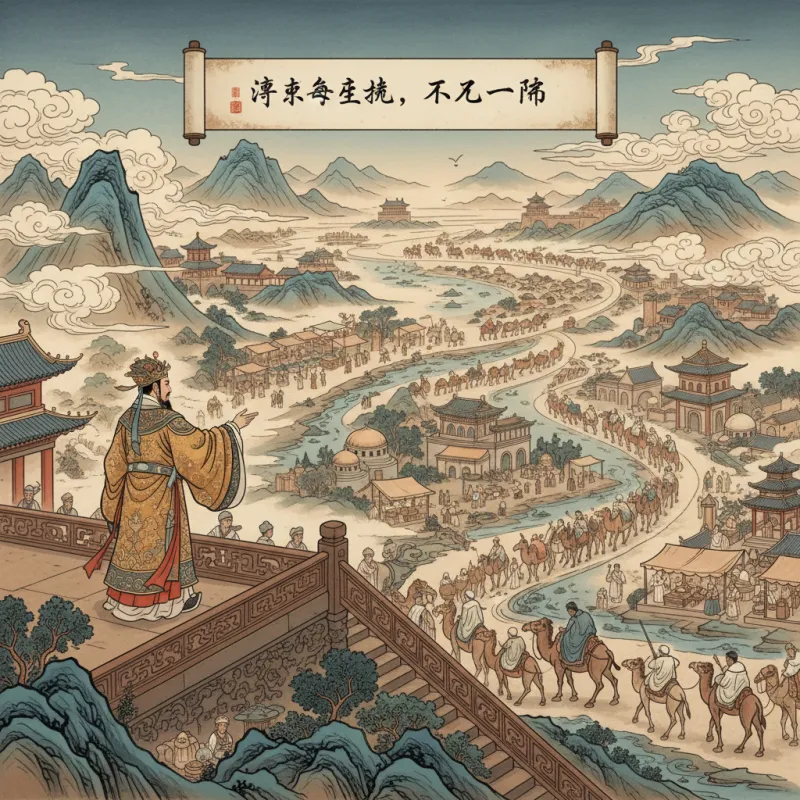
Picture a merchant in 4th century Chang'an (长安, Cháng'ān) telling his grandson about his upcoming journey to Rome. The boy imagines his grandfather following a single road across mountains and deserts, arriving months later at the gates of the Roman Empire. This never happened. Not once. Not ever. The Silk Road as we imagine it — a continuous highway of commerce stretching from China to the Mediterranean — is a fantasy invented by a 19th century German academic who never set foot on any of these routes.
The Term Itself Is a Modern Invention
Ferdinand von Richthofen coined "Seidenstraße" (Silk Road) in 1877 while writing a geographical study of China. He was sitting in a Berlin library, not riding a camel through the Taklamakan Desert. The Chinese called these routes the Western Regions (西域, Xīyù), the Arabs knew them as various caravan routes, and the Persians had their own names. Nobody involved in the actual trade used a single term for the entire network because nobody conceived of it as a single entity.
This linguistic accident has consequences. When we say "Silk Road," we imagine something that looks like the Appian Way or Route 66 — a defined path with a clear beginning and end. We picture Marco Polo's father setting out from Venice with a destination in mind, following road signs and asking for directions to "the Silk Road." The reality was that merchants operated within regional networks, rarely venturing beyond territories where they understood the languages, currencies, and customs.
It Was a Network, Not a Route
Think of it less like a highway and more like the internet — multiple pathways connecting nodes, with information (or goods) taking different routes depending on conditions. A bolt of silk leaving Chang'an during the Tang Dynasty (618-907 CE) might travel north through the Gansu Corridor, or south through Sichuan into India, or even by sea to Southeast Asia before heading west. The path depended on politics, weather, banditry, and which middlemen offered the best prices.
The typical pattern involved a chain of exchanges. A Chinese merchant might take silk to Dunhuang (敦煌, Dūnhuáng), where a Sogdian trader would buy it and transport it to Samarkand. There, a Persian merchant might acquire it and move it to Baghdad. An Arab trader could then carry it to Constantinople, where finally a Byzantine merchant might sell it in Rome. Each middleman marked up the price, which is why silk cost its weight in gold by the time it reached the Mediterranean.
This system meant that most merchants never saw the endpoints of trade. The Chinese merchant in Dunhuang had probably never met a Roman. The Roman buyer had certainly never met a Chinese silk producer. They existed in separate commercial ecosystems connected by intermediaries who jealously guarded their monopolies on geographic knowledge.
Silk Wasn't Even the Main Commodity
Here's another misconception: silk dominated these trade routes. In reality, silk was a luxury good that generated attention because wealthy Romans wrote about it, but by volume and value, other commodities mattered more. Horses from Central Asia were crucial to Chinese military power — the Han Dynasty (206 BCE - 220 CE) launched entire military campaigns to secure access to the "heavenly horses" of Ferghana. Jade from Khotan was prized in China long before silk went west. Spices, glass, precious metals, paper, gunpowder, and ideas moved along these routes in quantities that dwarfed silk shipments.
During certain periods, the routes carried almost no silk at all. After the Byzantine Empire learned sericulture in the 6th century CE (allegedly through monks who smuggled silkworm eggs in hollow bamboo staffs), Chinese silk lost its monopoly. Yet the trade networks continued operating, because they'd never been solely about silk. The name "Silk Road" obscures this diversity, making us think these routes had a single purpose when they actually facilitated the exchange of everything from religion to technology to disease.
The Routes Changed Constantly
Our mental image of the Silk Road is static — the same paths used for millennia. Wrong again. These routes shifted dramatically based on political and environmental conditions. When the Parthian Empire controlled Persia, certain routes flourished. When they fell to the Sassanids, the geography of trade shifted. The rise of Islam in the 7th century CE completely reconfigured commercial networks. The Mongol conquests of the 13th century opened routes that had been closed for centuries, which is why Marco Polo could travel in ways that would have been impossible 200 years earlier.
Climate change also played a role. Cities that thrived as trade hubs in 200 CE might be abandoned by 600 CE because water sources dried up or rivers changed course. The ancient oasis cities of the Taklamakan Desert rose and fell based on environmental conditions that modern archaeology is only beginning to understand. Niya, Loulan, and other settlements that once hosted thousands of merchants are now buried under sand dunes.
Even the term "road" implies infrastructure — paved surfaces, bridges, way stations. Some sections had these amenities, particularly within Chinese or Persian territory. But vast stretches were simply desert or mountain passes that merchants crossed using local guides and hoping they wouldn't encounter bandits or sandstorms. There were no road signs, no maps that showed the full extent of the routes, no central authority maintaining the paths.
Most Traffic Was Local and Regional
The romantic image of the Silk Road focuses on transcontinental trade — Chinese silk reaching Roman markets, Roman glassware arriving in Chang'an. These exchanges happened, but they were rare and expensive. The vast majority of trade was regional. A merchant in Kashgar might trade with Samarkand regularly but never venture to China or Persia. The caravanserais that dotted these routes served primarily local and regional traders, not international adventurers.
This regional focus meant that goods accumulated cultural modifications as they moved. A textile pattern that originated in Persia might be copied and altered in Sogdiana, then copied again with Chinese characteristics in Dunhuang. By the time the pattern reached its final destination, it bore little resemblance to the original. This cultural mixing was perhaps more significant than the physical movement of goods — ideas about art, religion, mathematics, and technology spread through these regional networks, transforming as they traveled.
The Maritime Routes Were Just as Important
We fixate on overland routes through Central Asia, but maritime trade was equally significant and often more efficient. During the Tang and Song Dynasties (960-1279 CE), Chinese ships sailed to India, the Persian Gulf, and East Africa. Arab dhows reached Chinese ports. These sea routes moved bulk goods that would have been impractical overland — ceramics, timber, rice, and large quantities of spices.
The maritime Silk Road (a term that's also anachronistic but useful) connected different networks of trade. Goods might travel overland from China to a port city, then by sea to India, then overland again to Persia. Or they might go entirely by sea from Chinese ports to the Red Sea. The flexibility of these combined networks is what made them resilient. When overland routes became dangerous or expensive, maritime alternatives existed. When pirates threatened sea lanes, caravans could go overland.
Why the Myth Persists
So why do we cling to this simplified narrative of "the Silk Road"? Partly because it's a compelling story — easier to imagine a single road than a complex, shifting network of regional exchanges. Partly because the term has become so embedded in popular culture that correcting it feels pedantic. And partly because the myth serves modern purposes, from tourism marketing to geopolitical initiatives like China's Belt and Road project, which explicitly invokes Silk Road imagery.
But understanding what these routes actually were — decentralized, diverse, constantly changing networks of regional trade — gives us a more accurate picture of premodern globalization. It wasn't a simple story of East meeting West along a defined path. It was thousands of merchants making local decisions, creating connections that accumulated into transcontinental networks without anyone planning or controlling the whole system. That's messier than the myth, but it's also more impressive. These traders built the first version of a connected world without maps, without a common language, and without any central authority coordinating their efforts. They just followed profit and curiosity, and in doing so, they changed history.
Related Reading
- The Silk Road: A Complete Beginner's Guide
- The Silk Road Was Not About Silk: What Actually Traveled Between China and the West
- Zheng He's Treasure Fleet: When China Ruled the Seas
- How Buddhism, Islam, and Christianity Traveled the Silk Road
- The Imperial Examination: The World's First Standardized Test
- Chinese Military Strategy: Sun Tzu and the Art of Winning Without Fighting
- The Role of Trade in Shaping Ancient Chinese Dynasties and Culture