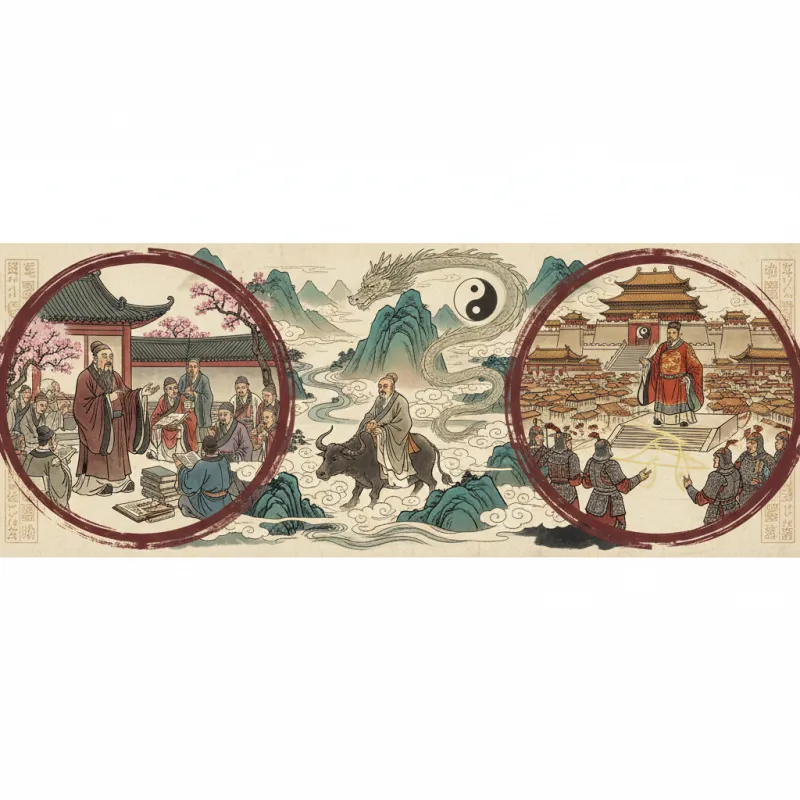
Picture this: It's 500 BCE, and China is tearing itself apart. The Zhou Dynasty has collapsed into chaos. Warlords are slaughtering each other's armies. Peasants are starving. And three men — a teacher, a hermit, and a bureaucrat — are about to propose three completely different solutions that will define Chinese civilization for the next 2,500 years.
This isn't ancient history gathering dust in a library. Walk through Beijing today and you'll see Confucian respect for hierarchy in every business meeting, Daoist temples tucked between skyscrapers, and Legalist surveillance cameras on every corner. The argument that started during the Warring States period never ended. It just went digital.
The Question That Started Everything
Here's what they were all trying to answer: How do you create order when everything is falling apart?
The Spring and Autumn period (770-476 BCE) had given way to the Warring States (475-221 BCE), and China was fragmenting into seven major kingdoms locked in constant warfare. The old feudal system was dead. The question wasn't philosophical — it was survival. Get the answer wrong, and your state gets conquered. Your family gets executed. Your culture disappears.
Three schools emerged with radically different answers. And here's the fascinating part: each one worked. Just in completely different ways.
Confucius: The Optimist Who Believed in Human Nature
Confucius (孔子, Kǒngzǐ, 551-479 BCE) was a failed politician who became history's most influential teacher. He spent years wandering from court to court, trying to convince rulers to adopt his ideas. Most of them thought he was naive.
His core belief? People are fundamentally good, and society breaks down when we forget how to be human to each other.
The centerpiece of his philosophy is ren (仁, rén) — often translated as "benevolence" or "humaneness," but really meaning something closer to "being fully human." A person with ren doesn't just follow rules. They genuinely care about others. They feel what others feel. When you see someone suffering, you don't need a law to tell you to help — you just do.
But Confucius wasn't some soft-hearted idealist. He believed in li (礼, lǐ) — ritual, propriety, the proper way of doing things. Not empty ceremony, but the accumulated wisdom of how humans should interact. How you greet your parents. How you conduct a funeral. How a ruler should treat subjects and subjects should treat rulers. These rituals aren't restrictions — they're the social technology that makes ren possible.
His most radical idea? Filial piety (孝, xiào) as the foundation of everything. Master the relationship with your parents, and you've learned the template for every other relationship. Respect flows upward, care flows downward, and society becomes a nested series of families. The emperor is the father of the nation. The magistrate is the father of the district. And it all starts with actual fathers and mothers.
The Confucian solution: Fix people through education and moral cultivation, and society fixes itself. No need for harsh laws or mystical withdrawal. Just billions of people trying to be better humans, one relationship at a time.
Laozi: The Mystic Who Said Stop Trying So Hard
Now meet Laozi (老子, Lǎozǐ), who probably didn't exist as a single historical person but represents a completely opposite worldview. The Daodejing (道德经, Dàodéjīng), attributed to him, is 5,000 characters of beautiful, cryptic poetry that basically says: Confucius, you're making everything worse.
The Daoist critique is devastating: All your rules and rituals and moral education? That's exactly the problem. You're teaching people to be artificial. You're creating a society of performers who've forgotten how to just be.
The core concept is dao (道, dào) — "the Way," but not a way you can follow like a road. It's more like the underlying pattern of reality itself. Water flowing downhill. Seasons changing. A tree growing without trying to grow. The dao is what happens when you stop forcing things.
And then there's wuwei (无为, wúwéi) — "non-action" or "effortless action." This doesn't mean doing nothing. It means acting in harmony with the natural flow of things. A skilled swimmer doesn't fight the current. A good ruler doesn't micromanage every detail. You accomplish more by doing less, because you're working with reality instead of against it.
The Daodejing is full of paradoxes that sound like riddles: "The softest thing in the world overcomes the hardest." "Those who know don't speak; those who speak don't know." "Govern a large country like you would cook a small fish" (meaning: don't overdo it, don't keep flipping it, just let it cook).
The Daoist solution: Stop trying to fix society. Society is broken because you keep trying to fix it. Return to simplicity. Embrace spontaneity. Let people be natural instead of civilized. The best government is the one people barely notice exists.
This philosophy deeply influenced Chinese art, poetry, and martial arts, where the goal is to move without thinking, to respond without planning. It's why Chinese landscape paintings show tiny humans dwarfed by mountains — a reminder that we're not the center of the universe.
Legalism: The Realist Who Trusted No One
And then there's Legalism, represented by Han Feizi (韩非子, Hán Fēizǐ, 280-233 BCE), who looked at both Confucius and Laozi and said: You're both delusional.
Legalists had zero faith in human nature. People aren't good. They're not naturally harmonious. They're selfish, short-sighted, and will absolutely screw you over if they can get away with it. Confucian moral education? Waste of time. Daoist spontaneity? Recipe for chaos.
The Legalist solution is brutally simple: fa (法, fǎ) — law. Clear, harsh, uniformly enforced laws with severe punishments. Make the consequences of bad behavior so terrible that people behave out of fear, not virtue.
But here's the clever part: Legalists also believed in shu (术, shù) — statecraft, the art of manipulation. A ruler should be unpredictable. Keep ministers guessing. Play them against each other. Never let anyone know what you're really thinking. Trust no one, not even your own family.
And shi (势, shì) — positional power. It doesn't matter if you're wise or virtuous. What matters is that you control the levers of power. A mediocre ruler with absolute authority is more effective than a sage without enforcement mechanisms.
This sounds dystopian, and it kind of is. But it worked. The state of Qin adopted Legalist policies and conquered all the other states, unifying China in 221 BCE under the First Emperor, Qin Shi Huang. The Qin Dynasty lasted only 15 years before collapsing from its own brutality, but it proved that Legalism could achieve what Confucianism and Daoism couldn't: actual, immediate, total control.
The Synthesis That Never Quite Happened
Here's what's fascinating: China never chose one philosophy over the others. Instead, it created a hybrid that's still operating today.
The official ideology became Confucianism. Emperors claimed to rule through virtue. The civil service examination system tested knowledge of Confucian classics. Filial piety became the foundation of social order.
But the actual machinery of government? Pure Legalism. Harsh laws. Extensive bureaucracy. Surveillance and punishment. The Confucian facade with a Legalist engine.
And Daoism? It became the escape valve. When Confucian society got too rigid, too demanding, too artificial, people retreated into Daoist poetry, painting, and philosophy. Scholars would be Confucian in public and Daoist in private. Work hard, climb the ladder, fulfill your duties — then go write poems about mountains and get drunk with friends.
This three-way tension shows up everywhere in Chinese culture. The dutiful son who secretly resents his obligations. The official who quotes Confucius while running a Legalist police state. The artist who abandons society to paint in the mountains. They're all playing out the same ancient argument.
Why This Still Matters
You might think this is all ancient history, but watch Chinese politics today and you'll see the same patterns.
The Chinese Communist Party uses Confucian language about harmony and social responsibility while operating a Legalist surveillance state. Xi Jinping quotes Confucius while building the most sophisticated system of social control in human history. The government promotes traditional values (Confucian) while maintaining absolute power through law and technology (Legalist).
And ordinary Chinese people? Many still navigate the same tensions. Public conformity, private skepticism. Respect for hierarchy, but also a Daoist sense that the whole system is kind of absurd. Work hard, follow the rules, but also find ways to flow around obstacles rather than confronting them directly.
The three-way argument never ended because each philosophy captures something true about human nature and society. We need moral education (Confucius). We need to stop overthinking and let things flow naturally (Laozi). We need clear rules and enforcement (Legalism). The question isn't which one is right — it's how to balance all three without letting any one dominate completely.
That's the conversation that started 2,500 years ago in the ruins of the Zhou Dynasty. It's still going. And if you're paying attention to Chinese political philosophy today, you're part of it.
Related Reading
- Mohism: The Lost Philosophy of Universal Love
- Legalism and the Qin Dynasty: When Ruthless Efficiency Built an Empire
- Confucius vs. Laozi: The Debate That Shaped Chinese Civilization
- The Hundred Schools of Thought: China's Golden Age of Philosophy
- Exploring the Philosophical Legacy of China’s Ancient Dynasties
- The Role of Trade in Shaping Ancient Chinese Dynasties and Culture
- Delving into Ancient China: A Journey Through Dynasties, Emperors, and Cultural Treasures
- Three Kingdoms: The History That Became China's Greatest Story