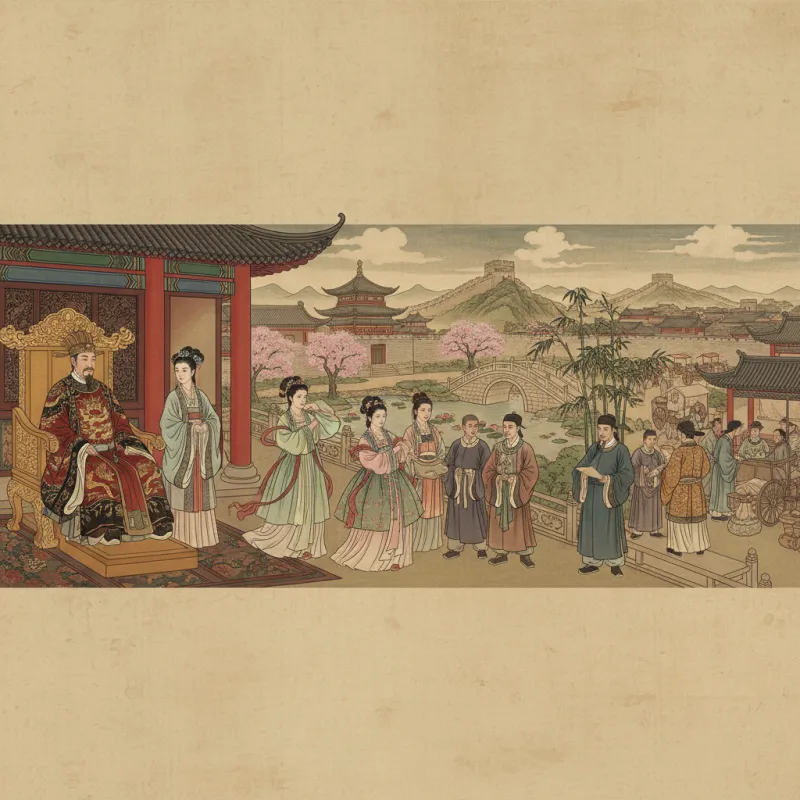
Picture this: A Tang Dynasty official steps out of his home wearing the wrong shade of purple, and by sunset he's stripped of his rank. A Ming Dynasty merchant's wife dares to wear silk embroidered with dragons, and imperial guards are at her door by morning. In imperial China, your wardrobe wasn't a personal choice — it was a legal document written in fabric, dye, and thread.
For over two millennia, Chinese clothing operated under a system so rigid that the width of your sleeve, the length of your robe, and even the number of pleats in your skirt were dictated by law. This wasn't vanity or bureaucratic overreach. Clothing was the visible architecture of Confucian social order, a daily reminder that everyone had their place, and stepping outside it — even in fashion — threatened the cosmic balance itself.
The Han Dynasty Blueprint: When Hanfu Was Born
The term 汉服 (hànfú, "Han clothing") gets thrown around today as if it describes one unified style, but that's misleading. What we call hanfu is actually a 400-year evolution during the Han Dynasty (206 BCE – 220 CE) that established the basic template: crossed collars that wrapped right over left, wide sleeves, a sash at the waist, and flowing robes that concealed the body's shape.
The signature garment was the 深衣 (shēnyī, "deep robe") — a one-piece outfit where the top and bottom were sewn together, symbolizing the unity of heaven and earth. Confucian scholars loved this garment because its construction embodied philosophical principles: the round collar represented heaven, the square hem represented earth, and the straight seam down the back represented the upright moral character of the wearer. You weren't just getting dressed — you were putting on a cosmological diagram.
But here's what the romantic reconstructions miss: most people didn't wear the elegant deep robe. Farmers wore short jackets and loose trousers because you can't plow a field in floor-length silk. Women wore 襦裙 (rúqún) — a wrap-around skirt paired with a short jacket — that was far more practical for daily work. The elaborate robes we see in museums were formal wear, the ancient equivalent of tuxedos that spent most of their time in storage.
Tang Dynasty: When China Wore the World
If Han clothing was about Confucian restraint, Tang Dynasty fashion (618-907 CE) was about cosmopolitan confidence. This was China at its most powerful and most open, when Chang'an was the world's largest city and the Silk Road pumped foreign influences directly into the imperial wardrobe.
Tang women's fashion is where things get interesting. The 齐胸襦裙 (qíxiōng rúqún) — a high-waisted skirt that tied just below the bust — created a silhouette that wouldn't look out of place in Regency England. Necklines dropped scandalously low by Chinese standards, sometimes revealing the shoulders entirely. Persian-style 胡服 (húfú, "barbarian clothing") became fashionable among aristocratic women, featuring fitted jackets, riding pants, and even boots — clothing that allowed them to play polo, hunt, and ride astride like men.
The Tang court tried repeatedly to ban these foreign styles, issuing edicts in 671, 718, and 780 CE that ordered women back into "proper" Chinese dress. Every edict failed. When your empire stretches from Korea to Central Asia, when foreign merchants fill your markets and foreign princesses marry your princes, fashion becomes impossible to control. The Tang Dynasty proved that even imperial law can't compete with what people actually want to wear.
Color regulations reached their peak of absurdity during this period. Purple was reserved for officials of the third rank and above — but not just any purple. The specific shade of 紫色 (zǐsè) was defined by law, and dye workshops were inspected to ensure compliance. Yellow became exclusively imperial after 618 CE; anyone else caught wearing it faced severe punishment. The system was so complex that officials needed reference guides to decode each other's outfits at court gatherings.
Song Dynasty: The Aesthetic Turn Inward
After the Tang collapsed into chaos, the Song Dynasty (960-1279 CE) pulled Chinese fashion back toward restraint. This wasn't just political conservatism — it reflected Neo-Confucian philosophy that prized inner cultivation over external display. Song literati considered Tang fashion vulgar and excessive, the aesthetic equivalent of nouveau riche showing off.
The ideal Song gentleman wore simple robes in muted colors: blacks, grays, browns, and deep blues. The 道袍 (dàopáo, "scholar's robe") became the uniform of the educated class — loose, comfortable, and deliberately understated. Wide sleeves were still fashionable, but now they symbolized that the wearer didn't perform manual labor, a subtle class marker rather than an ostentatious display.
Women's fashion took a darker turn. The practice of foot binding, which had existed in limited form during the Tang, became widespread among upper-class Song families. The resulting 三寸金莲 (sāncùn jīnlián, "three-inch golden lotuses") required special shoes and affected how women walked, stood, and dressed. Skirts became longer to hide bound feet; the swaying gait caused by foot binding became eroticized as feminine grace. This is the uncomfortable truth about historical fashion: sometimes what we find beautiful was built on suffering.
The Song also perfected 妆花 (zhuānghuā) — a complex weaving technique that created elaborate patterns in silk. Unlike embroidery, which was added after weaving, zhuanghua patterns were woven directly into the fabric, creating designs so intricate that a single robe could take months to produce. These garments were status symbols precisely because they represented enormous investments of skilled labor and expensive materials.
Yuan Dynasty: When the Mongols Rewrote the Rules
The Mongol conquest in 1279 CE shattered Chinese fashion conventions. The Yuan Dynasty (1271-1368 CE) imposed 蒙古服 (měnggǔfú, "Mongolian clothing") on the court: fitted robes with asymmetrical closures, narrow sleeves, and practical designs suited for horseback riding. For the first time in centuries, Chinese officials were legally required to wear "barbarian" clothing.
The traditional crossed collar disappeared from formal wear, replaced by robes that buttoned or tied on the side. The 质孙服 (zhìsūnfú) — a Mongolian-style robe with a distinctive diagonal closure — became mandatory court dress. Han Chinese scholars hated it, viewing it as a visible symbol of foreign domination, but they had no choice. Clothing had always been political in China; now it was explicitly colonial.
Interestingly, Han Chinese civilians largely ignored Mongol fashion and continued wearing traditional styles in daily life. This created a visual divide: Mongol-style clothing marked you as part of the ruling apparatus, while traditional hanfu became a quiet form of cultural resistance. Fashion became a way to signal loyalty or defiance without saying a word.
Ming Dynasty: The Great Restoration
When the Ming Dynasty (1368-1644 CE) overthrew the Mongols, one of their first acts was to restore "proper" Chinese clothing. The Hongwu Emperor issued detailed regulations in 1368 CE that banned Mongol styles and mandated a return to Tang and Song traditions — or rather, to an idealized version of them.
The 曳撒 (yèsǎn) — a long robe with a distinctive horse-hoof shaped cuff — became standard for officials. The 补子 (bǔzi, "mandarin square") system emerged: embroidered badges sewn onto robes that indicated rank through specific animals or symbols. Civil officials wore birds (cranes for first rank, golden pheasants for second, peacocks for third), while military officials wore beasts (lions, tigers, bears, panthers). You could read someone's entire career trajectory from their chest.
Ming women's fashion emphasized modesty after the relative openness of the Tang and Yuan periods. The 袄裙 (ǎoqún) — a long jacket over a pleated skirt — became standard, with high collars and long sleeves that covered the arms completely. The ideal silhouette was cylindrical, concealing the body's shape entirely. This reflected Neo-Confucian values that had intensified during the Song and now dominated Ming social thought.
But here's what makes Ming fashion fascinating: the gap between law and practice. Sumptuary laws prohibited commoners from wearing silk, limited them to specific colors, and banned certain decorative elements. Yet Ming novels and paintings show merchants' wives in elaborate silk robes, courtesans in fashions that rivaled aristocrats, and wealthy commoners flagrantly ignoring regulations. The government issued repeated edicts trying to enforce dress codes, which tells you everything about how well they worked. When you have to keep banning the same thing, people aren't listening.
Qing Dynasty: The Manchurian Makeover
The Manchu conquest in 1644 CE brought the most dramatic fashion revolution in Chinese history. The Qing Dynasty didn't just change clothing styles — they made Han Chinese men's hair and dress a test of political loyalty. The infamous 剃发令 (tìfà lìng, "hair cutting order") of 1645 CE forced Han men to adopt the Manchu queue hairstyle: shaved forehead and long braid down the back. The slogan was brutal: "Keep your hair and lose your head, or keep your head and lose your hair."
The 旗袍 (qípáo, "banner gown") — what Westerners call the "cheongsam" — originated as Manchu men's wear: a straight, fitted robe with a standing collar and side slits for horseback riding. Han Chinese men were required to wear it, abandoning the crossed-collar robes their ancestors had worn for two millennia. The 马褂 (mǎguà) — a short jacket worn over the robe — completed the Manchu look.
Women's fashion tells a more complex story. Manchu women wore straight, loose robes and never bound their feet, considering the practice barbaric. But Han Chinese women continued wearing modified Ming-style clothing and maintained foot binding despite Qing attempts to ban it. This created a visible ethnic divide: you could identify a woman's ethnicity from across the street based on her clothing and gait.
The qipao we recognize today — the fitted, side-slit dress with a high collar — didn't exist until the 1920s, when Shanghai women adapted the traditional Manchu robe into a modern fashion statement. What we think of as "traditional Chinese dress" is actually a 20th-century hybrid, created in a moment when China was desperately trying to be both modern and Chinese simultaneously.
The Fabric of Power
Chinese fashion history reveals an uncomfortable truth: clothing has always been about control. Every dynasty used dress codes to enforce social hierarchies, mark ethnic boundaries, and signal political loyalty. The romance of flowing silk robes and elegant embroidery obscures the fact that these garments were tools of governance, as carefully regulated as tax codes and criminal law.
What you wore determined where you could go, who you could marry, and how others treated you. A farmer who dressed above his station risked punishment; a merchant who wore silk faced fines; a woman who dressed "improperly" invited scandal. The system was designed to make social order visible and violations immediately obvious.
Yet people constantly pushed against these boundaries. They found loopholes, ignored regulations when they could get away with it, and adapted foreign styles despite official disapproval. The history of Chinese fashion isn't just about what emperors decreed — it's about the gap between law and life, between what authorities demanded and what people actually wore. That tension, between control and creativity, between tradition and change, is what makes Chinese fashion history so endlessly fascinating.
For more on how social hierarchies shaped daily life, see The Imperial Examination: The World's First Standardized Test. And to understand the philosophical foundations behind these clothing regulations, explore Confucianism: The Philosophy That Shaped China.
Related Reading
- What Ordinary People Ate in Ancient China (It Was Not What You Think)
- Daily Life in Ancient China: What Ordinary People Actually Did All Day
- What Did Ancient Chinese People Eat? A Dynasty-by-Dynasty Food History
- The Porcelain Trade: How Chinese Pottery Conquered the World
- Chinese Women Who Changed History (And Were Erased From It)
- Exploring the Rich Tapestry of Ancient Chinese History and Culture