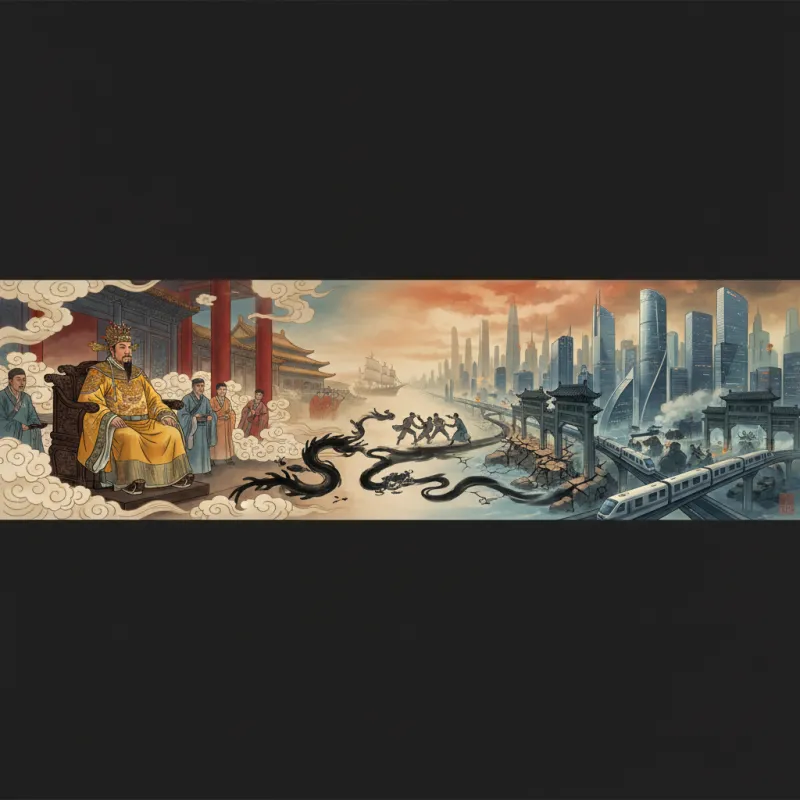
Every year, millions of Chinese tourists visit the Old Summer Palace in Beijing—not to admire its beauty, but to witness its ruins. The blackened stones and crumbling columns aren't preserved as archaeological curiosities. They're left deliberately unrestored, a calculated reminder of what British and French troops did in 1860 during the Second Opium War. "Never forget," the signs say. And China hasn't.
The Opium Wars weren't just military defeats. They were the beginning of what Chinese historians call the Century of Humiliation (百年耻辱, bǎi nián chǐ rǔ)—a period from 1839 to 1949 when foreign powers carved up China like a melon, as the saying went. But here's what makes these wars different from other colonial conflicts: they're not history in China. They're current events. They're the lens through which Chinese leaders and citizens interpret everything from trade disputes to territorial claims to the very purpose of the Chinese state.
The Drug War Britain Won
The First Opium War (1839-1842) started because China didn't want to buy British goods. The trade imbalance was staggering—Britain imported massive quantities of tea, silk, and porcelain from China, but China wanted almost nothing in return except silver. So the British East India Company found a product China would buy: opium from Bengal. By the 1830s, millions of Chinese were addicted, and silver was flowing out of China instead of in.
When Commissioner Lin Zexu (林则徐, Lín Zéxù) confiscated and destroyed over 1,000 tons of British opium in Canton in 1839, he thought he was enforcing Chinese law in Chinese territory. He was right, legally speaking. But Britain responded with gunboats. The Qing dynasty's war junks and medieval fortifications were no match for steam-powered warships and modern artillery. China lost, and the Treaty of Nanking (1842) forced China to pay reparations, open five ports to British trade, and cede Hong Kong Island "in perpetuity."
The Second Opium War (1856-1860) was even worse. This time Britain and France teamed up, and the pretext was even flimsier—a Chinese-owned ship flying a British flag was boarded by Chinese officials. The allies marched to Beijing, and in an act of calculated cultural destruction, they looted and burned the Yuanmingyuan (圆明园, Yuánmíngyuán), the Old Summer Palace. The French writer Victor Hugo called it "two bandits" destroying "one of the wonders of the world." The Convention of Peking (1860) legalized opium, opened more ports, allowed foreign missionaries to operate freely, and gave Russia a massive chunk of territory north of the Amur River.
The Unequal Treaties System
What followed the Opium Wars was worse than the wars themselves: the unequal treaties (不平等条约, bù píngděng tiáoyuē) system. Once Britain had forced China to accept unfavorable terms, every other power lined up for their share. France, Russia, Germany, Japan, even Belgium and Portugal—all extracted concessions. These treaties shared certain humiliating features: extraterritoriality (foreigners in China were subject to their own laws, not Chinese law), fixed low tariffs (China couldn't protect its industries), foreign control of customs revenue, and territorial concessions.
Shanghai became a patchwork of foreign settlements where Chinese people needed permission to enter certain areas of their own city. Signs reading "No dogs or Chinese allowed" may be apocryphal, but the sentiment was real—Chinese people were second-class citizens in Chinese cities. The foreign concessions had better infrastructure, better policing, and better public services than Chinese-controlled areas, which only emphasized China's weakness.
This wasn't colonization in the traditional sense—China was never formally a colony. It was something arguably worse: a semi-colonial state, sovereign in name but subordinate in practice, forced to watch foreign powers extract wealth and dictate terms while the Qing government remained nominally in charge but actually powerless. As the reformer Liang Qichao (梁启超, Liáng Qǐchāo) put it, China had become "the sick man of Asia."
How Humiliation Became National Identity
Here's where the Opium Wars' legacy gets complicated. The Century of Humiliation narrative is historically accurate—these events really happened, and they were genuinely traumatic for China. But it's also a carefully constructed political narrative that serves specific purposes in contemporary China.
Every Chinese student learns this history in detail. Textbooks devote extensive coverage to the Opium Wars, the unequal treaties, and the foreign invasions that followed. School trips to sites like the Old Summer Palace ruins are common. The message is consistent: China was weak, China was humiliated, and China must never be weak again. This narrative provides the emotional and ideological foundation for Chinese nationalism and for the Communist Party's legitimacy. The Party's core promise is simple: we will restore China's strength and dignity. We will ensure this never happens again.
This isn't subtle propaganda—it's explicit. Xi Jinping regularly invokes the Century of Humiliation when discussing the "Chinese Dream" (中国梦, Zhōngguó mèng) of national rejuvenation. The implication is clear: China's rise isn't aggression, it's restoration. China isn't seeking to dominate others; it's simply reclaiming its rightful place after an aberrant period of weakness. From this perspective, everything from economic development to military modernization to territorial claims is defensive, not offensive.
The Hong Kong Question
Hong Kong's return to China in 1997 was framed as the beginning of the end of the Century of Humiliation. The handover ceremony was heavy with symbolism—the British flag coming down, the Chinese flag going up, the People's Liberation Army marching in. For many Chinese, it was a moment of redemption: the unequal treaty that ceded Hong Kong was finally nullified.
But Hong Kong also illustrates the complications of the humiliation narrative. The "one country, two systems" framework was supposed to preserve Hong Kong's autonomy for 50 years. When Hong Kong residents protested in 2014 and 2019 for greater democracy and autonomy, Beijing saw it through the lens of the Opium Wars: foreign interference trying to use Hong Kong to weaken China, just like the British did. The 2020 National Security Law was justified as necessary to prevent Hong Kong from becoming a base for foreign subversion—the same logic that drove Commissioner Lin Zexu to destroy British opium in 1839.
From Hong Kong's perspective, the situation looked different: Beijing was eroding promised autonomy and freedoms. But from Beijing's perspective, shaped by the Century of Humiliation narrative, any challenge to sovereignty is an existential threat. The Opium Wars taught China's leaders that small concessions lead to catastrophic losses. Better to overreact than to appear weak.
Trade Wars and Historical Echoes
When the United States imposed tariffs on Chinese goods in 2018, Chinese state media immediately drew parallels to the Opium Wars. The comparison seems absurd at first—modern trade disputes have nothing to do with forcing drugs on China at gunpoint. But the emotional logic is clear: once again, a Western power is trying to prevent China's rise through economic coercion. Once again, China must resist or face humiliation.
This historical framing shapes how China approaches trade negotiations, technology transfer disputes, and economic policy. China's insistence on "indigenous innovation" and technological self-sufficiency isn't just economic policy—it's a response to the memory of being technologically inferior during the Opium Wars. The Made in China 2025 initiative, which aims for Chinese dominance in high-tech industries, is explicitly framed as preventing another century of humiliation. China remembers that technological backwardness led to military defeat, which led to unequal treaties, which led to national humiliation.
The Belt and Road Initiative can also be understood through this lens. By building infrastructure and expanding economic influence across Asia, Africa, and Europe, China is creating the kind of economic relationships it was denied during the Century of Humiliation. Critics call it "debt-trap diplomacy," but China sees it as finally having the power to shape international economic rules rather than having rules imposed on it.
The Taiwan Paradox
Taiwan presents the ultimate test of the Century of Humiliation narrative. The island was ceded to Japan after China's defeat in the First Sino-Japanese War (1895)—another unequal treaty, another piece of Chinese territory lost due to weakness. Taiwan's current separation from mainland China is seen in Beijing as the last unresolved legacy of that era of humiliation. Reunification isn't just a political goal; it's a historical imperative, the final step in erasing the Century of Humiliation.
This explains why Taiwan is non-negotiable for Beijing in a way that's hard for outsiders to understand. It's not just about territory or strategy—it's about completing the narrative of national restoration. As long as Taiwan remains separate, the Century of Humiliation isn't truly over. This is why Chinese leaders consistently say that reunification "cannot be passed down from generation to generation"—the historical wound must be healed.
The irony is that Taiwan's own development complicates this narrative. Taiwan has become a prosperous democracy with its own distinct identity, shaped by decades of separation from the mainland. Many Taiwanese, especially younger generations, don't see themselves as part of an incomplete Chinese nation waiting to be reunified. But the Century of Humiliation narrative doesn't accommodate this perspective—it sees only a historical wrong that must be righted.
Living in History's Shadow
The Opium Wars ended over 160 years ago, but they remain intensely present in Chinese political consciousness. This isn't unique to China—many nations are shaped by historical traumas. But few nations have made historical humiliation so central to their contemporary identity and foreign policy.
This creates both opportunities and dangers. The Century of Humiliation narrative has been remarkably effective at mobilizing national unity and justifying rapid development. It provides a clear story about where China has been and where it's going. But it also makes compromise difficult, turns every dispute into an existential question, and frames international relations as a zero-sum struggle between humiliation and dignity.
The challenge for China—and for the world—is whether China can move beyond this narrative while still honoring the genuine historical suffering it represents. Can China be confident without being defensive? Can it be strong without seeing every challenge as a potential return to weakness? Can it remember the Opium Wars without being imprisoned by them?
These aren't just questions for China. They're questions about how historical memory shapes contemporary politics, how nations process collective trauma, and whether it's possible to learn from history without being trapped by it. The ruins of the Old Summer Palace will remain unrestored, a permanent reminder. The question is what lessons China—and the world—will draw from them.
Related Reading
- The Cultural Revolution: What Actually Happened
- The Chinese Diaspora: How Chinese Culture Spread Worldwide
- How to Learn Chinese History: A Beginner's Roadmap
- 10 Ways Ancient China Changed the Modern World
- Confucius vs. Laozi: The Debate That Shaped Chinese Civilization
- Exploring the Rich Tapestry of Ancient Chinese History and Culture
- The Grand Canal: China Greatest Engineering Project