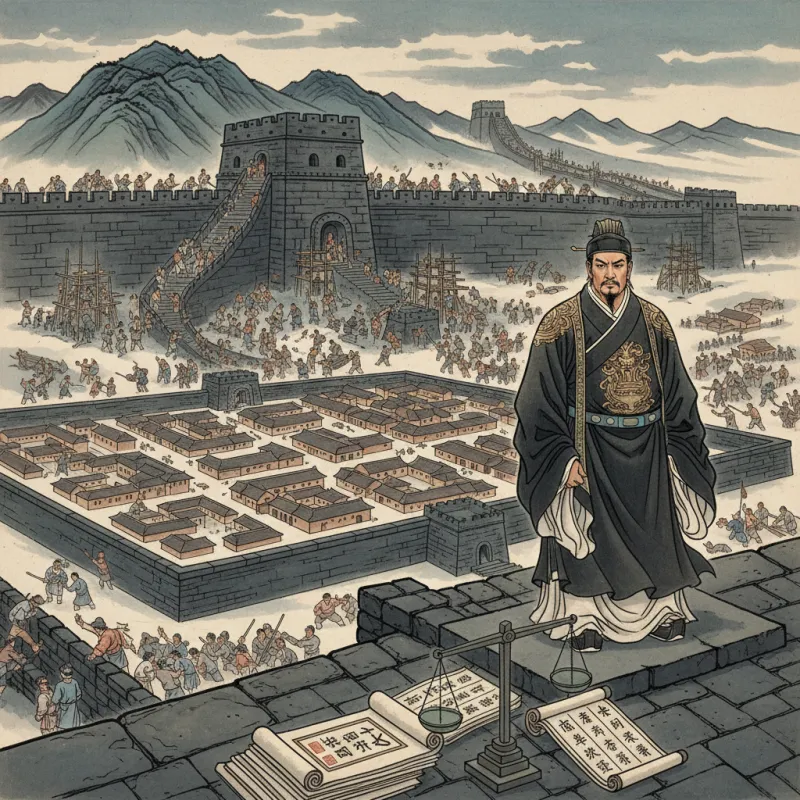
When Shang Yang (商鞅, Shāng Yāng) arrived in the state of Qin around 361 BCE, he brought with him a proposal so radical that half the court wanted him executed on the spot. He told Duke Xiao that if he wanted to dominate the other warring states, he needed to abandon Confucian virtue, ignore Daoist spontaneity, and build a system where laws were absolute, punishments were brutal, and the state controlled everything. The duke took the gamble. Within a generation, Qin transformed from a backwater frontier state into the most feared military power in China. Within a century and a half, it would conquer everyone else and forge the first unified Chinese empire. This is the story of Legalism (法家, Fǎ Jiā) — the philosophy that built an empire by treating humans not as moral beings to be cultivated, but as predictable animals to be controlled.
The Core Insight: Humans Are Selfish, So Use That
Legalism starts with an assumption that Confucians found repulsive: people are fundamentally self-interested. They don't need moral education — they need incentives. Han Feizi (韓非子, Hán Fēi Zǐ, c. 280-233 BCE), the philosophy's most systematic thinker, put it bluntly: a carpenter making coffins hopes for a plague, not because he's evil, but because plagues are good for business. A ruler who ignores this reality and expects people to act virtuously is a fool.
The Legalist solution was elegant and terrifying: create a system of rewards and punishments so clear and so severe that people have no choice but to obey. Make the laws public, apply them equally to everyone (in theory), and enforce them without mercy. If a general wins a battle, shower him with land and titles. If he loses, execute him. If a farmer produces surplus grain, exempt him from corvée labor. If he's lazy, enslave his family. The state doesn't care about your intentions or your character — only your results.
This was a direct assault on Confucian philosophy, which insisted that ritual and moral education could transform society from within. Legalists thought this was naive. Shang Yang reportedly said that waiting for people to become virtuous before governing them was like waiting for a river to run dry before crossing it. You'd be waiting forever.
The Three Tools of Control: Law, Statecraft, and Power
Legalism wasn't a single unified doctrine — it emerged from three distinct traditions that eventually merged. Understanding these components reveals how sophisticated and ruthless the system really was.
Fa (法, fǎ) — Law: This was Shang Yang's specialty. Laws must be written, published, and applied uniformly. No exceptions for nobles, no flexibility for circumstances. When Shang Yang's own reforms were violated by the crown prince's tutor, he had the tutor's nose cut off to prove that even the royal family wasn't above the law. The point wasn't justice — it was predictability. If people know exactly what will happen when they break a rule, they won't break it.
Shu (術, shù) — Statecraft or Technique: This was the domain of Shen Buhai (申不害, Shēn Bùhài, d. 337 BCE), who served as chancellor of the state of Han. Shu focused on how a ruler maintains control over his bureaucracy. The key principle: never let your ministers know what you're thinking. Assign overlapping responsibilities so officials spy on each other. Demand results but never explain your methods. Keep everyone off-balance and paranoid. A ruler who reveals his desires gives his ministers the power to manipulate him.
Shi (勢, shì) — Power or Positional Advantage: Shen Dao (慎到, Shèn Dào, c. 350-275 BCE) argued that authority comes not from personal virtue but from institutional position. A wise man without power is helpless; a fool on the throne can command armies. The ruler's job is to accumulate and guard his positional power, never delegating so much authority that a minister could challenge him.
Han Feizi synthesized all three into a comprehensive system. A Legalist state needed harsh laws (fa) that everyone feared, cunning techniques (shu) that kept officials obedient, and concentrated power (shi) that made the ruler unchallengeable.
Shang Yang's Reforms: The Laboratory of Legalism
The state of Qin became Legalism's testing ground, and Shang Yang was its mad scientist. His reforms between 356 and 338 BCE were so comprehensive that they restructured Qin society from top to bottom.
He abolished the old aristocratic system and created twenty ranks of military merit. Your status depended entirely on how many enemy heads you brought back from battle — one head, one rank. Nobles who didn't fight lost their privileges. Peasants who fought well could become lords. This created a military machine where everyone had an incentive to be vicious.
He divided the population into groups of five and ten families, making them mutually responsible for each other's behavior. If one person committed a crime and the others didn't report it, the entire group was punished. This turned every neighborhood into a surveillance network.
He forced families to split up when sons came of age, preventing the accumulation of clan power. He standardized weights and measures to prevent merchant fraud. He even banned innkeepers from accepting guests without official travel permits, making it nearly impossible to move around the state without government approval.
The results were dramatic. Qin's agricultural output soared because farmers knew that hard work would be rewarded and laziness would be punished. Its army became unstoppable because soldiers fought with suicidal bravery to earn ranks. Other states watched in horror as Qin grew stronger year by year.
But Shang Yang himself met a Legalist end. When Duke Xiao died in 338 BCE, the new ruler — the same crown prince whose tutor Shang Yang had mutilated — had him torn apart by chariots. The laws remained, but their creator was destroyed by the system he built. There's a lesson there about the dangers of making enemies when you're the one enforcing brutal punishments.
Han Feizi: The Philosophy's Dark Masterpiece
If Shang Yang was Legalism's engineer, Han Feizi was its philosopher-poet. Born into the royal family of the state of Han, he watched his homeland grow weaker while Qin grew stronger. He studied under the Confucian master Xunzi (荀子, Xún Zǐ) alongside Li Si (李斯, Lǐ Sī), who would later become Qin's prime minister. But where Xunzi taught that human nature was bad but could be reformed through education, Han Feizi concluded that human nature was bad and should be exploited through institutions.
His writings are chillingly clear. He argued that a ruler should trust no one — not his wife, not his sons, not his closest advisors. Everyone wants something from you, and they'll manipulate you to get it. The solution is to remain inscrutable, to govern through impersonal laws rather than personal relationships, and to make yourself so powerful that betrayal becomes impossible.
He also understood something that earlier Legalists missed: you can't just terrorize people into submission. You need to make them dependent on the state for everything they value. Control the economy, control military advancement, control social status, and people will have no choice but to serve you. This is why Qin's legal code was so comprehensive — it regulated everything from how much grain you could store to what kind of clothes you could wear.
The irony is that Han Feizi's own theories predicted his fate. When he traveled to Qin to offer his services, his former classmate Li Si saw him as a threat and had him imprisoned. Han Feizi died in jail, possibly by forced suicide, possibly by poison. Li Si understood the Legalist principle perfectly: eliminate potential rivals before they can challenge you.
The Qin Dynasty: Legalism's Triumph and Collapse
In 221 BCE, King Zheng of Qin completed the conquest of the other warring states and declared himself Qin Shi Huang (秦始皇, Qín Shǐ Huáng) — the First Emperor. It was Legalism's greatest victory. For the first time in centuries, all of China was united under a single government, and that government ran on Legalist principles.
The emperor standardized everything: writing systems, currency, axle widths for carts, legal codes. He built massive infrastructure projects — roads, canals, and the early sections of the Great Wall. He created a centralized bureaucracy that reported directly to him. He crushed regional power bases and relocated aristocratic families to the capital where he could watch them.
He also burned books and buried scholars alive. In 213 BCE, Li Si convinced him that intellectual diversity was dangerous. They banned all books except those on medicine, divination, and agriculture. Confucian scholars who protested were executed. This wasn't random tyranny — it was Legalist logic. Ideas are dangerous because they give people alternatives to state ideology. Better to eliminate them.
But here's the problem with Legalism: it's unstable. The system worked as long as the First Emperor was alive to enforce it, but when he died in 210 BCE, everything fell apart. His son was weak, the bureaucracy was corrupt, and the people were exhausted from decades of brutal labor and harsh punishments. Within four years, the dynasty collapsed in a series of massive rebellions.
The Qin dynasty lasted only fifteen years — the shortest major dynasty in Chinese history. Yet its impact was permanent. Every dynasty that followed used Legalist administrative techniques even while claiming to follow Confucian values. The imperial examination system, the centralized bureaucracy, the legal codes — all had Legalist DNA.
The Hidden Legacy: Confucian Face, Legalist Bones
After the Qin collapsed, Legalism became politically toxic. The Han dynasty (漢朝, Hàn Cháo, 206 BCE - 220 CE) officially adopted Confucianism as state ideology. Scholars praised benevolent government and criticized Qin's harshness. But look at what the Han actually did: they kept the Qin's administrative structure, they kept the legal codes (with modifications), they kept the centralized control. They just talked about it differently.
This became the pattern for the next two thousand years. Chinese emperors would quote Confucius while governing like Han Feizi. They'd talk about virtue while maintaining elaborate systems of surveillance, collective punishment, and bureaucratic control. The phrase "Confucian on the outside, Legalist on the inside" (外儒內法, wài rú nèi fǎ) captures this perfectly.
Even today, you can see Legalist thinking in how the Chinese state operates. The emphasis on social stability over individual rights, the use of technology for surveillance, the assumption that people need to be managed rather than trusted — these aren't new ideas. They're ancient ones, refined over millennia.
Why Legalism Still Matters
Most people who study Chinese philosophy focus on Confucianism and Daoism because they're more appealing. They offer wisdom about how to live well, how to be a good person, how to find meaning. Legalism offers none of that. It's not interested in the good life — only in the stable state.
But that's exactly why it matters. Legalism is the philosophy of power in its purest form. It asks: How do you build institutions that function regardless of whether the people running them are virtuous? How do you create systems that are stronger than individuals? How do you maintain order in a world where people are selfish and unpredictable?
These aren't just ancient questions. Every government, every corporation, every organization faces them. The Legalist answer — clear rules, strong incentives, concentrated authority — is still tempting because it works, at least in the short term. The Qin dynasty proved that you can build an empire on fear and efficiency.
But the Qin dynasty also proved that such systems are brittle. They can't adapt, they can't inspire loyalty, and they collapse when the pressure becomes too great. The philosophy that unified China also destroyed the dynasty that implemented it most purely.
That's the paradox at the heart of Legalism. It's brilliant and terrible, effective and unsustainable, the philosophy that built an empire and couldn't keep it. Understanding it means understanding something fundamental about power — how to get it, how to use it, and why it's never enough.
Related Reading
- Famous Trials That Changed Chinese Law
- Crime and Punishment in Imperial China
- The Magistrate System: How Justice Worked
- Ancient Chinese Law: When Justice Was Personal and Punishment Was Public
- Chinese Women Who Changed History (And Were Erased From It)
- Ancient Chinese Dynasties and Emperors: Legal Systems, Battles, and Cultural Legacy
- The Role of Trade in Shaping Ancient Chinese Dynasties and Culture