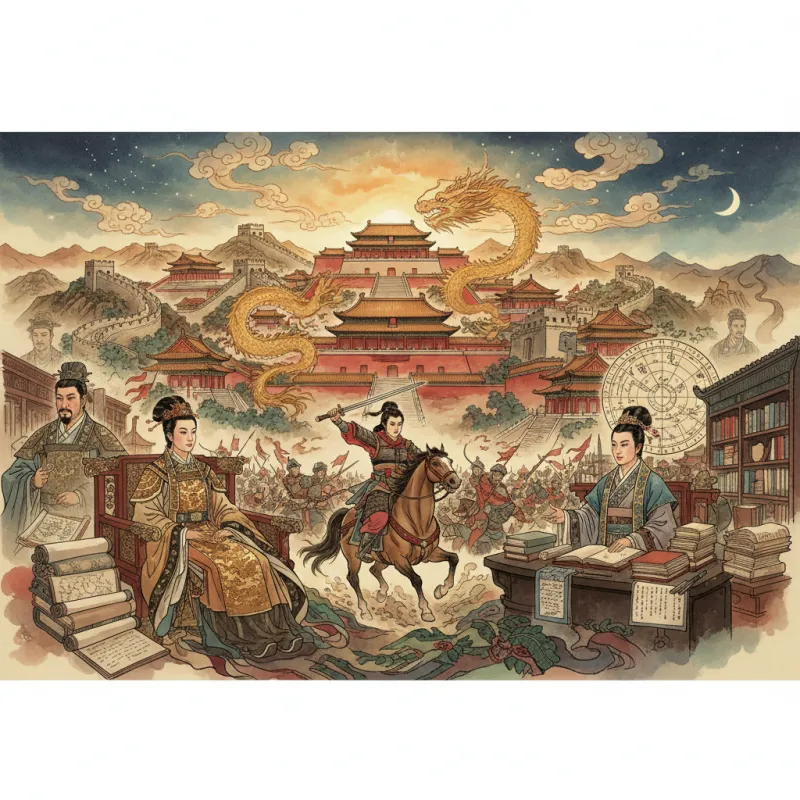
The imperial library was burning. As flames consumed the Eastern Han capital in 92 CE, a woman named Ban Zhao (班昭) rushed not to save her family's treasures, but to rescue something more valuable: the unfinished manuscript of the Book of Han (汉书, Hàn Shū). Her brother had died before completing this monumental history, and the emperor had done something unprecedented—he'd asked a woman to finish it. What Ban Zhao didn't know was that her contribution would be systematically minimized for the next two millennia, her name appearing in footnotes while male historians claimed the glory.
This is the pattern of Chinese women's history: not absence, but erasure. Not silence, but silencing. The women existed. They wrote, ruled, invented, and shaped dynasties. Then male historians wrote them out, or wrote them down, reducing empresses to footnotes and scholars to curiosities. Recovering their stories means reading what wasn't said, examining what was dismissed as "women's writing," and recognizing that when official histories claim women did nothing, they're revealing more about the historians than the history.
Ban Zhao: The Woman Who Wrote History (Then Vanished From It)
Ban Zhao didn't just complete the Book of Han—she revolutionized it. When her brother Ban Gu (班固) died in 92 CE, he'd left the astronomical tables, chronological tables, and eight biographical chapters unfinished. These weren't minor sections. The astronomical tables established the mathematical and cosmological framework for understanding the dynasty. The chronological tables provided the temporal structure for the entire work. Without them, the Book of Han was unusable.
Emperor He (和帝, Hé Dì) summoned Ban Zhao to the palace. She was already in her forties, a widow, and a mother. She was also the most educated woman in the empire. She completed the tables with such mathematical precision and historical insight that the Book of Han became the model for all subsequent dynastic histories. Every official history written for the next 1,800 years followed the structure Ban Zhao established.
Then the erasure began. Later historians credited her brother with the entire work. When they mentioned Ban Zhao at all, they called her "the woman who helped" or "the brother's assistant." Some claimed she merely "copied" Ban Gu's notes. The mathematical tables she created from scratch? Attributed to her brother posthumously. The biographical chapters she researched and wrote? Described as "completed by the family."
But Ban Zhao's influence extended beyond the Book of Han. She became the tutor to Empress Deng Sui (邓绥, Dèng Suí) and the palace women, teaching them history, astronomy, mathematics, and classical literature. She wrote Lessons for Women (女诫, Nǚ Jiè), which modern readers often misinterpret as a conservative text promoting female subservience. Read in context, it's actually a strategic manual for women's survival and influence in a patriarchal system—a guide to working within constraints while maintaining intellectual autonomy. The women who shaped Chinese imperial politics understood this distinction.
Princess Pingyang: The General They Called a Princess
In 617 CE, as the Sui Dynasty collapsed into chaos, a woman raised an army. Not a small force—70,000 soldiers. Princess Pingyang (平阳公主, Píngyáng Gōngzhǔ), daughter of Li Yuan (the future Emperor Gaozu of Tang), didn't wait for her father and brothers to rescue her from the civil war. She sold her jewelry, recruited soldiers, and began conquering territory.
She was a brilliant military strategist. She captured the Huxian Pass, a critical strategic position. She coordinated with her father's forces to take Chang'an, the capital. She commanded troops in multiple successful campaigns. When she died in 623 CE, military honors were proposed for her funeral—drums, military music, the full ceremonial treatment given to generals.
Court officials objected. Women shouldn't receive military honors, they argued. It violated propriety. Emperor Gaozu, her father, overruled them: "The Princess personally beat the drums and led troops in battle. She was not merely a woman following her husband. How can we treat her funeral as an ordinary woman's?" She received full military honors, the only woman in Tang Dynasty history to do so.
Then the historians got to work. Later accounts downplayed her military achievements. They emphasized her role as a "dutiful daughter" helping her father. They suggested her husband actually commanded the troops (he didn't—he was elsewhere). They transformed a general into a princess, a commander into a supporting character. The 70,000 soldiers she commanded became a footnote. Her strategic victories became her father's triumphs.
Shangguan Wan'er: The Prime Minister Without the Title
Shangguan Wan'er (上官婉儿, Shàngguān Wǎn'ér, 664-710 CE) was born into a family condemned for treason. Her grandfather and father were executed when she was an infant. She and her mother became palace slaves. By age fourteen, she was drafting imperial edicts for Empress Wu Zetian (武则天, Wǔ Zétiān), the only woman to rule China in her own name. By her twenties, she was effectively running the government.
She didn't hold the title of prime minister—women couldn't hold official positions. But she performed every function of the role. She drafted policy, managed court politics, selected officials, and shaped the literary culture of the Tang Dynasty. Emperors and empresses relied on her judgment. When Empress Wu wanted to understand the political implications of a decision, she asked Shangguan Wan'er. When Emperor Zhongzong needed an edict written, Shangguan Wan'er wrote it. When the court needed to navigate factional conflicts, Shangguan Wan'er negotiated.
She was also a poet of extraordinary skill. She established literary salons, judged poetry competitions, and shaped Tang poetic aesthetics. Her poems were collected and studied. She influenced the development of regulated verse (律诗, lǜshī), the dominant poetic form of the Tang Dynasty.
In 710 CE, she was killed in a palace coup. The new regime destroyed most of her writings. Of the thousands of poems she wrote, fewer than forty survive. Her political writings were scattered or attributed to the emperors she served. Later historians described her as a "talented concubine" or a "palace woman who could write." They erased her political role entirely, reducing a prime minister to a poetess, a power broker to a pretty writer.
Her tomb was discovered in 2013, looted and damaged. Even in death, the erasure continued.
Huang Daopo: The Weaver Who Transformed an Economy
In the late 13th century, a peasant woman named Huang Daopo (黄道婆, Huáng Dàopó) revolutionized Chinese textile production. She didn't come from a scholarly family. She wasn't educated in the classics. She was a runaway child bride who fled to Hainan Island and learned advanced weaving techniques from the Li people (黎族, Lí zú).
When she returned to her hometown near Shanghai around 1295, she brought knowledge that would transform the regional economy. She introduced new cotton processing tools: a better cotton gin, an improved spinning wheel, and a revolutionary loom design. These weren't minor improvements—they increased productivity by orders of magnitude. She taught local women her techniques, establishing a textile industry that made the Jiangnan region wealthy.
The economic impact was enormous. Cotton cloth production exploded. The region became the textile center of China. Thousands of families prospered. The techniques Huang Daopo introduced remained standard for centuries.
After her death, local people built temples to honor her. They recognized what she'd accomplished. But official histories ignored her. When they mentioned textile innovations at all, they attributed them to anonymous "craftsmen" or vague "folk techniques." A woman who transformed an economy became invisible in the historical record.
It wasn't until the 20th century that historians began seriously studying her contributions. Even now, she's often presented as a folk hero or a legend, as if acknowledging her real achievements requires treating her as mythical.
The Pattern of Erasure
These aren't isolated cases. They're examples of a systematic pattern. Chinese women made history, then male historians unmade their contributions. The methods varied, but the result was consistent:
Attribution erasure: Women's work was credited to male relatives. Ban Zhao's historical writing became her brother's. Princess Pingyang's military victories became her father's.
Role minimization: Women who held power were described as helpers or assistants. Shangguan Wan'er, who functioned as prime minister, became a "talented concubine."
Genre dismissal: Women's writing was categorized as "women's literature" (闺秀文学, guīxiù wénxué), a separate and lesser category. This allowed historians to acknowledge women wrote while simultaneously dismissing their work as unimportant.
Moral reframing: Women's achievements were reinterpreted as violations of propriety. Princess Pingyang's military genius became evidence of the dynasty's chaos—a woman leading armies meant the social order had collapsed.
Physical destruction: Women's writings were destroyed, scattered, or left unpreserved. Shangguan Wan'er's thousands of poems reduced to forty. Ban Zhao's personal writings lost entirely.
The women who navigated imperial court politics understood these mechanisms and sometimes worked to counter them, but the institutional bias was overwhelming.
Reading What Wasn't Written
Recovering women's history requires new methods. Official histories are useful, but they must be read critically, with attention to what's absent, minimized, or dismissed. Unofficial sources—poetry collections, family records, local gazetteers, archaeological evidence—often preserve what official histories erased.
When a history mentions a woman briefly, then moves on, that's worth investigating. When a woman is described as "merely" doing something, that "merely" is doing heavy lifting. When women's contributions are attributed to male relatives, look for the original sources. When women's writing is dismissed as a minor genre, read it anyway.
The tomb of Shangguan Wan'er, discovered in 2013, contained evidence of her political importance that contradicted centuries of historical minimization. Archaeological evidence doesn't lie the way historians do. Physical artifacts—tools, buildings, inscriptions—preserve what texts erase.
Why This Matters Now
The erasure of women from Chinese history isn't just a historical problem. It shapes contemporary assumptions about women's capabilities, about Chinese culture, and about history itself. When we accept the historical narrative that Chinese women were passive, confined, and powerless, we're accepting a lie that male historians constructed.
The real history is more interesting. Chinese women were generals, historians, prime ministers, inventors, and poets. They shaped dynasties, transformed economies, and created literary traditions. They worked within severe constraints, but they worked—and their work mattered.
Recovering their stories isn't about adding women to an existing narrative. It's about recognizing that the existing narrative is incomplete, biased, and often deliberately false. It's about understanding that absence of evidence isn't evidence of absence—it's evidence of erasure.
Ban Zhao completed the Book of Han in the imperial library, establishing the model for all subsequent Chinese historical writing. Then historians spent two millennia minimizing her contribution. The irony is perfect: the woman who shaped how Chinese history would be written was herself written out of that history. But she existed. She wrote. She mattered. And now, finally, we're beginning to acknowledge what she and countless other women actually did.
Related Reading
- The Four Great Beauties of Ancient China: History and Legend
- Women Who Changed Chinese History: Warriors, Empresses, and Rebels
- The Empress Who Ruled China: Wu Zetian's Impossible Rise
- Wu Zetian: How China's Only Female Emperor Seized and Kept Power
- The Real Mulan: History, Legend, and the Disney Version
- Mohism: The Lost Philosophy of Universal Love
- Traditional Chinese Medicine: 2,500 Years of Healing
- Zhuge Liang: The Sleeping Dragon Who Became China's Greatest Strategist