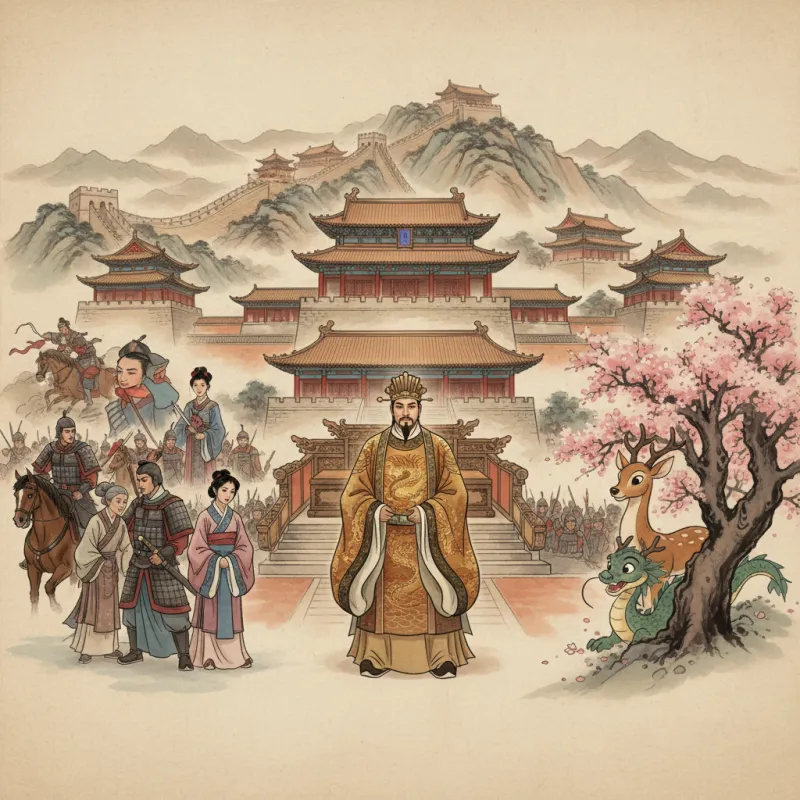
A young woman sits at her loom, weaving cloth in the dim light of an oil lamp. But her hands have stopped moving. The shuttle lies still. Instead of the rhythmic clack-clack of wood on wood, there's only the sound of sighing — deep, troubled sighs that her parents can hear from the next room. This scene, captured in a 1,500-year-old poem, is where one of China's most enduring legends begins. Not with battle drums or war cries, but with a daughter who knows what's coming and has already made her choice.
The Ballad That Started Everything
The Ballad of Mulan (木兰辞 Mùlán Cí) is deceptively simple — roughly 360 Chinese characters that pack more narrative punch than most modern novels. Scholars date it to the Northern Wei Dynasty (北魏 Běi Wèi, 386-534 CE), though the earliest surviving written version appears in the Musical Records of Old and New (古今乐录 Gǔjīn Yuèlù) from the 6th century. Unlike the elaborate historical chronicles that documented emperors and battles, this was a folk song, passed orally through generations before someone finally wrote it down.
The poem wastes no time. Mulan is weaving when the conscription notices arrive — the Khan (可汗 Kèhán) is raising an army, and every family must send a man. Her father's name is on the list. But her father is old, and her younger brother is still a child. The poem gives us her decision in stark, matter-of-fact language: "I'll buy a horse at the eastern market, a saddle at the western market, a bridle at the southern market, and a whip at the northern market." No dramatic speeches. No divine intervention. Just a woman methodically preparing for war.
What makes the ballad brilliant is what it doesn't say. We never learn which war Mulan fought in, or against whom. We don't know her family name (木兰 Mùlán means "magnolia," likely a given name or pseudonym). The poem skips over twelve years of military service in a single stanza: "Through a hundred battles, she crossed ten thousand miles." Then she's home, putting on her old clothes, and her comrades are shocked — "We traveled together for twelve years and never knew Mulan was a woman!"
This ambiguity is a feature, not a bug. It allowed every subsequent dynasty to claim Mulan as their own.
The Historical Hunt: Was She Real?
Here's where it gets messy. Chinese historians have been arguing about Mulan's historicity for centuries, and they've proposed at least four different time periods for her supposed life.
The Northern Wei theory is most popular because that's when the ballad emerged. The Northern Wei was founded by the Tuoba (拓跋 Tuòbá) clan, a Xianbei (鲜卑 Xiānbēi) people from the northern steppes who had adopted Chinese culture while retaining their nomadic military traditions. This hybrid culture — Chinese bureaucracy meets steppe warfare — created exactly the kind of environment where a woman might plausibly serve in the army undetected. The Xianbei had a tradition of women riding horses and handling weapons, unlike the more restrictive gender norms of Han Chinese society.
Some scholars place Mulan in the Sui Dynasty (隋朝 Suí Cháo, 581-618 CE), pointing to a general named Mulan who appears in historical records. But this Mulan was male, and the connection is probably coincidental. Others argue for the Tang Dynasty (唐朝 Táng Cháo, 618-907 CE), when the story gained widespread popularity. A few contrarians even suggest the Han Dynasty (汉朝 Hàn Cháo, 206 BCE-220 CE), though this seems like wishful thinking.
The truth? Mulan probably wasn't a single historical person. She's more likely a composite — a folk hero who crystallized around real stories of women who disguised themselves as men to serve in various wars. China's long history of warfare meant there were always women who, for various reasons, ended up in military camps. Some were discovered and punished. Some weren't. The ones who succeeded became whispered stories, and eventually those stories merged into the figure we call Mulan.
How Mulan Evolved Through the Dynasties
Every dynasty that retold Mulan's story reshaped her to reflect its own values, and tracking these changes is like watching Chinese culture argue with itself about what women should be.
During the Tang Dynasty, the story exploded in popularity. The Tang was relatively cosmopolitan and had several powerful women, including Empress Wu Zetian (武则天 Wǔ Zétiān), China's only female emperor. Tang versions of the Mulan story emphasized her military prowess and loyalty to the state. She became a model of 忠 (zhōng) — loyalty — one of the cardinal Confucian virtues, proving that women could embody traditionally masculine ideals.
The Ming Dynasty (明朝 Míng Cháo, 1368-1644 CE) gave us Mulan Joins the Army (木兰从军 Mùlán Cóngjūn), a full-length play by Xu Wei (徐渭). This version added romantic subplots and made Mulan more conventionally feminine when she returned home. The Ming was obsessed with proper gender roles and Neo-Confucian orthodoxy, so their Mulan had to be carefully domesticated — yes, she could fight, but only temporarily, and she rushed back to traditional femininity as soon as possible.
The Qing Dynasty (清朝 Qīng Cháo, 1644-1912 CE) produced the novel The Complete Account of Extraordinary Mulan (木兰奇女传 Mùlán Qínǚ Zhuàn), which turned her into a full-blown superhero with magical powers. This Mulan didn't just fight — she commanded armies, performed impossible feats, and became a general. The Qing, founded by the Manchu people who conquered China, had their own traditions of warrior women, and they weren't shy about celebrating female martial prowess.
Each version tells you more about the dynasty that created it than about any historical Mulan.
The Filial Piety Paradox
Here's what makes Mulan fascinating from a cultural perspective: she's a rebel who's also the perfect Confucian daughter. This shouldn't work, but it does.
Confucian society had strict rules about gender. Women belonged in the inner quarters (内 nèi), managing the household. Men belonged in the outer world (外 wài), engaging in politics and warfare. Cross-dressing was taboo. Women serving in the military was unthinkable. Mulan violated every single one of these norms.
But she did it for the most Confucian reason possible: 孝 (xiào), filial piety. She couldn't let her elderly father go to war, so she went instead. By breaking the rules, she upheld the deeper principle. This paradox is why Confucian scholars could celebrate her story instead of condemning it. She proved that women could be just as filial as men — maybe more so, since her sacrifice was greater.
The ballad emphasizes this brilliantly. When the Khan offers Mulan a government position as a reward for her service, she refuses. She doesn't want power or glory. She just wants to go home to her parents. This is the perfect Confucian ending: duty fulfilled, hierarchy restored, family reunited. The fact that she spent twelve years cross-dressed and killing people becomes almost irrelevant compared to her filial devotion.
It's a neat trick, and it's why Mulan's story survived when other tales of gender-bending women were suppressed or forgotten. She was subversive enough to be interesting but orthodox enough to be safe.
Disney's Mulan: What Changed and Why It Matters
When Disney released Mulan in 1998, they made changes that reveal the vast cultural gap between Chinese and American storytelling.
First, they added Mushu, the wise-cracking dragon sidekick. Chinese audiences found this baffling. Dragons (龙 lóng) are powerful, imperial symbols in Chinese culture — having one act as comic relief felt disrespectful. The original ballad has no magical elements at all; it's a realistic story about human courage and sacrifice.
Second, Disney made Mulan clumsy and uncertain at the beginning, a classic Western "finding yourself" narrative. The ballad's Mulan makes her decision immediately and never wavers. She doesn't need to discover her true self — she already knows who she is and what she must do. The Western obsession with individual self-actualization doesn't map onto the Chinese emphasis on duty and family obligation.
Third, Disney added a love story with Captain Li Shang. The original ballad mentions no romance whatsoever. Mulan's comrades are shocked when they discover she's a woman, but there's no suggestion that any of them were attracted to her or vice versa. The relationship that matters is between Mulan and her parents, not between Mulan and a man. By centering romance, Disney fundamentally changed what the story was about.
The 2020 live-action Mulan tried to correct some of these issues by removing Mushu and the songs, adding more Chinese cultural elements, and emphasizing 忠勇真 (zhōng yǒng zhēn) — loyalty, bravery, and truth. But it introduced new problems, like giving Mulan magical 气 (qì) powers from birth, which undermined the original story's message that ordinary people can do extraordinary things through courage and determination.
Both Disney versions struggled with a fundamental tension: American audiences expect heroes to rebel against oppressive systems and "be themselves," while the Chinese Mulan story celebrates someone who works within the system to fulfill her obligations. These are almost opposite moral frameworks, and trying to satisfy both created narrative incoherence.
Mulan's Modern Legacy
Today, Mulan appears everywhere in Chinese popular culture — TV dramas, films, operas, video games, even as a feminist icon in discussions of women's roles in modern China. But what she represents keeps shifting.
For some, she's proof that Chinese culture has always had strong female role models, countering Western stereotypes about Asian women being passive and submissive. For others, she's a cautionary tale about how women can only succeed by pretending to be men, highlighting ongoing gender discrimination. Some celebrate her as a military hero; others emphasize her as a devoted daughter. She's become a kind of cultural Rorschach test — everyone sees in her what they want to see.
The story's endurance suggests it touches something universal about the conflict between individual desire and family obligation, between social rules and human necessity. Mulan's choice — to sacrifice her own safety and comfort for her father's sake — resonates across cultures, even if the specific cultural context differs.
What's remarkable is that a 1,500-year-old folk ballad about a woman who probably never existed continues to generate new interpretations, new debates, and new versions. The Ballad of Mulan has survived longer than most Chinese dynasties. It's outlasted the very social system that created it. And it shows no signs of fading away.
The Unanswered Questions
The original ballad ends with a famous metaphor: "The male hare's feet go hop and skip, the female hare's eyes are muddled and fuddled. But when two hares run side by side, who can tell which is male and which is female?" It's a playful ending, but also a profound one. After twelve years of military service, after proving herself equal to any man in combat and leadership, Mulan returns to being a woman. But has she really? Can she?
The ballad doesn't answer this question, and maybe that's the point. Mulan exists in the space between categories — not quite a man, not quite a woman in the traditional sense, but fully human in a way that transcends both. She's a reminder that the boxes we create for people are always too small, and that sometimes the most heroic thing you can do is refuse to fit.
Whether she was real or not almost doesn't matter. The story is real. The questions it raises are real. And fifteen centuries later, we're still trying to answer them.
Related Reading
- Wu Zetian: How China's Only Female Emperor Seized and Kept Power
- Women Who Changed Chinese History: Warriors, Empresses, and Rebels
- Chinese Women Who Changed History (And Were Erased From It)
- The Four Great Beauties of Ancient China: History and Legend
- The Empress Who Ruled China: Wu Zetian's Impossible Rise
- Unveiling Ancient Chinese Innovations: A Journey Through Dynasties and Culture
- Chinese Philosophy in Five Minutes: Confucius, Laozi, and the Arguments That Shaped a Civilization
- Chinese Art and Calligraphy: The Four Arts Every Scholar Had to Master