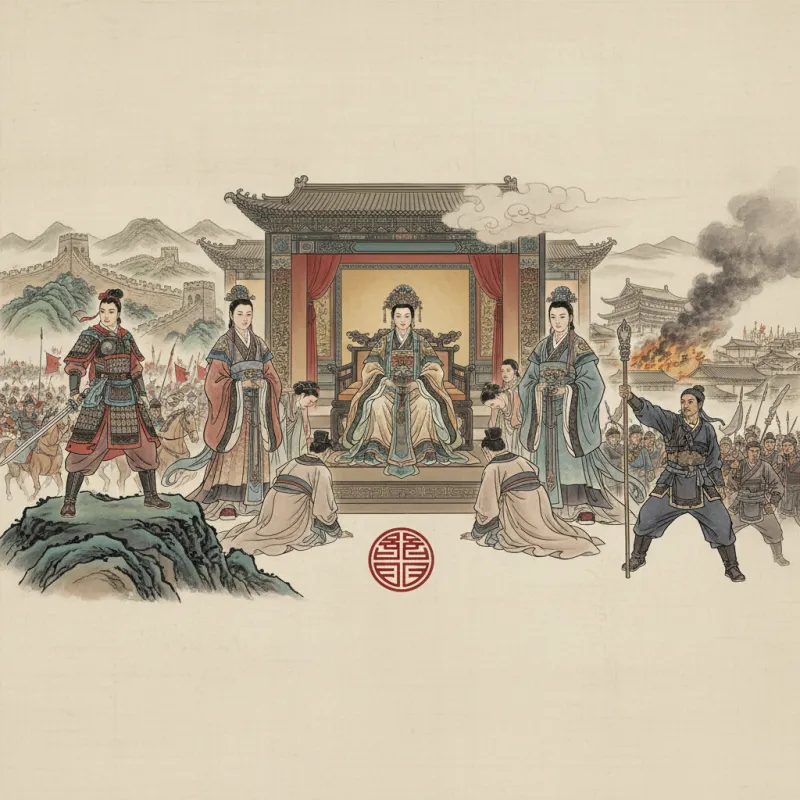
When Empress Wu Zetian 武则天 (Wǔ Zétiān) declared herself emperor — not empress, emperor — in 690 CE, she did something no woman in Chinese history had done before or since: she founded her own dynasty. She changed the name of the country itself to Zhou 周, erected monuments to her reign, and ruled with an iron fist for fifteen years. Then the official histories spent the next thirteen centuries trying to bury her under accusations of sexual depravity, cruelty, and illegitimacy. This is the pattern of women's history in China — extraordinary achievement followed by systematic erasure.
The Confucian Conspiracy Against Women's History
Chinese history, as traditionally written, is a story told by men about men. The Twenty-Four Histories — the official historical canon spanning from the mythical Yellow Emperor to the Ming dynasty — were compiled by male scholars working within a rigid Confucian framework that viewed women's participation in public life as fundamentally unnatural. The 科举 (kējǔ) examination system that produced these scholars was closed to women for its entire 1,300-year existence. The result? A historical record that treats women as footnotes, cautionary tales, or invisible altogether.
The phrase 红颜祸水 (hóngyán huòshuǐ, "beauty brings disaster") encapsulates this worldview perfectly. When dynasties fell, male historians blamed beautiful women — never the incompetent emperors who actually made the disastrous decisions. Daji 妲己, the consort blamed for the fall of the Shang dynasty, was described as a demon fox spirit who invented torture devices. Yang Guifei 杨贵妃, blamed for the An Lushan Rebellion that nearly destroyed the Tang dynasty, was just a woman who liked lychees. The emperor who abandoned his duties to spend time with her? Somehow less culpable.
But the archaeological and textual evidence tells a different story. Women commanded armies, administered provinces, wrote poetry that defined literary movements, and made the political decisions that kept empires running. Their stories survived despite the best efforts of Confucian historians to minimize them.
Warriors Who Led Armies
Fu Hao 妇好 (died c. 1200 BCE) is the earliest named female military commander in Chinese history, and her story only came to light in 1976 when archaeologists discovered her tomb at Yinxu, the Shang dynasty capital. The oracle bone inscriptions found there reveal that she wasn't just a consort of King Wu Ding — she was a military general who led campaigns of 13,000 soldiers against the Qiang and other tribes. Her tomb contained 130 weapons, including bronze battle-axes inscribed with her name. The Shang kings consulted the oracle bones before her military campaigns, treating her as a strategic asset, not a decorative wife.
Princess Pingyang 平阳公主 (died 623 CE), daughter of the Tang dynasty founder Li Yuan, raised her own army of 70,000 soldiers during the rebellion that overthrew the Sui dynasty. She didn't just fund troops or provide moral support — she personally commanded military operations, captured strategic territories, and coordinated with her father's forces. When she died, her father ordered a full military funeral with battle standards and drums, overruling officials who protested that such honors were inappropriate for a woman. The pass she captured was renamed Niangzi Pass 娘子关 (Niángzǐ Guān, "Lady's Pass") in her honor, and it still bears that name today.
Qin Liangyu 秦良玉 (1574-1648) is the only woman with a biography in the official Ming History's section on military commanders — not consorts, not empresses, but generals. She inherited command of her husband's tribal forces in what is now Sichuan and led them in battle for decades, fighting Japanese pirates, rebel forces, and the Manchu invasion. She was so respected that the Ming court gave her the title of General and consulted her on military strategy. When Beijing fell to the Manchus, she was one of the last commanders still fighting for the Ming cause.
Empresses Who Actually Ruled
The title 皇后 (huánghòu, empress) usually meant "emperor's wife," but some women turned it into actual political power. Empress Lü 吕后 (241-180 BCE) ruled the Han dynasty for fifteen years after her husband Liu Bang's death, first as regent for her son, then effectively as emperor herself. She eliminated rivals, appointed her own relatives to key positions, and maintained stability during a crucial transition period. The official histories paint her as a monster who tortured her husband's concubines, but they can't deny that the empire prospered under her rule.
Empress Dowager Cixi 慈禧太后 (Cíxǐ Tàihòu, 1835-1908) ruled China for 47 years, longer than any other woman in Chinese history. She started as a low-ranking concubine, became the mother of an emperor, and then maneuvered herself into power as regent. The standard narrative portrays her as a conservative obstacle to modernization who squandered money on her Summer Palace while China crumbled. The reality is more complex: she supported some reforms, navigated impossible political situations during China's most humiliating century, and maintained Qing power far longer than seemed possible. Was she a great ruler? Debatable. Was she a political genius who played a weak hand brilliantly? Absolutely.
But Wu Zetian remains the ultimate example. She didn't rule through a son or hide behind a regent's title — she declared herself 皇帝 (huángdì, emperor), the first and only woman to do so. She created new Chinese characters, including one for her own name. She promoted Buddhism over Confucianism partly because Buddhist texts were less hostile to female authority. She used secret police and ruthless purges to eliminate opposition, but so did most successful emperors. The difference is that when male emperors did this, historians called it "strong leadership." When Wu did it, they called it proof that women shouldn't rule.
Rebels and Revolutionaries
Not all influential women worked within the system. Some tried to burn it down. Qiu Jin 秋瑾 (1875-1907) was a poet, feminist, and revolutionary who fought against both the Qing dynasty and the traditional gender system that confined women. She left her arranged marriage, went to Japan to study, learned bomb-making, and returned to China to organize armed uprising. She dressed in men's clothing, practiced swordsmanship, and wrote poetry comparing herself to famous male warriors. When the Qing authorities arrested her in 1907, she refused to confess under torture and was executed at age 31. She became a martyr for both the republican and feminist movements.
The Taiping Rebellion (1850-1864), one of the deadliest wars in human history, had surprisingly progressive gender policies for a 19th-century movement. Hong Xuanjiao 洪宣娇, sister of the rebellion's leader, commanded female battalions and held high rank in the Taiping hierarchy. The Taiping banned foot-binding, allowed women to take the civil service examinations, and gave women property rights. These policies didn't survive the rebellion's defeat, but they demonstrated that alternative gender systems were possible even in 19th-century China.
The Literary Women Who Shaped Culture
Military and political power weren't the only ways women influenced Chinese history. Li Qingzhao 李清照 (1084-1155), considered one of the greatest poets in Chinese history, wrote 词 (cí, lyric poetry) that defined the Song dynasty aesthetic. She wrote about love, loss, and the chaos of war with a directness that male poets rarely achieved. Her work was so good that later scholars couldn't believe a woman wrote it and tried to attribute it to male poets.
Ban Zhao 班昭 (45-116 CE) completed her brother's historical work, the Book of Han, making her one of China's first female historians. She also wrote Lessons for Women (女诫 Nǚjiè), which modern readers often dismiss as a Confucian conduct manual teaching women to be submissive. But read in context, it's more subversive than it appears — Ban Zhao argued that women needed education and that wives should be intellectual companions to their husbands, radical ideas for her time.
The tradition of 才女 (cáinǚ, talented women) — educated women who wrote poetry, painted, and participated in literary culture — persisted throughout Chinese history despite official disapproval. These women created networks, mentored each other, and preserved their work even when the official literary establishment ignored them. Their poetry collections, often published privately or circulated in manuscript, offer a counter-narrative to the male-dominated official culture.
Why Their Stories Matter Now
The systematic minimization of women's roles in Chinese history wasn't just about the past — it shaped assumptions about what women could do in the present. When early 20th-century reformers argued that women should have education and political rights, conservatives cited "Chinese tradition" as evidence that such ideas were foreign imports. They conveniently forgot about Fu Hao, Princess Pingyang, and Wu Zetian.
The recovery of women's history in China has been a slow process. Archaeological discoveries like Fu Hao's tomb provided evidence that couldn't be dismissed or reinterpreted. Feminist scholars in China and abroad have reexamined the historical sources, reading between the lines of texts written by hostile male historians. The result is a much richer, more accurate picture of Chinese history — one where women were active participants, not passive victims or dangerous temptresses.
This matters because history shapes how we imagine the future. When people say "women have never ruled China," they're wrong — Wu Zetian ruled for fifteen years. When they say "Chinese women were always confined to the home," they're ignoring Princess Pingyang's army and Qin Liangyu's military career. When they claim that feminism is a Western import incompatible with Chinese culture, they're forgetting Qiu Jin and the Taiping women warriors.
The women who changed Chinese history didn't do it by being perfect or by conforming to modern feminist ideals. They were complicated, sometimes ruthless, often working within systems that oppressed other women even as they carved out power for themselves. Wu Zetian's reign included brutal purges. Empress Lü tortured her rivals. But their complexity is precisely what makes them interesting — they were political actors making difficult choices in difficult circumstances, not symbols or saints.
Recovering the Lost Narratives
The project of recovering women's history in China continues. Every few years, new archaeological discoveries reveal more evidence of women's participation in ancient Chinese society. Scholars are reexamining familiar texts with new questions, finding women's voices in sources that previous generations of historians overlooked. The internet has made it easier for Chinese feminists to share research and challenge official narratives.
But resistance persists. Textbooks still minimize women's roles. Popular historical dramas focus on palace intrigue and romance rather than women's actual political and military achievements. The phrase 红颜祸水 still gets used, usually as a joke, but jokes reveal underlying assumptions.
The women who changed Chinese history deserve better than to be remembered as footnotes, villains, or romantic figures. They deserve to be understood as what they were: political actors, military commanders, writers, and rebels who shaped one of the world's oldest continuous civilizations. Their stories aren't just "women's history" — they're Chinese history, period. The fact that we have to specify "women who changed Chinese history" as a separate category reveals how much work remains to be done.
For more on how women navigated power in imperial China, see Women in the Forbidden City. The contrast between official Confucian ideology and actual practice is explored further in Confucianism and Women's Roles.
Related Reading
- Chinese Women Who Changed History (And Were Erased From It)
- The Real Mulan: History, Legend, and the Disney Version
- The Empress Who Ruled China: Wu Zetian's Impossible Rise
- The Four Great Beauties of Ancient China: History and Legend
- Wu Zetian: How China's Only Female Emperor Seized and Kept Power
- Innovations of Ancient China: How Dynasties Shaped World-Changing Inventions
- The Grand Canal: China Greatest Engineering Project
- Chinese Astronomy: Mapping the Stars for 4000 Years