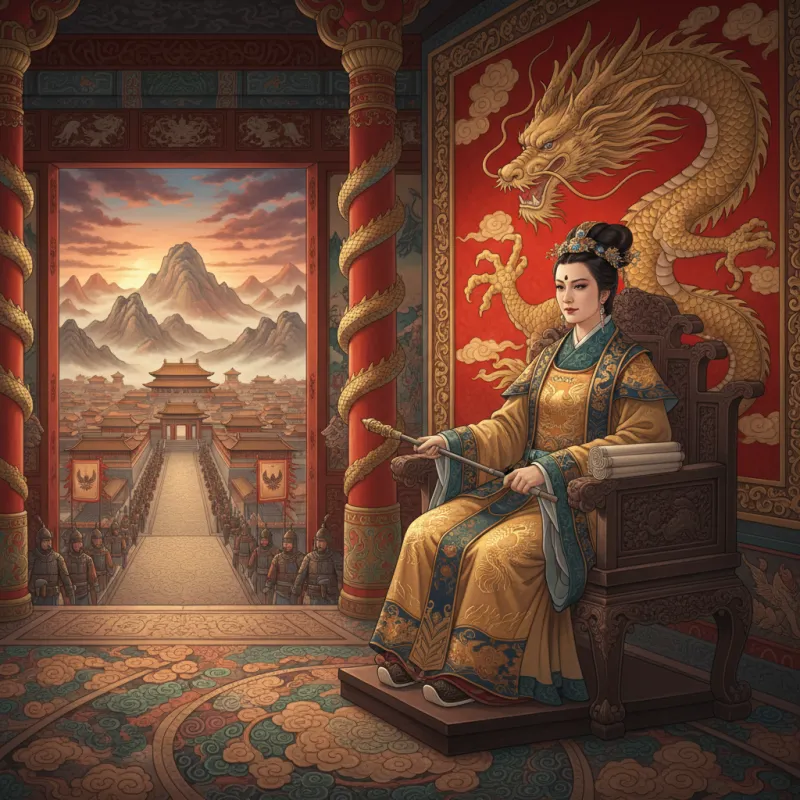
A fourteen-year-old girl walks into the Forbidden City as a fifth-rank concubine — one of dozens warming the bed of an aging emperor. Forty years later, she sits on the Dragon Throne itself, having outmaneuvered, outlasted, and occasionally eliminated everyone who stood between her and absolute power. Wu Zetian (武则天, Wǔ Zétiān, 624–705 CE) didn't just break the rules. She rewrote them, then had them carved in stone with her name on top.
Her story isn't a fairy tale. It's a political thriller spanning four decades, three emperors, countless corpses, and one fundamental question: how does someone with zero institutional power in a rigidly patriarchal system become the most powerful person in the empire?
The Fifth-Rank Concubine Who Refused to Disappear
When Wu entered Emperor Taizong's palace in 637 CE as a 才人 (cáirén) — a "talented lady" concubine of the fifth rank — she had about as much political capital as a potted plant. The imperial harem wasn't a meritocracy. It was a holding pen for beautiful women who existed to produce sons and stay quiet. Most fifth-rank concubines lived and died without the emperor remembering their names.
Wu had other plans. She cultivated literacy and political awareness, rare among concubines. When Taizong died in 649 CE, standard protocol dictated her fate: head shaved, sent to a Buddhist convent, forgotten. The emperor's son, now Emperor Gaozong, was supposed to inherit the throne, the empire, and a fresh harem. He wasn't supposed to inherit his father's concubines.
But Gaozong had noticed Wu during his father's reign. Within two years, he violated every rule of propriety and filial piety by bringing her back to the palace — not as a nun, but as his own concubine. Confucian scholars were horrified. Wu was delighted. She'd just executed the most audacious comeback in Chinese imperial history, and she was only getting started.
Eliminating the Competition (655–660 CE)
Gaozong already had an empress: Wang (王皇后, Wáng Huánghòu), a well-connected aristocrat who'd failed to produce a son. He also had a favorite concubine, Consort Xiao (蕭淑妃, Xiāo Shūfēi), who had produced children. Wu needed both of them gone.
The historical record gets murky here, thick with propaganda from both Wu's supporters and her enemies. The most notorious accusation: that Wu strangled her own infant daughter and framed Empress Wang for the murder. Whether true or fabricated, the story worked. By 655 CE, both Empress Wang and Consort Xiao were deposed, imprisoned, and — according to later accounts — brutally executed on Wu's orders, their hands and feet cut off and their bodies thrown into wine vats.
Wu became Empress Wu. But she didn't stop there. Over the next five years, she systematically purged the court of anyone loyal to the old empress or skeptical of her rise. The body count included high-ranking officials, military commanders, and members of the imperial family. She wasn't securing her position as empress. She was clearing the path to something unprecedented.
The Shadow Emperor (660–683 CE)
In 660 CE, Emperor Gaozong suffered a stroke. He didn't die, but he never fully recovered. For the next twenty-three years, Wu effectively ruled the Tang Dynasty from behind a screen — literally. Court protocol required her to sit behind a curtain during state meetings, invisible but omnipresent, whispering instructions to an increasingly incapacitated emperor.
This period reveals Wu's real genius: institutional manipulation. She didn't just accumulate personal power; she restructured the government to consolidate it. She expanded the 科举 (kējǔ) civil service examination system, promoting officials based on merit rather than aristocratic birth. This created a new class of bureaucrats who owed their positions to her, not to old noble families. She established the 铜匦 (tóngguǐ) — bronze petition boxes where anyone could submit complaints or suggestions directly to the throne, bypassing traditional channels and creating an intelligence network that reported to her.
She also cultivated a network of informants and secret police, the most notorious being the 酷吏 (kùlì) — "cruel officials" who investigated, tortured, and executed her enemies with bureaucratic efficiency. Confucian historians later demonized these figures, but they were effective. Dissent became dangerous. Loyalty became survival.
When Gaozong finally died in 683 CE, Wu had been the de facto ruler for over two decades. The question wasn't whether she had power. It was whether she'd settle for wielding it from behind the throne or claim it openly.
The Impossible Throne (684–690 CE)
Wu placed her third son, Li Zhe, on the throne as Emperor Zhongzong. He lasted six weeks before she deposed him for showing too much independence. She replaced him with her fourth son, Li Dan (Emperor Ruizong), who understood the assignment: sit quietly, sign what mother tells you to sign, and don't get ideas.
But Wu wasn't satisfied with puppet emperors. In 690 CE, at age sixty-five, she did something no woman in Chinese history had done: she declared herself 皇帝 (huángdì) — not empress dowager, not regent, but Emperor. She established a new dynasty, the Zhou (周, Zhōu), interrupting the Tang Dynasty and placing herself at its center.
The ideological gymnastics required to justify this were extraordinary. Confucian doctrine explicitly positioned women as subordinate to men in every context. The entire imperial system was built on patrilineal succession. Wu needed to dismantle fifteen hundred years of political philosophy without triggering a rebellion.
She did it through a combination of Buddhist theology, creative historiography, and shameless propaganda. She commissioned texts "proving" that she was the reincarnation of Maitreya Buddha, destined to rule. She elevated her mother's clan and created new noble titles for women. She had scholars compile the 《列女传》 (Liènǚ Zhuàn) — "Biographies of Exemplary Women" — highlighting powerful women throughout Chinese history, constructing a precedent where none existed.
Most importantly, she delivered results. The empire was stable, prosperous, and expanding. The bureaucracy functioned. The borders were secure. For most people, the gender of the person on the throne mattered less than whether the harvests were good and the taxes reasonable. Wu understood that legitimacy comes not just from tradition but from competence.
The Reformer Behind the Ruthlessness
History remembers Wu Zetian for the purges, the executions, the alleged infanticide. But her administrative reforms shaped the Tang Dynasty for generations. She expanded the examination system, breaking the aristocracy's stranglehold on government positions. She promoted officials based on ability, including men from humble backgrounds who would never have approached power under the old system.
She was also a patron of Buddhism, commissioning the massive Longmen Grottoes (龙门石窟, Lóngmén Shíkū) near Luoyang, where the largest Buddha statue reportedly bears her face. This wasn't just piety; it was political strategy. Buddhism, unlike Confucianism, had no inherent problem with female authority. By elevating Buddhism, Wu elevated herself.
Her military campaigns extended Tang influence into Central Asia and Korea. Her economic policies stabilized grain prices and expanded trade. She wasn't a perfect ruler — no emperor was — but she was an effective one. The empire she left behind was larger, richer, and more centralized than the one she'd entered as a fifth-rank concubine.
The Fall and the Verdict (705 CE)
In 705 CE, at age eighty, Wu was forced to abdicate. A palace coup led by officials loyal to the Tang restoration removed her from power and reinstalled her son as Emperor Zhongzong. She died later that year, and the Zhou Dynasty died with her. The Tang Dynasty resumed as if she'd been an interruption, an aberration, a mistake.
Confucian historians spent the next thousand years ensuring she'd be remembered as a monster: the concubine who murdered her way to power, the usurper who violated every principle of proper governance, the woman who proved why women shouldn't rule. They weren't entirely wrong about the murders. But they were wrong about the lesson.
Wu Zetian's story isn't about whether women should rule. It's about how power actually works. She understood that legitimacy is constructed, not inherited. That institutions can be reformed by those who control them. That competence matters more than tradition when the empire needs governing. That ruthlessness, while morally complicated, is often politically necessary.
She also understood something her critics never acknowledged: the system that kept women powerless wasn't natural or inevitable. It was a choice, maintained by force and ideology. She chose differently, and for fifteen years, she made it work.
Modern assessments of Wu Zetian are more nuanced than the Confucian condemnations. She was neither the demon of traditional historiography nor a feminist icon ahead of her time. She was a politician who saw an opportunity, seized it with both hands, and refused to let go until they pried the throne from her eighty-year-old fingers.
The Lessons of the Dragon Throne
Wu Zetian's career offers a masterclass in political power: how to acquire it without institutional support, how to maintain it against constant opposition, and how to use it to reshape the system that tried to exclude you. She built alliances with the marginalized, created new institutions loyal to her, eliminated threats before they materialized, and justified her rule through ideology and results.
She also paid the price. Her reputation was destroyed by the same historians whose positions she'd created. Her dynasty lasted only fifteen years. Her reforms were credited to the Tang emperors who came after. History tried to erase her, and nearly succeeded.
But she sat on the Dragon Throne. She ruled the largest empire on earth. She did it as a woman in a system designed to make that impossible. And whether you admire her or condemn her, you can't ignore her.
For more on powerful women who shaped Chinese history, see Empress Dowager Cixi and Ban Zhao: Scholar and Historian. Wu Zetian wasn't the only woman to wield power in imperial China, but she was the only one who claimed it openly, completely, and without apology.
Related Reading
- The Four Great Beauties of Ancient China: History and Legend
- Chinese Women Who Changed History (And Were Erased From It)
- Women Who Changed Chinese History: Warriors, Empresses, and Rebels
- The Real Mulan: History, Legend, and the Disney Version
- The Empress Who Ruled China: Wu Zetian's Impossible Rise
- Song Dynasty: The World's Most Advanced Civilization
- Zheng He's Treasure Fleet: When China Ruled the Seas
- Unraveling the Economic Tapestry of Ancient Chinese Dynasties