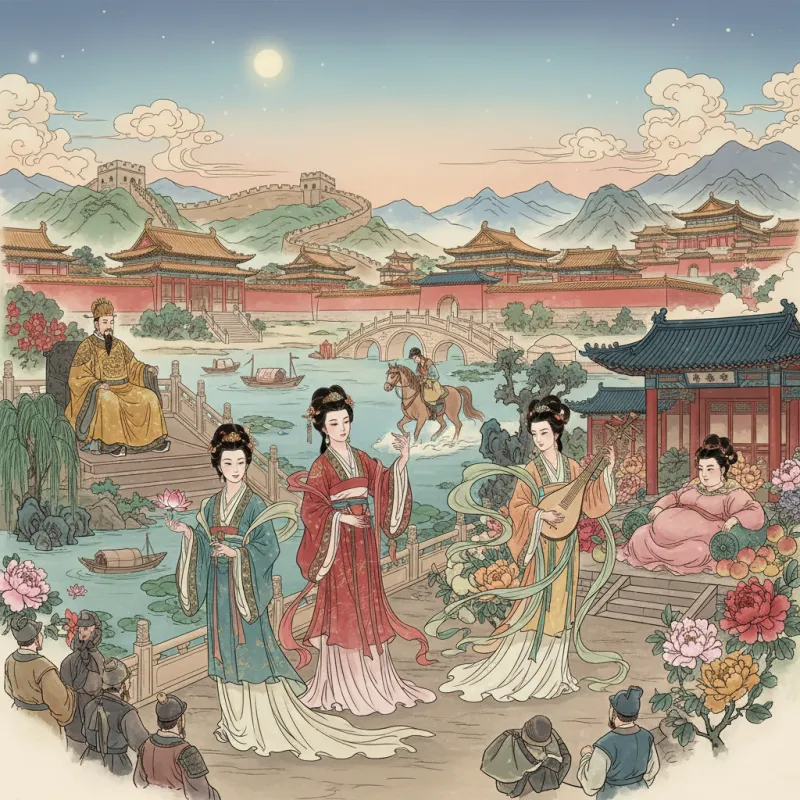
Four women. Four dynasties. Four catastrophes blamed on beauty rather than incompetence. The 四大美女 (sì dà měinǚ, "Four Great Beauties") of Chinese tradition weren't just legendary for their looks — they were scapegoats for political collapse, their stories weaponized to explain away the failures of emperors and kingdoms. Xi Shi, Wang Zhaojun, Diao Chan, and Yang Guifei: each supposedly so beautiful that fish forgot to swim, birds forgot to fly, the moon hid in shame, and flowers wilted in comparison. But strip away the poetic hyperbole and you'll find something more interesting than fairy tales about pretty faces. You'll find stories about how Chinese culture has always been deeply uncomfortable with female power, even when that power was entirely fictional.
Xi Shi: The Spy Who Came in from the Lake
Xi Shi (西施, Xī Shī) lived during the Spring and Autumn period, around 500 BCE, when the kingdom of Yue had just suffered a humiliating defeat at the hands of Wu. King Goujian of Yue, desperate for revenge, supposedly recruited Xi Shi — a simple washerwoman from a village — and trained her in the arts of seduction. The plan was straightforward: send her to King Fuchai of Wu as a "gift," let her beauty distract him from governance, and watch his kingdom crumble from within.
And according to legend, it worked. Fuchai became so obsessed with Xi Shi that he neglected his military, ignored his advisors, and built her an extravagant palace. Yue attacked. Wu fell. Mission accomplished.
Here's what bothers me about this story: Xi Shi gets all the blame for Wu's collapse, but she was essentially a human weapon deployed by Goujian. She had no agency in this plan. Yet Chinese literature remembers her as the beauty who "sank a kingdom" (沉鱼, chén yú, literally "sinking fish" — fish were so stunned by her reflection they forgot to swim and sank). The idiom celebrates her beauty while simultaneously making her responsible for a military defeat that had everything to do with Fuchai's incompetence and Goujian's strategic patience.
What happened to Xi Shi after Wu's fall? Nobody knows. Some versions say she sailed away with her lover Fan Li to live happily ever after. Others say Goujian's wife had her drowned, viewing her as a dangerous temptation. The uncertainty itself is telling — once she'd served her narrative purpose as the beautiful destroyer, Chinese historians lost interest in her actual fate.
Wang Zhaojun: The Diplomatic Sacrifice
Wang Zhaojun (王昭君, Wáng Zhāojūn) has the most historically grounded story of the four, though legend has thoroughly embroidered the facts. During the Han Dynasty (around 33 BCE), Emperor Yuan needed to secure peace with the Xiongnu, the nomadic confederation that constantly threatened China's northern borders. The solution: a marriage alliance. Wang Zhaojun, a palace lady, was selected to marry the Xiongnu chanyu (chieftain).
The popular version adds a twist: Wang Zhaojun was actually the most beautiful woman in the palace, but the court painter Mao Yanshou had painted her portrait unfavorably because she refused to bribe him. The emperor selected brides based on portraits, so Zhaojun was overlooked until the Xiongnu alliance required a sacrifice. Only when she appeared before the emperor for the farewell ceremony did he realize what he was losing. Too late — diplomatic commitments had been made.
This story does something clever: it criticizes imperial bureaucracy and corruption while still centering everything on female beauty. The real scandal should be that the emperor chose wives from paintings rather than meeting them, or that court painters could be bribed to alter women's fates. Instead, the story focuses on Zhaojun's beauty being "wasted" on barbarians, and on the emperor's regret. She becomes 落雁 (luò yàn, "falling geese") — geese supposedly fell from the sky in shock at her beauty when she traveled north.
Wang Zhaojun actually lived for decades among the Xiongnu, bore children, and by all accounts helped maintain peace between the Han and the steppe peoples. She was a successful diplomat. But Chinese literature prefers to imagine her as eternally homesick, playing melancholy songs on her pipa (琵琶, pípa, a traditional lute) while gazing south toward China. The message: even successful women who serve the state are tragic figures if they're separated from Chinese civilization. This connects to broader patterns in how Chinese culture viewed women's roles in imperial politics.
Diao Chan: The Fictional Weapon
Here's where things get interesting: Diao Chan (貂蝉, Diāo Chán) probably never existed. She appears in the 14th-century novel Romance of the Three Kingdoms (三国演义, Sānguó Yǎnyì), set during the chaotic period after the Han Dynasty's collapse around 190 CE. In the novel, the minister Wang Yun uses Diao Chan in a "chain stratagem" (连环计, liánhuán jì) to turn the tyrant Dong Zhuo against his adopted son, the warrior Lü Bu.
Wang Yun promises Diao Chan to both men. She plays along, flirting with Lü Bu while pretending to be Dong Zhuo's concubine. The two men become jealous rivals. Eventually Lü Bu kills Dong Zhuo, eliminating a major threat to the Han court. Diao Chan's beauty is described as 闭月 (bì yuè, "shaming the moon") — the moon supposedly hid behind clouds rather than compete with her.
What fascinates me is that Chinese culture needed to invent a beautiful woman to explain Lü Bu's betrayal of Dong Zhuo. The historical records suggest political and military factors, but Romance of the Three Kingdoms — which has shaped Chinese historical consciousness far more than actual histories — insists that a woman's beauty must have been involved. Even when creating fiction, the author defaulted to "beautiful woman causes political disaster" as the most plausible explanation.
Diao Chan has no agency in her own story. She's explicitly a tool used by Wang Yun. Yet she's remembered as one of the Four Great Beauties, celebrated and blamed in equal measure for Dong Zhuo's death. The novel doesn't even bother to tell us what happened to her afterward. She vanishes from the narrative once she's served her purpose.
Yang Guifei: The Concubine Who Broke an Empire
Yang Guifei (杨贵妃, Yáng Guìfēi, 719-756 CE) is the most recent and best-documented of the four beauties, and her story is the most tragic. She was the beloved consort of Emperor Xuanzong during the Tang Dynasty's height. Xuanzong, who had been a capable ruler for decades, became infatuated with Yang Guifei in his old age. He showered her with gifts, promoted her relatives to high positions, and increasingly neglected state affairs.
The Tang court's obsession with Yang Guifei created opportunities for ambitious men. Her distant relative Yang Guozhong became chancellor despite limited qualifications. The general An Lushan, who may have been Yang Guifei's lover (sources are unclear and probably exaggerated), gained enormous military power. In 755 CE, An Lushan rebelled, launching the catastrophic An Lushan Rebellion that killed millions and permanently weakened the Tang Dynasty.
As Xuanzong fled the capital with Yang Guifei, his own troops mutinied. They blamed the crisis on Yang Guifei and her family, and demanded her death. Xuanzong, faced with losing his army's loyalty, ordered Yang Guifei to commit suicide. She was strangled with a silk cord at age 37. Her beauty is described as 羞花 (xiū huā, "shaming flowers") — flowers supposedly wilted in her presence.
Here's what infuriates me about how this story is told: Yang Guifei gets blamed for the An Lushan Rebellion, but she held no official position and commanded no armies. Xuanzong was the emperor. He chose to neglect governance. He promoted Yang Guozhong. He trusted An Lushan with massive military forces. Every disastrous decision was made by men with actual power. Yang Guifei's only "crime" was being beautiful and accepting the emperor's affection.
The poet Bai Juyi's famous poem "Song of Everlasting Regret" (长恨歌, Chánghèn Gē) romanticizes Xuanzong's grief and longing for Yang Guifei after her death, but it also perpetuates the idea that her beauty caused the rebellion. The poem is gorgeous and heartbreaking, and it's also a masterpiece of blaming the victim. Yang Guifei was murdered by her lover's soldiers to appease a mutiny, and Chinese literature turned her into a cautionary tale about the dangers of female beauty rather than a story about imperial incompetence and military rebellion.
The Pattern: Beauty as Political Excuse
Look at these four stories together and a pattern emerges. Each beauty is associated with a political or military disaster: Wu's defeat, the Xiongnu alliance, Dong Zhuo's assassination, the An Lushan Rebellion. In each case, the disaster had complex political, military, and economic causes. In each case, Chinese tradition simplifies the story by blaming a beautiful woman.
This is the 红颜祸水 (hóng yán huò shuǐ, "beautiful woman brings disaster") trope, one of the most persistent themes in Chinese literature and historiography. It serves a useful purpose for male rulers and historians: it deflects blame from incompetent emperors and failed policies onto women who had little or no actual power. King Fuchai wasn't a fool who neglected his kingdom — he was bewitched by Xi Shi. Emperor Xuanzong didn't make catastrophic decisions — he was led astray by Yang Guifei.
The trope also reinforces the idea that female beauty is inherently dangerous and must be controlled. Women who are too beautiful become threats to political stability, not because they do anything wrong, but simply because men can't control themselves around them. The solution, according to this logic, is to restrict women's access to power and public life. The Four Great Beauties become arguments for female seclusion and subordination.
Why These Four?
China's history includes countless beautiful women, so why did these four become canonical? The answer lies partly in their geographic and temporal distribution. Xi Shi represents the ancient Spring and Autumn period and the south. Wang Zhaojun represents the Han Dynasty and the northern frontier. Diao Chan represents the Three Kingdoms period and the central plains. Yang Guifei represents the Tang Dynasty and the height of Chinese civilization. Together, they span Chinese history and geography, making them useful symbols for talking about beauty and disaster across different contexts.
Their stories also hit different notes. Xi Shi is the spy and seductress. Wang Zhaojun is the reluctant sacrifice. Diao Chan is the willing tool. Yang Guifei is the beloved concubine. They represent different ways that beautiful women could supposedly influence politics, giving Chinese literature a full palette of "beauty brings disaster" narratives to draw from.
The four idioms describing their beauty — sinking fish, falling geese, shaming the moon, wilting flowers — became a set phrase (沉鱼落雁,闭月羞花, chén yú luò yàn, bì yuè xiū huā) that's still used today to describe extraordinary beauty. The idioms are so embedded in Chinese culture that most people know them without knowing the full stories behind them.
The Modern Legacy
The Four Great Beauties remain cultural touchstones in modern China. They appear in films, TV dramas, operas, and novels. Tourist sites associated with them (often dubiously) attract visitors. Their images sell cosmetics and fashion. They're taught in schools as part of Chinese cultural literacy.
But modern retellings increasingly push back against the traditional narratives. Some contemporary versions emphasize the beauties' intelligence and agency rather than just their looks. Others explicitly critique the 红颜祸水 trope and the way these stories blame women for men's failures. Feminist scholars have written extensively about how the Four Great Beauties reflect patriarchal anxieties about female power and sexuality.
The tension between celebrating these women as cultural icons and recognizing how their stories perpetuate harmful stereotypes remains unresolved. They're simultaneously symbols of Chinese cultural heritage and examples of how that heritage has often been hostile to women's autonomy and dignity. You can appreciate the poetry and artistry of their stories while also recognizing the ugly politics embedded in them.
What the Stories Don't Say
What strikes me most about the Four Great Beauties is what their stories leave out. We know almost nothing about what these women (the ones who actually existed) thought, wanted, or believed. Their inner lives are blanks that Chinese literature filled with male fantasies and anxieties. Xi Shi's feelings about being used as a weapon? Unknown. Wang Zhaojun's actual experience among the Xiongnu? Reduced to homesickness. Yang Guifei's perspective on the rebellion and her own death? Silence.
The stories also erase these women's accomplishments. Wang Zhaojun was apparently an effective diplomat who helped maintain peace for decades, but that's not what she's remembered for. Yang Guifei was educated, talented in music and dance, and politically astute enough to navigate the Tang court for years, but her story reduces her to a beautiful distraction. Even Diao Chan, who's fictional, is denied any motivation beyond obedience to Wang Yun's plan.
This erasure matters because the Four Great Beauties aren't just historical curiosities. They're templates that have shaped how Chinese culture thinks about beautiful women for centuries. The message is clear: beauty is dangerous, beautiful women are responsible for men's bad decisions, and women's value lies in their appearance rather than their actions or thoughts. These are the stories that Chinese empresses and consorts had to navigate, and that continue to influence gender dynamics in Chinese society today.
The Four Great Beauties deserve better than the stories they've been given. They deserve to be remembered as complex human beings rather than as symbols of male anxiety about female beauty and power. But that would require rewriting centuries of literature and tradition, and confronting some uncomfortable truths about how Chinese culture has treated women throughout its history. Until then, we're left with these beautiful, troubling stories — celebrating and blaming four women for disasters they didn't cause, in a pattern that repeats itself across Chinese history and literature.
Related Reading
- The Empress Who Ruled China: Wu Zetian's Impossible Rise
- The Real Mulan: History, Legend, and the Disney Version
- Wu Zetian: How China's Only Female Emperor Seized and Kept Power
- Chinese Women Who Changed History (And Were Erased From It)
- Women Who Changed Chinese History: Warriors, Empresses, and Rebels
- Ancient Chinese Medicine: A Look into Dynasties and Healing Practices
- The Role of Trade in Shaping Ancient Chinese Dynasties and Culture
- Wu Zetian: China's Only Female Emperor