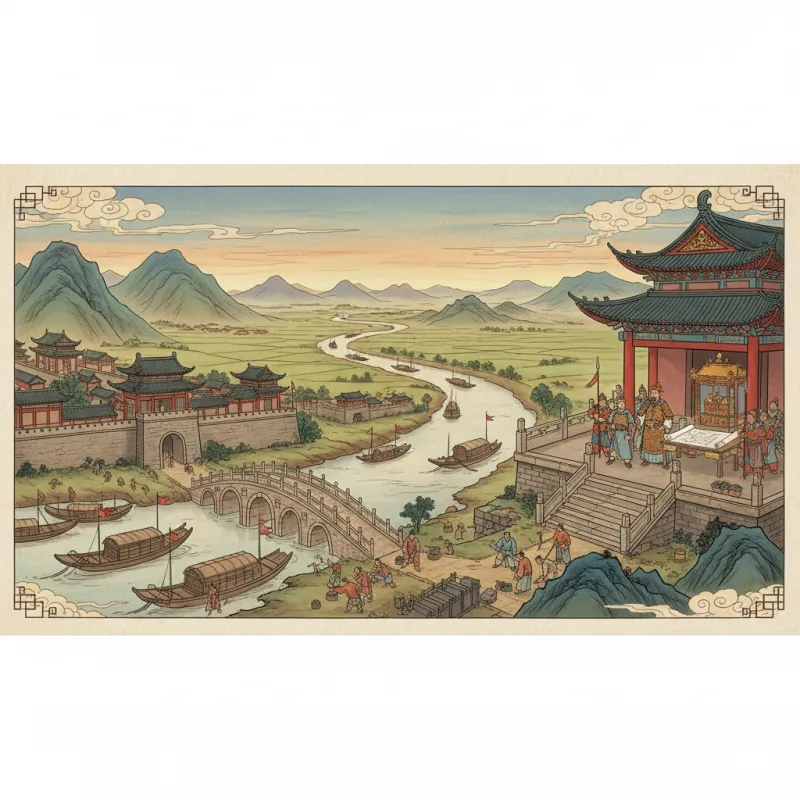
The Great Wall gets all the attention. It's photogenic, it's dramatic, and it's visible from... well, not from space, despite the myth, but it's certainly visible from nearby hills. Meanwhile, the Grand Canal (大运河, Dà Yùnhé) quietly did something far more impressive: it kept an empire fed, connected, and functioning for over a thousand years. While the Wall was built to keep enemies out, the Canal was built to hold China together — and it succeeded in ways the Wall never could.
Stretching 1,794 kilometers from Beijing to Hangzhou, the Grand Canal is the world's longest artificial waterway. But raw numbers don't capture what made it revolutionary. This wasn't just a ditch filled with water. It was a hydraulic engineering marvel that connected five major river systems, climbed elevation changes of over 40 meters, and required the invention of entirely new technologies to function. The pound lock, which wouldn't appear in Europe until the 15th century, was being used on Chinese canals by the 10th century. The Grand Canal didn't just move goods — it moved ideas, people, and power itself.
Why Build a River When You Already Have Rivers?
China has plenty of rivers. The Yellow River (黄河, Huáng Hé) and the Yangtze River (长江, Cháng Jiāng) are two of the world's longest, and dozens of smaller rivers crisscross the landscape. So why spend centuries and countless lives building an artificial one?
The answer is simple: China's natural rivers run east-west, but China's political and economic needs ran north-south. The fertile rice-producing regions were in the south, particularly around the Yangtze Delta. The political and military power centers were in the north, first in Luoyang and Xi'an, later in Beijing. Without a way to move southern grain to northern armies and bureaucrats, the empire couldn't function. Overland transport was prohibitively expensive — moving grain by cart cost roughly 30 times more than moving it by water. The empire needed a north-south waterway, so it built one.
The earliest sections date back to the 5th century BCE, when the State of Wu dug canals to move troops and supplies during the Warring States period. But the Grand Canal as we know it was primarily the work of the Sui Dynasty (581-618 CE). Emperor Yang (隋炀帝, Suí Yángdì) gets a bad reputation in Chinese history — he's often portrayed as a tyrant who bankrupted the empire with vanity projects. The Grand Canal was one of those projects, and yes, it did bankrupt the Sui Dynasty. Millions of laborers were conscripted, and hundreds of thousands died during construction. The Sui Dynasty collapsed shortly after the Canal's completion.
But here's the thing: every dynasty that came after the Sui used the Canal. The Tang, the Song, the Yuan, the Ming, the Qing — they all depended on it. Emperor Yang's "vanity project" became the economic backbone of imperial China. The Sui Dynasty paid the price, but every subsequent dynasty reaped the benefits. It's one of history's great ironies: the project that destroyed one empire made all the others possible.
The Engineering Challenge
Building a 1,800-kilometer canal through varied terrain isn't like digging a trench. The Grand Canal had to cross mountains, navigate different elevations, and connect river systems that flowed in different directions. The engineering challenges were immense, and the solutions were ingenious.
The most significant innovation was the pound lock (船闸, chuán zhá). Early canals used simple flash locks — basically dams with gates that could be opened to create a surge of water that would carry boats through. This wasted enormous amounts of water and was dangerous for the boats. The pound lock, developed during the Song Dynasty (960-1279 CE), created a chamber between two gates. A boat would enter the chamber, the gates would close, and water would be added or drained to match the level on the other side. This allowed boats to "climb" elevation changes efficiently and safely.
The Canal also required constant dredging. Silt from the Yellow River was a perpetual problem — the river carries so much sediment that it's literally named after its color. Keeping the Canal navigable required a permanent workforce of dredgers and maintenance crews. The Qing Dynasty (1644-1912 CE) employed over 20,000 workers just for Canal maintenance. This wasn't a build-it-and-forget-it project. It was a living system that required constant attention.
Water supply was another challenge. The Canal needed a steady flow of water, but it passed through regions with different rainfall patterns and competing demands for water. The solution was an elaborate system of feeder canals, reservoirs, and water gates that regulated flow. During the Yuan Dynasty (1271-1368 CE), engineer Guo Shoujing (郭守敬) redesigned portions of the Canal to improve water management, creating a system so efficient that parts of it are still in use today.
The Economic Engine
The Grand Canal transformed China's economy. Before the Canal, regional economies were largely self-contained. After the Canal, China became an integrated economic system. Rice from the Yangtze Delta fed the northern capitals. Silk from Hangzhou reached markets in Beijing. Tea, porcelain, salt, and countless other goods flowed along the waterway. The Canal created a national market centuries before similar systems emerged in Europe.
The grain tribute system (漕运, cáo yùn) was the Canal's primary function. Every year, millions of shi (石, a unit of volume roughly equivalent to 100 liters) of rice traveled north to feed the imperial bureaucracy, the military, and the capital's population. During the Ming Dynasty (1368-1644 CE), the annual grain shipment reached 4 million shi — roughly 400,000 tons of rice. This wasn't just logistics; it was the foundation of imperial power. Control the Canal, control the grain supply. Control the grain supply, control the empire.
Cities along the Canal prospered. Yangzhou (扬州), Suzhou (苏州), and Hangzhou (杭州) became wealthy commercial centers. Merchants, boatmen, dockworkers, warehouse operators, and countless others made their living from Canal trade. The Canal created a middle class of merchants and traders who operated outside the traditional Confucian hierarchy of scholars, farmers, artisans, and merchants. These Canal merchants accumulated wealth that rivaled the landed gentry, and their influence shaped Chinese society in ways that historians are still exploring.
The Canal also facilitated cultural exchange. Ideas, technologies, and cultural practices spread along the waterway. The spread of Neo-Confucianism during the Song Dynasty was aided by the Canal's ability to move scholars and books. The popularity of certain regional cuisines in distant cities can be traced to Canal trade routes. The Canal didn't just move goods — it moved culture itself.
The Dark Side
The Grand Canal's construction and maintenance came at an enormous human cost. The Sui Dynasty's initial construction conscripted millions of laborers, many of whom died from exhaustion, disease, or accidents. The exact death toll is unknown, but contemporary sources describe bodies piled along the construction route. Emperor Yang's reputation as a tyrant is partly deserved — he pushed the project forward with brutal efficiency, regardless of the human cost.
But the human cost didn't end with construction. Maintaining the Canal required constant labor. Dredging crews worked in dangerous conditions. Boatmen faced hazards from floods, storms, and accidents. The grain tribute system created opportunities for corruption — officials skimmed grain, demanded bribes, and exploited boatmen. The Canal was an economic engine, but it was also a system of exploitation.
The environmental impact was significant too. Diverting water from natural rivers affected ecosystems. The constant dredging and traffic disrupted aquatic life. The Canal's construction altered drainage patterns, sometimes causing floods in areas that had previously been safe. The Yellow River's tendency to change course — it shifted its mouth from north to south of the Shandong Peninsula multiple times — was partly exacerbated by Canal-related water management projects.
Decline and Revival
The Grand Canal's importance began to decline in the 19th century. The arrival of railways offered faster, more reliable transport. The Canal had always been vulnerable to floods, droughts, and silting — problems that trains didn't face. The Yellow River's course changes repeatedly damaged or destroyed sections of the Canal. By the early 20th century, much of the Canal was no longer navigable.
The founding of the People's Republic of China in 1949 brought renewed attention to the Canal. Restoration projects in the 1950s and 1960s made portions navigable again, though the Canal never regained its former economic importance. Modern highways and railways had taken over the transport function that the Canal once served.
But in recent decades, the Canal has found new life. In 2014, UNESCO designated the Grand Canal as a World Heritage Site, recognizing its historical and cultural significance. Tourism has brought economic benefits to Canal cities. The Chinese government has invested in restoration and preservation, viewing the Canal as a symbol of Chinese engineering prowess and historical continuity.
Today, portions of the Canal still carry commercial traffic, though nothing like the grain fleets of the imperial era. Cruise boats carry tourists through scenic sections. The Canal has become a cultural artifact, a reminder of what Chinese civilization achieved when it set its mind to connecting a vast empire.
The Canal's Legacy
The Grand Canal's influence extends far beyond its physical presence. It demonstrated that large-scale infrastructure projects could transform a civilization. It showed that engineering could solve political and economic problems. It proved that a centralized state could mobilize resources on an unprecedented scale.
The Canal also shaped Chinese attitudes toward infrastructure. The idea that the state should build and maintain large public works projects — roads, bridges, dams, canals — is deeply embedded in Chinese political culture. The modern Chinese government's enthusiasm for infrastructure projects, from high-speed rail to the Three Gorges Dam, echoes the imperial government's commitment to the Grand Canal. The scale may be different, but the underlying philosophy is the same: infrastructure is power, and the state should wield that power for the common good (or at least for the state's benefit).
The Canal influenced Chinese literature and art. Poets wrote about Canal scenes. Painters depicted Canal landscapes. The Canal appears in novels, plays, and folk tales. It became part of the Chinese cultural imagination, a symbol of both human achievement and human suffering.
Comparing the Grand Canal to other great infrastructure projects reveals its unique character. The Roman aqueducts were impressive, but they served individual cities, not an entire empire. The Silk Road was longer, but it was a network of routes, not a single engineered system. The Panama Canal is shorter and took less time to build. The Grand Canal stands alone in its combination of length, complexity, duration of use, and historical importance.
Why It Matters
The Grand Canal matters because it shows what's possible when a civilization commits to a long-term project. It wasn't built in a generation or even a century. It evolved over nearly two millennia, with each dynasty adding, modifying, and improving. It required sustained effort, technological innovation, and enormous resources. And it worked. For over a thousand years, it did exactly what it was designed to do: it held China together.
The Canal also matters because it challenges our assumptions about what makes infrastructure important. The Great Wall is famous because it's visible and dramatic. The Grand Canal is less famous because it's subtle and functional. But functionality matters more than drama. The Wall failed to keep invaders out — the Mongols, the Manchus, and others all breached it. The Canal succeeded in keeping the empire fed and connected. Which one was really more important?
The Grand Canal is a reminder that the most important achievements are often the least celebrated. It's not photogenic. It's not dramatic. It's just a long, flat waterway that quietly changed the course of Chinese history. And that's exactly why it deserves more attention than it gets.
Related Reading
- Ancient Chinese Currency: From Cowrie Shells to Paper Money
- The Porcelain Trade: How Chinese Pottery Conquered the World
- Chinese Porcelain: The Luxury Good That Changed World Trade
- The Tea Trade: How a Chinese Plant Reshaped the World
- Diplomacy and Cultural Exchange in Chinese Ancient Dynasties
- Unraveling the Economic Tapestry of Ancient Chinese Dynasties
- Confucius: Teachings That Shaped a Civilization