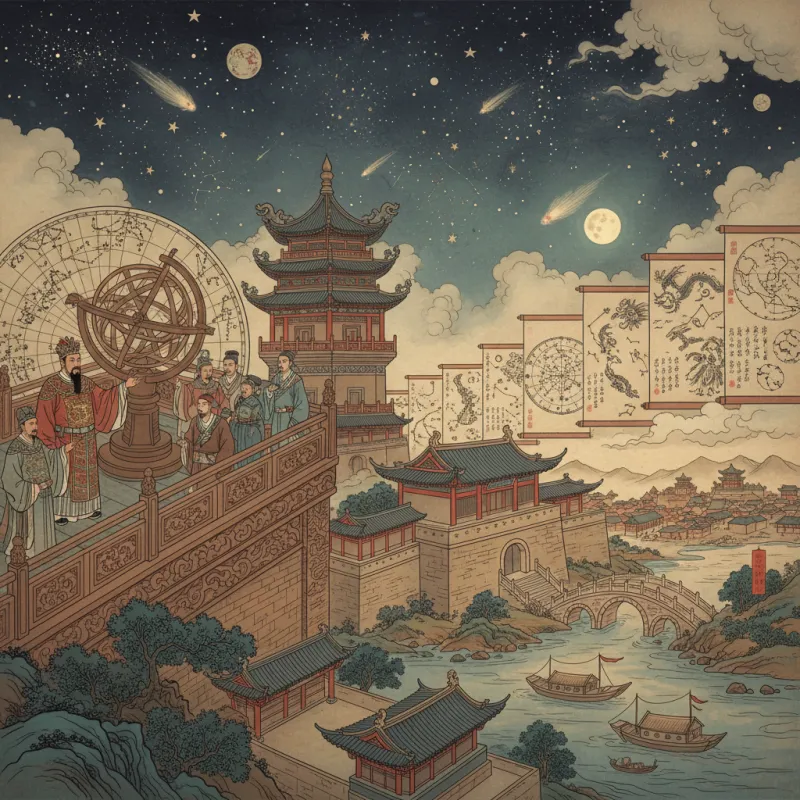
When a "guest star" blazed into view near the constellation we call Taurus in July 1054 CE, Chinese astronomers at the Song dynasty court didn't panic. They measured its position, recorded its brightness (visible even in daylight for 23 days), tracked its gradual fade over 653 days, and filed their observations in the official histories. Nearly a thousand years later, those meticulous notes helped modern astronomers identify the Crab Nebula as a supernova remnant — and confirmed that Chinese record-keepers had been watching the sky with scientific precision for millennia. That 1054 supernova? Europeans didn't record it at all. They were too busy arguing about theology to notice one of the most spectacular cosmic events of the medieval period.
The Emperor's Eyes on Heaven
Chinese astronomy wasn't stargazing for fun. It was statecraft. The Bureau of Astronomy (钦天监, Qīntiān Jiàn, literally "Imperial Observatory") held the same bureaucratic weight as the Ministry of War. Why? Because in Chinese political philosophy, the emperor ruled by the Mandate of Heaven (天命, tiānmìng), and heaven communicated through celestial phenomena. A solar eclipse at the wrong time could signal divine displeasure. A comet might herald rebellion or invasion. Miss predicting an eclipse, and you weren't just a bad astronomer — you were threatening the cosmic order that legitimized imperial rule.
This wasn't superstition dressed up as science. It was science motivated by political necessity. The pressure to get predictions right drove Chinese astronomers to develop increasingly sophisticated mathematical models. By the Han dynasty (206 BCE - 220 CE), court astronomers were using algebraic methods to calculate eclipse cycles. They had to be accurate within hours, or face imperial wrath. Some astronomers were executed for failed predictions. That's one way to ensure quality control.
The oldest confirmed astronomical observation in human history comes from oracle bone inscriptions during the Shang dynasty (商朝, ~1600-1046 BCE). These weren't vague references to "the moon was bright" — they recorded specific solar and lunar eclipses with dates precise enough that modern astronomers can verify them using computer models. We're talking about observations from 3,200 years ago that match our calculations to within days. The Babylonians were observing the sky around the same time, but their records are fragmentary. Greek astronomy came centuries later. Europe didn't develop comparable systematic observation until the Renaissance.
Star Maps and Celestial Bureaucracy
While European astronomers were still using Greek constellation names, Chinese astronomers had divided the sky into 283 asterisms (星官, xīngguān) grouped into 31 regions. This wasn't the Greek system of 48 constellations — it was far more detailed. The Chinese mapped the sky like they mapped their empire: as an administrative hierarchy. The central region around the north celestial pole represented the imperial palace. Surrounding regions corresponded to government ministries, military camps, marketplaces, and even the imperial harem.
The most important constellation was the Purple Forbidden Enclosure (紫微垣, Zǐwēi Yuán), circling the north pole. This was the emperor's celestial palace, and the pole star itself was the celestial emperor. When you understand this cosmology, you realize why the Forbidden City in Beijing was called "forbidden" and "purple" — it was the earthly mirror of the celestial palace. Architecture imitating astronomy imitating political structure. Everything connected.
Chinese astronomers created detailed star catalogs that rival anything produced in the West until the telescope era. The Gan-Shi Star Catalog (甘石星经, Gān Shí Xīng Jīng), compiled around 350 BCE by astronomers Gan De and Shi Shen, listed over 800 stars with position measurements. For comparison, Ptolemy's Almagest (150 CE) — considered the pinnacle of Greek astronomy — cataloged 1,022 stars. The Chinese were in the same league, and they got there earlier.
Instruments That Measured the Cosmos
The armillary sphere (浑仪, húnyí) was the Swiss Army knife of Chinese astronomy. Picture a complex arrangement of bronze rings representing celestial coordinates, with a sighting tube in the center. Rotate the rings, align the tube with a star, and read off its position. The earliest Chinese armillary spheres date to the Han dynasty, but they reached peak sophistication during the Song dynasty (960-1279 CE), when the polymath Su Song built a water-powered astronomical clock tower that automatically tracked celestial positions.
Su Song's clock tower, completed in 1094 CE, was an engineering marvel that combined an armillary sphere, a celestial globe, and a mechanical clock — all powered by a water wheel with an escapement mechanism. This was essentially a medieval computer for astronomical calculation. The tower stood 12 meters tall and employed a staff of astronomers to maintain it. When the Jin dynasty conquered northern China in 1127, they dismantled the tower and tried to rebuild it in their capital. They failed. The knowledge was too specialized, the engineering too precise.
Chinese astronomers also pioneered the gnomon (圭表, guībǐao) — a vertical pole that casts a shadow. Simple concept, profound applications. By measuring shadow lengths at noon throughout the year, astronomers could determine the solar year length, calculate the summer and winter solstices, and establish accurate calendars. The Zhou Bi Suan Jing (周髀算经, Zhōubì Suànjīng), an astronomical text from around 100 BCE, describes using gnomons to measure the sun's position and even estimate the distance to the sun (they got the method right, but the distance wrong — the sun is much farther than they calculated).
During the Yuan dynasty (1271-1368 CE), the astronomer Guo Shoujing built a gnomon 40 feet tall in Dengfeng, Henan province. It still stands today. Why so tall? Because a taller gnomon casts a longer shadow, allowing more precise measurements. Guo used this instrument to calculate the solar year as 365.2425 days — identical to the value in the modern Gregorian calendar, but he did it in 1280, three centuries before Pope Gregory XIII's calendar reform.
The Calendar Wars
Every dynasty needed a new calendar. Not because the old one was wrong (though it often was), but because issuing a calendar was an act of sovereignty. The emperor who controlled time controlled legitimacy. This led to what I call the "calendar wars" — intense competition among astronomers to create the most accurate calendar and win imperial favor.
The Chinese calendar is lunisolar, meaning it tracks both the moon's phases and the sun's annual cycle. This is mathematically complex. You need to predict new moons (for month beginnings) while keeping the calendar aligned with the solar year (for agricultural seasons). The solution? Intercalary months — extra months inserted every few years to keep things synchronized. Getting the intercalation rules right required sophisticated astronomical observation and calculation.
By the Tang dynasty (618-907 CE), Chinese astronomers had developed the Dayan Calendar (大衍历, Dàyǎn Lì), which could predict eclipses years in advance and calculated the solar year to within 50 seconds of the true value. The astronomer Yi Xing (一行, 683-727 CE), a Buddhist monk and mathematician, led the project. He organized a nationwide survey to measure the sun's shadow at different latitudes, essentially mapping China's geography through astronomy. This was science at imperial scale.
The calendar wasn't just for court use. Farmers needed to know when to plant and harvest. The 24 solar terms (二十四节气, èrshísì jiéqì) divided the solar year into periods marking seasonal changes: Start of Spring, Rain Water, Awakening of Insects, Clear and Bright, and so on. These terms, still used in Chinese agriculture today, show how astronomy directly served practical needs. Chinese agricultural innovations depended on accurate seasonal timing.
When Jesuits Met Mandarins
The collision between Chinese and European astronomy came in the early 17th century, when Jesuit missionaries arrived at the Ming court with telescopes and European astronomical tables. The Jesuits, led by Matteo Ricci and later Johann Adam Schall von Bell, saw astronomy as their ticket to converting China. They were right — sort of.
In 1629, the Ming court held an astronomical showdown. Chinese astronomers using traditional methods competed against Jesuits using European techniques to predict an eclipse. The Jesuits won. Their predictions were more accurate. This was humiliating for the Chinese astronomical establishment, but it opened the door for Jesuit influence. Schall von Bell was appointed director of the Imperial Observatory and tasked with reforming the Chinese calendar.
Here's the twist: the Jesuits didn't replace Chinese astronomy — they merged with it. Schall von Bell's "New Western Calendar" (新法历书, Xīnfǎ Lìshū) combined European planetary models with Chinese calendar structure and terminology. It was a hybrid system, and it worked. When the Qing dynasty (1644-1912) conquered China, they kept Schall von Bell in his position. The Manchu emperors understood that accurate astronomy was too important to let ethnic politics interfere.
The Jesuit period reveals something important: Chinese astronomy wasn't "backward" or "unscientific." It was optimized for different goals. Chinese astronomers excelled at positional astronomy — tracking where celestial objects appeared in the sky. European astronomers, influenced by Copernican heliocentrism, focused on explaining why objects moved as they did. Both approaches were scientific. They just asked different questions.
The Legacy Written in Stars
Chinese astronomical records are still scientifically valuable today. When astronomers want to study long-term phenomena like variable stars, supernova remnants, or comet orbits, they turn to Chinese historical texts. The 1054 supernova I mentioned at the start? Our understanding of the Crab Nebula's expansion rate depends partly on that Chinese observation. Japanese and Korean records (which borrowed Chinese astronomical methods) provide additional data points.
Chinese records of Halley's Comet go back to 240 BCE — every single apparition for over 2,000 years. European records are spotty until the Renaissance. When Edmund Halley calculated his comet's orbit in 1705, he used Chinese observations to verify its periodicity. Chinese astronomers had been tracking it for centuries; they just didn't realize it was the same comet returning.
The influence of Chinese astronomy spread throughout East Asia. Korean and Japanese astronomical traditions were essentially branches of the Chinese system, adapted to local needs. Vietnamese astronomy followed Chinese models. Even Islamic astronomers during the Mongol period incorporated Chinese observations and instruments. The Silk Road carried not just goods but astronomical knowledge.
Why It Matters Now
Chinese astronomy represents one of humanity's longest continuous scientific traditions. While European science experienced disruptions — the fall of Rome, the medieval period, religious conflicts — Chinese astronomical observation continued unbroken from the Shang dynasty through the Qing. That's 3,000+ years of accumulated data, refined methods, and institutional knowledge.
This continuity came at a cost. Chinese astronomy was so tightly bound to imperial bureaucracy that it struggled to adapt when the imperial system collapsed in 1912. The Republican period saw Chinese astronomers scrambling to catch up with Western astrophysics and cosmology. Modern Chinese astronomy is now world-class — China operates major telescopes, contributes to international projects, and recently landed a rover on the far side of the moon — but there was a century-long gap where the tradition nearly died.
What Chinese astronomy teaches us is that science doesn't develop in a vacuum. It's shaped by political structures, cultural values, and practical needs. The Chinese mapped the stars for 4,000 years not because they were more curious than other civilizations, but because their political system made astronomy essential. The emperor needed heaven's approval, and astronomers were the interpreters. That pressure — that need to be right or face consequences — drove innovation.
When you look up at the night sky, remember: humans have been watching those same stars for millennia, asking questions, making measurements, trying to understand our place in the cosmos. The Chinese did it longer and more systematically than almost anyone else. Their records are still teaching us things. That's a legacy worth celebrating.
Related Reading
- The Four Great Inventions: Paper, Printing, Gunpowder, and the Compass
- Chinese Astronomy: Mapping the Stars for 4,000 Years
- Traditional Chinese Medicine: 2,500 Years of Healing
- Chinese Science and Technology: Inventions That Changed the World (Before Europe Noticed)
- Emperor Wu of Han: The Warrior Emperor Who Shaped Chinese Identity
- Chinese Military Strategy: Sun Tzu and the Art of Winning Without Fighting
- The Three Kingdoms: History, Fiction, and Why Everyone's Obsessed