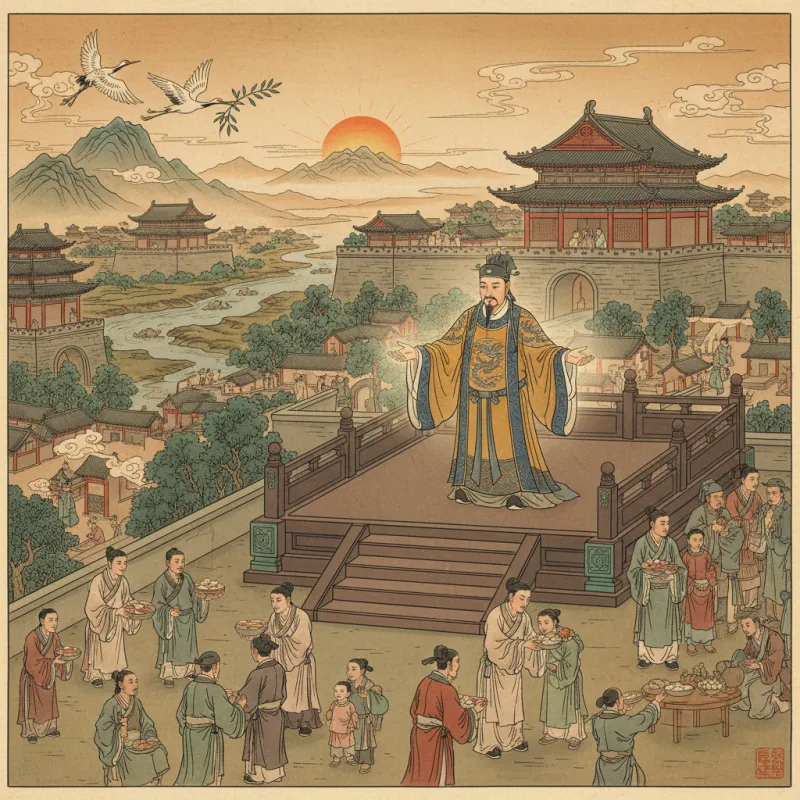
Picture this: Around 400 BCE, a man walks barefoot through the dust of the Warring States, his skin darkened by the sun, his robes patched and worn. He's just traveled three days without sleep to prevent a war. He's not a general or a diplomat. He's Mozi (墨子, Mòzǐ), and he's about to do something that would make Confucius roll over in his grave — he's going to argue that you should love a stranger's child exactly as much as you love your own.
For two centuries, this radical idea nearly won. Mohism wasn't some fringe cult. It was the dominant intellectual force challenging Confucianism, with organized chapters across China, a disciplined following that made early Christians look disorganized, and a leader who reportedly turned down a fief of ten thousand households because accepting it would contradict his principles. Then it vanished so completely that by the Han dynasty, scholars had to dig through imperial archives just to remember what Mohists believed.
The Carpenter Who Challenged Confucius
Mozi wasn't born into the scholar class. Most sources suggest he started as a craftsman, possibly a carpenter or siege engineer, which explains his obsession with practical utility and his contempt for Confucian ritual. While Confucians were debating the proper length of a mourning period, Mozi was asking: "Does this actually help anyone?"
His answer was usually no. He looked at the elaborate three-year mourning period Confucians demanded and saw economic disaster — fields left unplowed, businesses abandoned, families impoverished. He looked at expensive funerals with jade burial suits and ritual bronze vessels and saw resources that could feed the hungry. He looked at Confucian music and saw a waste of time that could be spent on productive labor. The Confucians called him a barbarian. He called them parasites.
But Mozi's real heresy wasn't his utilitarianism. It was his doctrine of "universal love" (兼爱, jiān ài) — the idea that you should care for all people equally, without the hierarchical distinctions that formed the bedrock of Confucian society. Confucius taught that love should flow outward in concentric circles: first your parents, then your siblings, then your extended family, then your community, and so on. Mozi said this was exactly the problem. Partial love — loving your own more than others — was the root cause of war, theft, and social disorder.
The Logic of Loving Everyone
Here's where Mohism gets interesting. Mozi wasn't making a sentimental appeal to human kindness. He was making a ruthlessly logical argument about self-interest. Why do states go to war? Because rulers love their own states more than others. Why do thieves steal? Because they love themselves more than their victims. The solution isn't to suppress self-interest — it's to expand the circle of who counts as "self."
If everyone practiced universal love, Mozi argued, there would be no war because attacking another state would be like attacking your own. There would be no theft because taking from others would be like taking from yourself. It's not mystical — it's game theory two thousand years before John Nash.
The Mohists backed this up with what might be the earliest systematic logic in Chinese philosophy. The "Mohist Canons" (墨经, Mòjīng) contain definitions, logical principles, and methods of argumentation that parallel Aristotle's work in Greece. They distinguished between necessary and sufficient conditions. They understood the concept of logical contradiction. They even dabbled in early mathematics and physics, with surprisingly accurate observations about optics, mechanics, and geometry.
This wasn't philosophy as aesthetic contemplation — it was philosophy as engineering. The Mohists wanted to build a better society the way you'd build a better siege engine: through careful observation, logical reasoning, and practical testing.
The Mohist War Machine
And speaking of siege engines — the Mohists were famous for them. This is where the movement gets genuinely strange. These pacifist philosophers who preached universal love were also the most feared defensive military specialists in China. Mohist engineers would travel to small states threatened by larger neighbors and help them build impregnable fortifications. They had detailed manuals on defensive warfare, covering everything from fire-fighting techniques to psychological warfare against besieging armies.
The most famous story involves Mozi himself. When he heard that the powerful state of Chu was planning to attack the small state of Song using a new siege weapon, he walked for ten days to reach the Chu capital. There, he challenged Gongshu Ban (公输班, Gōngshū Bān), the inventor of the weapon, to a simulation. Using his belt as the city walls and sticks as weapons, Mozi defeated nine different attack strategies. When Gongshu Ban said he knew how to defeat Mozi but wouldn't say it aloud, Mozi replied: "I know what you're thinking, and I won't say it either." He'd already sent three hundred of his disciples to Song to prepare the defenses. The invasion was called off.
This wasn't hypocrisy — it was consistent with Mohist principles. They opposed aggressive warfare but supported defensive warfare because defense protected the innocent. They were philosophical pacifists but practical realists, which might explain why they survived as long as they did in the brutal Warring States period.
The Discipline That Confucians Envied
The Mohist organization was unlike anything else in ancient China. They had a supreme leader called the "juzi" (钜子, jùzǐ) who commanded absolute loyalty. Members lived communally, shared resources, and were expected to sacrifice personal comfort for the movement's goals. They wore simple clothing, ate plain food, and traveled constantly to spread their teachings and help states under threat.
This wasn't a loose network of scholars debating in gardens. It was a disciplined organization with chapters across China, a clear hierarchy, and members who would die for their principles. One story tells of a Mohist leader whose son committed murder. The local lord wanted to pardon him out of respect for the father, but the father insisted his son be executed according to Mohist law. When Confucians heard this story, they were horrified — it violated filial piety. When Mohists heard it, they saw a man who truly practiced universal love, treating his son no differently than any other criminal.
This organizational strength was both Mohism's greatest asset and, ultimately, its fatal weakness. The movement could mobilize resources and coordinate action in ways that loose networks of Confucian scholars couldn't match. But it also meant that when the movement collapsed, it collapsed completely. There was no gradual decline, no splintering into competing schools that might preserve some of the ideas. When the juzi line ended and the organization dissolved, Mohism simply ceased to exist.
Why Mohism Lost
The standard explanation is that Mohism was too demanding. Universal love required you to treat strangers like family, which felt unnatural and impossible. The strict lifestyle — no music, no elaborate rituals, no personal luxuries — was too austere for most people. And the emphasis on utility over culture made Mohism feel cold and mechanical compared to the rich aesthetic tradition of Confucianism.
But I think the real reason is more political. Mohism was a philosophy for a world of small, competing states where defensive alliances and mutual aid made sense. When Qin unified China in 221 BCE, that world disappeared. The new empire didn't need defensive military specialists — it needed administrators who could manage a vast bureaucracy. It didn't need universal love — it needed a hierarchical ideology that justified imperial authority. Confucianism, with its emphasis on loyalty to superiors and its elaborate ritual system that reinforced social hierarchy, was perfect for empire. Mohism, with its egalitarian principles and its suspicion of authority, was dangerous.
The Han dynasty made Confucianism the official state ideology, and that was essentially the end. Mohist texts were preserved in imperial libraries, but nobody read them. The ideas were too foreign, too challenging to the social order. By the Tang dynasty, even scholars who studied ancient philosophy barely mentioned Mohism. It became a historical curiosity, a footnote in the story of Chinese thought.
The Modern Rediscovery
Mohism stayed dead for over a thousand years. Then, in the late 19th and early 20th centuries, Chinese intellectuals looking for alternatives to Confucianism rediscovered it. Suddenly, Mozi looked remarkably modern. His utilitarianism anticipated Jeremy Bentham. His logic anticipated Western philosophy. His egalitarianism anticipated socialism. His pacifism anticipated the anti-war movements of the 20th century.
Scholars like Liang Qichao (梁启超, Liáng Qǐchāo) championed Mohism as proof that China had its own tradition of scientific thinking and democratic values. Sun Yat-sen, the founder of the Republic of China, praised Mohist ideas about meritocracy and mutual aid. Even Mao Zedong, in his early writings, showed Mohist influence in his emphasis on serving the people and his suspicion of traditional hierarchy.
But here's the irony: modern admirers of Mohism tend to cherry-pick the parts they like — the logic, the egalitarianism, the proto-scientific thinking — while ignoring the parts that make Mohism genuinely strange. They skip over Mozi's belief in ghosts and spirits who punish wrongdoers. They downplay his religious justification for universal love, which wasn't based on human sentiment but on the "will of Heaven" (天志, tiān zhì). They ignore his genuine hostility to art, music, and culture, which he saw as wasteful distractions from productive labor.
The real Mohism wasn't a proto-modern philosophy waiting to be discovered. It was a radical, demanding, sometimes bizarre system of thought that made sense in its own context but doesn't translate easily to ours. That's what makes it fascinating.
What We Lost
I sometimes wonder what Chinese philosophy would look like if Mohism had survived. Not as the dominant ideology — that probably would have been just as stifling as Confucian orthodoxy — but as a living tradition in dialogue with Confucianism and Daoism.
Would Chinese culture have developed a stronger tradition of formal logic? Would the emphasis on utility and practical benefit have led to earlier scientific development? Would the egalitarian principles have created pressure for more democratic institutions? Or would Mohism have evolved and compromised, becoming just another tool for imperial control like Confucianism did?
We'll never know. What we do know is that for a brief moment in the Warring States period, there was a genuine alternative to the hierarchical, ritual-bound, family-centered worldview that would dominate Chinese thought for two millennia. A carpenter-philosopher argued that you should love everyone equally, that ideas should be judged by their practical utility, and that war was always wrong except in self-defense. Thousands of people believed him enough to give up personal comfort and risk their lives for his vision.
Then the empire came, and that vision became inconvenient. So it was forgotten, buried in archives, erased from memory. The disappearance of Mohism is a reminder that intellectual history isn't a story of inevitable progress where the best ideas win. Sometimes the best ideas lose because they threaten the wrong people at the wrong time. Sometimes entire ways of thinking can simply vanish, leaving barely a trace.
The texts survived, though. Buried in imperial libraries, copied by scribes who probably didn't understand what they were preserving, the Mohist writings waited. They're still waiting, really — waiting for us to figure out what to do with a philosophy that's too radical for its own time and too strange for ours.
Related Reading
- Legalism and the Qin Dynasty: When Ruthless Efficiency Built an Empire
- The Hundred Schools of Thought: China's Golden Age of Philosophy
- Chinese Philosophy in Five Minutes: Confucius, Laozi, and the Arguments That Shaped a Civilization
- Confucius vs. Laozi: The Debate That Shaped Chinese Civilization
- Exploring the Philosophical Legacy of China’s Ancient Dynasties
- Daily Life in Ancient China: What Ordinary People Actually Did All Day
- Three Kingdoms: The History That Became China's Greatest Story
- Unveiling the Role of Women in Ancient Chinese Dynasties