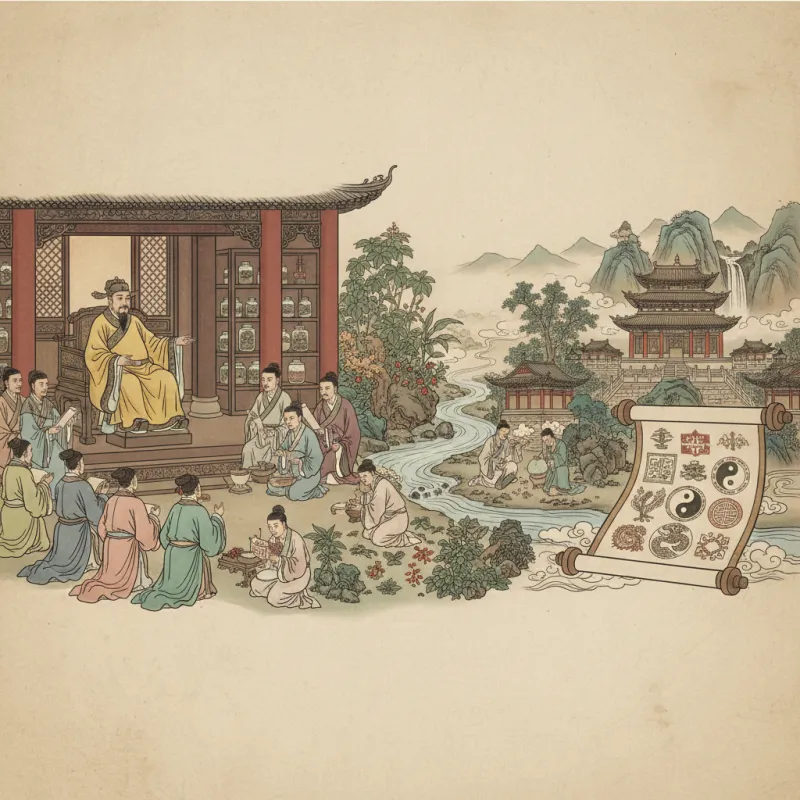
A physician in the Han dynasty court places three fingers on the emperor's wrist and closes his eyes. For several minutes, he feels the pulse at different positions and depths, detecting what he describes as twenty-eight distinct qualities — slippery, wiry, choppy, floating, sinking. From this alone, he claims to diagnose not just illness, but its root cause, its progression, and the patient's constitutional imbalances. To a modern doctor, this sounds like mysticism. To practitioners of Traditional Chinese Medicine (中医 zhōngyī), it's sophisticated diagnostic technique refined over millennia.
Traditional Chinese Medicine represents something genuinely unusual in medical history: a comprehensive healing system that developed almost entirely independently of Western medicine, yet survived into the modern era as a living practice rather than a historical curiosity. While Hippocratic medicine evolved into modern biomedicine, TCM maintained its theoretical framework largely intact — and today, roughly one-quarter of the world's population uses some form of it, either as primary healthcare or alongside conventional treatment.
The question isn't whether TCM "works" in the way modern clinical trials define efficacy (that debate generates more heat than light). What's historically fascinating is how a medical tradition based on entirely different assumptions about the body — no germ theory, no cellular biology, no biochemistry — could develop effective treatments for certain conditions and maintain institutional continuity for over two millennia.
The Foundational Texts: Medicine Meets Philosophy
TCM's theoretical foundation crystallized during the Warring States period (475-221 BCE) and early Han dynasty (206 BCE-220 CE), when Chinese thinkers were systematizing knowledge across multiple domains. The two texts that defined the tradition — the Huangdi Neijing (黄帝内经 Huángdì Nèijīng, "Yellow Emperor's Inner Canon") and the Shennong Bencao Jing (神农本草经 Shénnóng Běncǎo Jīng, "Divine Farmer's Materia Medica") — weren't written by single authors but compiled over generations, much like Confucian classics that shaped Chinese intellectual life.
The Neijing is particularly remarkable because it's not a practical medical manual but a theoretical treatise. It introduces concepts that would define TCM for the next two thousand years: qi (气 qì, vital energy), yin-yang (阴阳 yīn-yáng) balance, the five phases (五行 wǔxíng — wood, fire, earth, metal, water), and the system of meridians (经络 jīngluò) through which qi supposedly flows. These weren't empirical discoveries but philosophical frameworks borrowed from cosmology and applied to the body.
Here's what's interesting: the Neijing's authors were clearly aware they were theorizing. The text is structured as dialogues between the Yellow Emperor and his physician Qi Bo, asking fundamental questions about health and disease. It reads less like a medical textbook and more like natural philosophy — an attempt to understand the body through the same principles that explained seasonal changes, political harmony, and cosmic order.
The Shennong Bencao Jing took a different approach, cataloging 365 medicinal substances (a number chosen for symbolic resonance with the solar year) and their properties. This was practical pharmacology, describing which herbs treated which conditions based on accumulated clinical experience. Many of these remedies — like ma huang (麻黄 má huáng, ephedra) for respiratory conditions — contain active compounds that modern pharmacology has isolated and studied.
The Golden Age: Zhang Zhongjing and Clinical Practice
If the Neijing provided theory, Zhang Zhongjing (张仲景 Zhāng Zhòngjǐng, c. 150-219 CE) gave TCM its clinical foundation. His Shanghan Zabing Lun (伤寒杂病论 Shānghán Zábìng Lùn, "Treatise on Cold Damage and Miscellaneous Disorders"), later divided into two texts, remains the most influential clinical manual in TCM history.
Zhang wrote during a devastating epidemic that killed two-thirds of his extended family. His response was to systematically document disease patterns and treatment protocols — not abstract theory but specific formulas for specific presentations. He described six stages of "cold damage" disease progression, each requiring different herbal formulas. His approach was remarkably empirical: if the patient presents with these symptoms, use this formula; if symptoms change, modify accordingly.
What made Zhang's work endure was its practicality. He provided over 100 herbal formulas with precise ingredient ratios, many still prescribed today. Xiao Yao San (逍遥散 Xiāo Yáo Sǎn, "Free Wanderer Powder"), originally formulated for what TCM calls "liver qi stagnation," is now one of the most commonly prescribed formulas in modern China, used for conditions ranging from depression to menstrual irregularities.
Zhang also established the diagnostic method that defines TCM practice: pattern differentiation (辨证论治 biànzhèng lùnzhì). Rather than naming diseases, TCM identifies patterns — clusters of symptoms indicating specific imbalances. Two patients with the same Western diagnosis might receive completely different treatments based on their individual patterns. This personalized approach is what modern practitioners cite as TCM's strength, though it makes clinical research challenging.
Acupuncture: From Bronze Men to Modern Clinics
Acupuncture (针灸 zhēnjiǔ, literally "needle-moxibustion") developed alongside herbal medicine but followed a different trajectory. The earliest acupuncture needles were stone or bone; bronze and iron needles appeared during the Han dynasty. The practice was based on the meridian theory outlined in the Neijing — the idea that qi flows through specific channels in the body, and inserting needles at precise points could regulate this flow.
During the Song dynasty (960-1279 CE), the imperial medical bureau commissioned life-sized bronze statues with acupuncture points marked on the surface and hollow interiors filled with water. Students would insert needles at the correct points; if they hit accurately, water would leak out. These "bronze men" (铜人 tóngrén) represented the standardization of acupuncture technique, much as Song dynasty innovations standardized other technologies.
What's curious about acupuncture is that its mechanism remains genuinely unclear even to modern researchers. Clinical trials show it has effects beyond placebo for certain conditions — particularly chronic pain and nausea — but whether this relates to meridians, qi, or neurological mechanisms is debated. The traditional explanation (regulating qi flow) doesn't align with anatomical reality, yet the practice produces measurable physiological changes. This disconnect between theory and outcome is TCM's central puzzle.
The Qing Dynasty Crisis: Confronting Western Medicine
When Jesuit missionaries brought Western medical knowledge to China in the 17th century, TCM faced its first serious intellectual challenge. The Qing dynasty (1644-1912) saw increasing contact with European medicine, which could explain anatomy through dissection, understand infection through microscopy, and perform surgical procedures TCM couldn't match.
The response among Chinese physicians was mixed. Some dismissed Western medicine as crude and invasive, lacking TCM's sophisticated understanding of systemic balance. Others recognized its strengths in surgery and acute care while maintaining TCM's superiority for chronic conditions. A few attempted synthesis, trying to reconcile meridian theory with anatomical knowledge — efforts that satisfied neither tradition.
The real crisis came in the early 20th century, when Chinese intellectuals blamed traditional culture for China's weakness relative to Western powers. TCM became a target of modernizers who saw it as superstitious and unscientific. In 1929, the Nationalist government nearly abolished TCM entirely, proposing to phase out traditional practitioners and replace them with Western-trained doctors. Only massive protests by TCM practitioners and patients prevented this.
Communist Revival: Making TCM Scientific
Ironically, the Communist Party — ostensibly committed to scientific materialism — became TCM's savior. Mao Zedong, facing a shortage of Western-trained doctors and needing to provide healthcare to hundreds of millions of rural Chinese, pragmatically embraced TCM. His famous 1958 directive stated that "Chinese medicine is a great treasure house" that should be explored and elevated.
The Communist approach was to "scientize" TCM — strip away what they considered superstitious elements, standardize treatments, and integrate it with Western medicine. They established TCM universities, funded research, and created a system where hospitals offered both traditional and Western treatments. This wasn't preservation of tradition so much as reinvention, creating what some scholars call "Communist Chinese Medicine" — a modernized, institutionalized version quite different from pre-1949 practice.
This period also saw TCM's international expansion. The 1972 Nixon visit to China included a famous incident where a journalist's appendicitis was treated with acupuncture anesthesia, generating enormous Western interest. By the 1980s, acupuncture clinics were opening across the United States and Europe, though often divorced from TCM's broader theoretical framework.
The Modern Paradox: Global Spread, Contested Legitimacy
Today, TCM occupies a strange position. In China, it's fully integrated into the healthcare system — major hospitals have TCM departments, and practitioners receive university training alongside Western medicine. The Chinese government actively promotes TCM internationally as cultural soft power, funding TCM centers worldwide and pushing for WHO recognition.
Yet TCM's scientific legitimacy remains contested. Some herbal formulas have yielded important drugs — artemisinin, derived from qinghao (青蒿 qīnghāo, sweet wormwood) and used to treat malaria, won its discoverer Tu Youyou the 2015 Nobel Prize. But many TCM claims don't hold up to rigorous testing, and the theoretical framework of qi and meridians has no anatomical or physiological basis.
The debate often generates more heat than light because both sides talk past each other. TCM advocates point to clinical experience and patient outcomes; critics demand mechanistic explanations and controlled trials. TCM emphasizes holistic, individualized treatment; modern medicine requires standardized, reproducible protocols. These are fundamentally different epistemologies, different ways of knowing.
What's undeniable is TCM's historical achievement: maintaining institutional continuity and clinical practice for over two millennia, adapting to changing circumstances while preserving core concepts. Whether you view it as profound wisdom or pre-scientific medicine, it represents an alternative path medical knowledge could take — one that prioritized pattern recognition over reductionism, balance over intervention, and empirical observation within a philosophical framework that modern science would reject.
The tradition that began with Han dynasty physicians feeling pulses continues in clinics worldwide, its practitioners still using formulas Zhang Zhongjing prescribed 1,800 years ago. That persistence, regardless of how you evaluate TCM's efficacy, is historically remarkable — a medical tradition that refused to become merely historical.
Related Reading
- Chinese Astronomy: Mapping the Stars for 4000 Years
- Chinese Science and Technology: Inventions That Changed the World (Before Europe Noticed)
- Chinese Astronomy: Mapping the Stars for 4,000 Years
- The Four Great Inventions: Paper, Printing, Gunpowder, and the Compass
- Ancient Chinese Inventions the West Forgot to Credit
- Delving into Ancient China: A Journey Through Dynasties, Emperors, and Cultural Treasures
- 10 Ways Ancient China Changed the Modern World