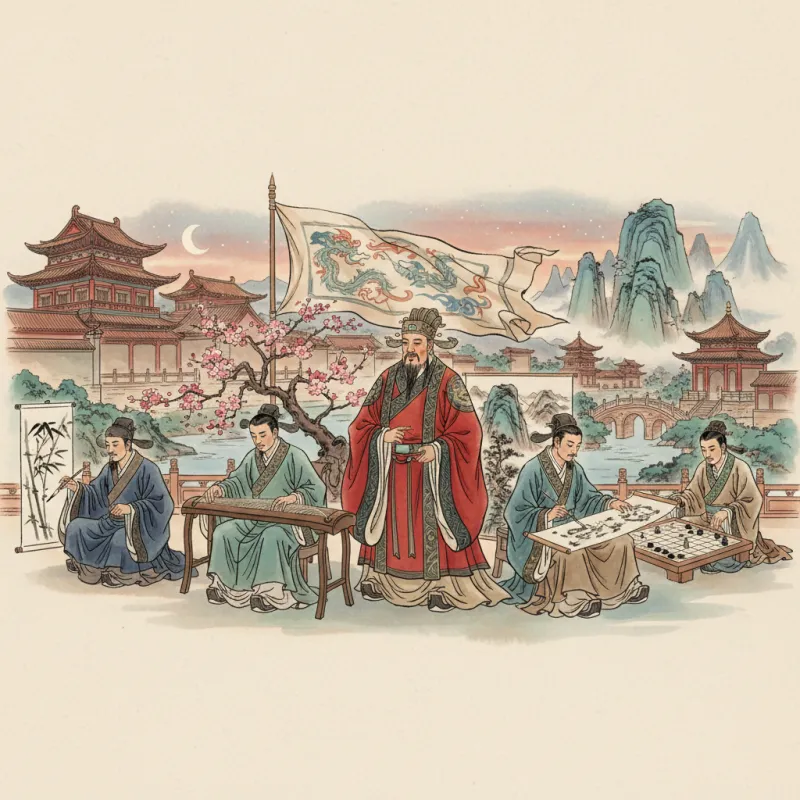
A scholar who couldn't play the guqin was like a general who couldn't ride a horse — technically capable, perhaps, but fundamentally incomplete. For over two millennia, Chinese literati measured cultivation not by what you knew, but by what you could do with your hands. The Four Arts — qin (琴, qín, the seven-string zither), qi (棋, qí, the strategy game weiqi), shu (书, shū, calligraphy), and hua (画, huà, painting) — weren't decorative accomplishments. They were the operating system of elite culture, the shared language through which scholars communicated refinement, moral character, and philosophical depth.
Why These Four? The Logic Behind the Canon
The selection wasn't arbitrary. Each art addressed a different dimension of the cultivated self. Music trained the ear and emotions. Strategy games sharpened the mind. Calligraphy disciplined the hand and revealed character. Painting synthesized observation, technique, and imagination. Together, they formed a complete curriculum for developing what Confucians called junzi (君子, jūnzǐ) — the exemplary person.
But there's a deeper pattern. All four arts share a crucial quality: they cannot be faked. You either can play the qin or you can't. Your calligraphy either flows with natural rhythm or it doesn't. A weiqi player's strategic thinking is immediately visible on the board. Unlike memorizing classics or reciting poetry — skills that could be crammed — the Four Arts required years of patient practice. They were proof of sustained effort, of a life lived in pursuit of refinement rather than mere examination success.
The term wénrén sìyì (文人四艺, the Four Arts of the Scholar) became standardized during the Song Dynasty (960-1279), though the practices themselves were ancient. By the Ming (1368-1644) and Qing (1644-1912) dynasties, no self-respecting scholar's studio was complete without a qin hanging on the wall, a weiqi board in the corner, brushes and ink stones on the desk, and scrolls of painting adorning the walls.
Qin: The Instrument That Listens Back
The guqin (古琴, gǔqín, "ancient zither") produces one of the quietest sounds in the musical world. Its seven silk strings — now often metal — create a contemplative, almost whispered tone that forces listeners to lean in, to become still. This wasn't a design flaw. It was the point.
Unlike the pipa or erhu, instruments designed for entertainment and performance, the qin was never meant for crowds. It was an instrument of solitude and intimate friendship. The famous story of Boya and Ziqi captures this perfectly: the qin master Boya played for his friend Ziqi, who understood every nuance of his music. When Ziqi died, Boya broke his qin and never played again, because no one else could truly hear him. The qin required not just a skilled player, but a skilled listener — someone who understood the philosophical and emotional language embedded in each piece.
The repertoire was ancient and specific. Pieces like "Flowing Water" (流水, Liú Shuǐ) and "Wild Geese Descending on the Sandbank" (平沙落雁, Píng Shā Luò Yàn) weren't just melodies — they were sonic landscapes, philosophical meditations rendered in sound. A scholar who could play these pieces demonstrated not just technical skill, but cultural literacy and emotional depth.
The qin was also deeply connected to Daoist philosophy. Its quiet, unforced sound embodied wuwei (无为, wúwéi) — effortless action. The best qin playing, like the best calligraphy, appeared natural and uncontrived, even though it required decades of practice to achieve that naturalness.
Qi: Strategy as Character Revelation
Weiqi (围棋, wéiqí, "surrounding game"), known in the West as Go, is deceptively simple: two players, black and white stones, a 19x19 grid. The goal is to control more territory than your opponent. But within that simplicity lies staggering complexity — more possible board positions than atoms in the observable universe.
For Chinese scholars, weiqi was more than a game. It was a mirror of character. How you played revealed who you were. Did you play aggressively, seeking immediate advantage? Or patiently, building influence across the board? Did you panic under pressure, or maintain composure? The game stripped away pretense. Your strategic thinking, your emotional control, your ability to read situations — all became visible on the board.
The connection between weiqi and military strategy was explicit. Many classic texts on warfare, including Sunzi's Art of War, use weiqi metaphors. The game taught crucial lessons: the importance of flexibility, the danger of overextension, the value of knowing when to sacrifice small advantages for larger gains. Emperors and generals studied weiqi not as recreation, but as training.
But weiqi also had a contemplative dimension. Unlike chess, where pieces are captured and removed, weiqi stones remain on the board, creating an evolving landscape. The game taught scholars to think in terms of influence and potential rather than direct confrontation — a very Chinese approach to conflict that valued indirect methods and long-term positioning over immediate victory.
Shu: The Art Where Character Becomes Visible
Chinese calligraphy (书法, shūfǎ, "the method of writing") occupies a unique position in world art. In the West, handwriting is functional — a means to record words. In China, it became the supreme art form, more prestigious than painting. Why? Because calligraphy was believed to reveal the writer's inner character with perfect transparency.
The logic was straightforward: when you write, your hand moves according to your qi (气, qì, vital energy). Your emotional state, your moral cultivation, your entire being flows through the brush onto paper. A person with a refined character produces refined calligraphy. A crude person produces crude writing. You cannot hide who you are when you hold a brush.
This belief had real consequences. During imperial examinations, candidates' calligraphy was scrutinized as carefully as their essay content. Beautiful handwriting could elevate a mediocre essay; poor calligraphy could doom a brilliant one. The reasoning was that if a candidate couldn't discipline their hand, how could they discipline a province?
The great calligraphers became cultural heroes. Wang Xizhi (王羲之, 303-361 CE), whose "Preface to the Orchid Pavilion" (兰亭序, Lántíng Xù) is considered the pinnacle of running script, was celebrated not just as an artist but as a moral exemplar. His calligraphy was studied, copied, and analyzed for centuries — not just for technique, but for the character it revealed.
Different scripts served different purposes. Regular script (楷书, kǎishū) demonstrated discipline and precision. Running script (行书, xíngshū) showed fluidity and natural grace. Cursive script (草书, cǎoshū) revealed spontaneity and emotional intensity. A complete scholar could write in all styles, adapting their hand to the occasion and mood.
Hua: Painting as Philosophical Statement
Chinese painting (国画, guóhuà, "national painting") developed in close relationship with calligraphy — they used the same tools, the same brushwork, often appeared on the same scroll. But painting added another dimension: the ability to capture not just the appearance of things, but their essential nature.
The distinction between "professional" and "literati" painting was crucial. Professional painters, who worked for courts and wealthy patrons, emphasized technical skill and realistic detail. Literati painters — the scholars who practiced painting as one of the Four Arts — deliberately rejected photographic realism. They painted ideas, not appearances. A literati landscape wasn't trying to show you what a mountain looked like; it was trying to capture the feeling of being in mountains, the philosophical experience of nature.
This approach reached its peak during the Song Dynasty, when scholar-officials like Su Shi (苏轼, 1037-1101) argued that painting should express the artist's inner landscape. Su Shi famously painted bamboo, not because he wanted to document bamboo accurately, but because bamboo — flexible yet strong, hollow yet upright — embodied qualities he admired. His bamboo paintings were self-portraits in vegetable form.
The "Three Perfections" (三绝, sān jué) — poetry, calligraphy, and painting combined on a single scroll — represented the ultimate synthesis of scholarly arts. A landscape painting might include a poem in beautiful calligraphy, all created by the same hand. This integration of arts was uniquely Chinese, reflecting the belief that all forms of cultivation were interconnected.
Literati painters also developed a sophisticated theory of brushwork. The "Six Principles" established by Xie He in the 5th century remained influential for over a millennium. The first principle — "spirit resonance" (气韵生动, qìyùn shēngdòng) — was the most important and most elusive. It meant that a painting should pulse with life energy, should feel animated by the same qi that flows through living things. Technical skill alone couldn't achieve this; it required the artist's cultivated spirit.
The Four Arts in Practice: A Day in a Scholar's Life
How did these arts fit into daily life? For a Ming Dynasty scholar-official, they weren't separate activities scheduled into a busy day. They were woven into the fabric of existence.
Morning might begin with calligraphy practice — copying a passage from the classics, not just to memorize the words, but to align one's qi through the disciplined movement of the brush. Midday might include a game of weiqi with a colleague, ostensibly for recreation but actually a form of strategic thinking practice and social bonding. Evening could bring friends together for qin music, with one person playing while others listened in meditative silence. And throughout the day, whenever inspiration struck, a scholar might paint — a quick bamboo sketch, a landscape capturing a mood.
The arts also served social functions. When scholars visited each other, they didn't just talk — they played music together, competed at weiqi, exchanged paintings and calligraphy. These activities created bonds deeper than conversation alone could forge. Sharing art was sharing one's inner self.
The Decline and Modern Revival
The Four Arts began declining in the late Qing Dynasty as Western education models displaced traditional scholar culture. The imperial examination system, which had sustained demand for these skills, was abolished in 1905. The May Fourth Movement of 1919 explicitly rejected traditional culture as feudal and backward. During the Cultural Revolution (1966-1976), practicing the Four Arts could be dangerous — they were condemned as elitist remnants of the old society.
But in recent decades, there's been a remarkable revival. Calligraphy classes are popular in Chinese schools. Weiqi has experienced a renaissance, partly due to Chinese players dominating international competitions. The guqin was designated a UNESCO Intangible Cultural Heritage in 2003, sparking renewed interest. Traditional Chinese painting, while no longer the dominant art form, maintains a devoted following.
What's changed is the context. The Four Arts are no longer requirements for social advancement or markers of elite status. They've become voluntary practices, chosen by people seeking connection to cultural heritage or personal cultivation. In some ways, this makes them more authentic — people practice them because they want to, not because they must.
What the Four Arts Teach Us
The genius of the Four Arts system was its holistic approach to human development. It recognized that cultivation isn't just intellectual — it's also physical, emotional, aesthetic, and social. You can't become a complete person by reading alone. You need to train your hands, refine your senses, develop patience and discipline through long practice.
This stands in sharp contrast to modern education, which often treats arts as optional enrichment rather than core curriculum. The Chinese literati would have found this baffling. How can you claim to be educated if you've never disciplined your hand through calligraphy, never trained your strategic thinking through weiqi, never learned to listen deeply through music, never tried to capture the essence of things through painting?
The Four Arts also embodied a particular vision of excellence — one that valued depth over breadth, patient mastery over quick achievement, personal cultivation over public performance. In an age of rapid skill acquisition and constant self-promotion, there's something appealing about practices that require decades to master and are best enjoyed in quiet solitude or intimate company.
Perhaps most importantly, the Four Arts remind us that culture isn't just what we know — it's what we can do, what we've internalized so deeply that it becomes part of how we move through the world. A scholar who had mastered the Four Arts didn't just know about Chinese culture. They embodied it, carried it in their hands and breath and vision. That kind of cultivation, that depth of integration, is rare in any era. But it remains an ideal worth pursuing.
Related Reading
- Chinese Opera: A Thousand Years of Drama
- Chinese Architecture: Forbidden Cities, Pagodas, and Garden Design
- Chinese Painting: Mountains, Mist, and Empty Space
- Chinese Calligraphy: The Art of Writing as High Culture
- Diplomacy and Cultural Exchange in Chinese Ancient Dynasties
- Wu Zetian: How China's Only Female Emperor Seized and Kept Power
- The Four Great Inventions: How China Changed the World