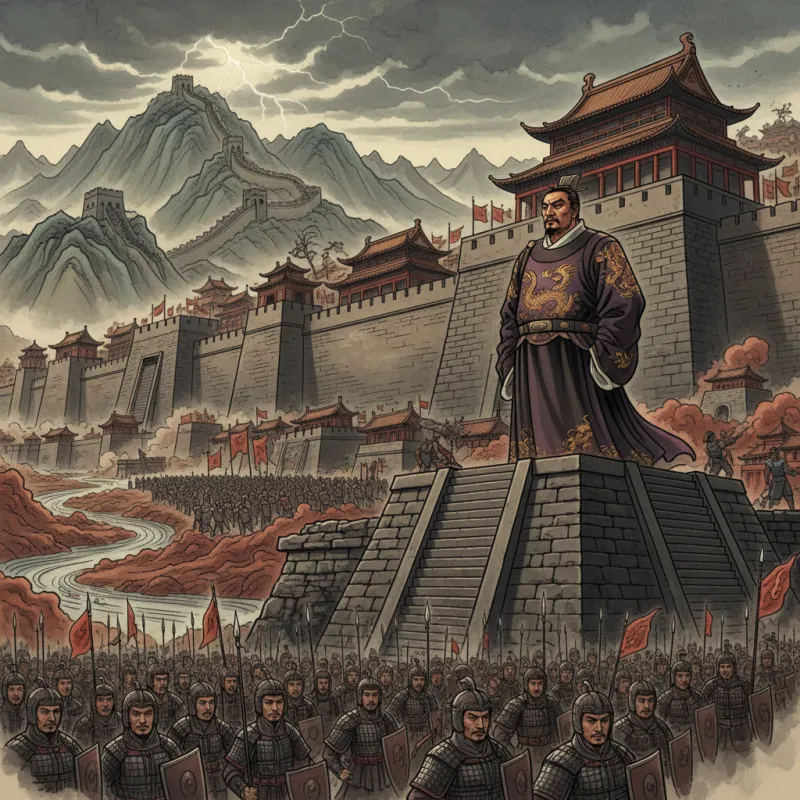
Picture this: 221 BCE, the Qin palace. A minister suggests leniency for a group of scholars who criticized the emperor. The response? Bury 460 of them alive and burn their books. Welcome to Legalism in action — the philosophy that turned ancient China into a unified empire through methods so brutal that its own architects couldn't survive it.
The Philosophy That Dares to Say What Others Won't
Legalism (法家 fǎjiā, literally "School of Law") is Chinese philosophy's uncomfortable truth-teller. While Confucius preached moral cultivation and Laozi advocated natural harmony, Legalist thinkers like Han Feizi (韓非子 Hán Fēizǐ) and Shang Yang (商鞅 Shāng Yāng) looked at human nature and saw something darker: self-interest, greed, and the constant potential for chaos. Their solution wasn't to educate people into virtue or align them with the Dao — it was to control them through an iron framework of laws and punishments.
The Legalist worldview is refreshingly cynical. People don't need moral instruction; they need clear rules and certain consequences. A farmer doesn't plow his field because he's virtuous — he does it because he'll starve if he doesn't. A soldier doesn't fight bravely because he loves his country — he fights because cowardice means execution and valor means rewards. Strip away the Confucian pretense about human goodness, the Legalists argued, and you find the real mechanisms of social order: fear and incentive.
This wasn't armchair philosophy. Shang Yang, serving as chief minister in the state of Qin during the 4th century BCE, turned these ideas into policy. He standardized measurements, reorganized the population into mutual-responsibility groups where one person's crime meant punishment for all, and created a merit-based military system that rewarded battlefield success with land and titles. The reforms were so effective that Qin transformed from a peripheral western state into a military powerhouse. They were also so unpopular that when Shang Yang's patron died, his enemies tore him apart with chariots.
The Architect of Empire: Li Si and the Qin Unification
By 247 BCE, when the future First Emperor Qin Shi Huang (秦始皇 Qín Shǐhuáng) took the throne at age thirteen, Legalism had already made Qin the strongest of the Warring States. But it took Li Si (李斯 Lǐ Sī), a student of the Confucian-turned-Legalist philosopher Xunzi, to weaponize these ideas into a blueprint for total unification.
Li Si understood something crucial: conquering territory is one thing, but holding an empire together requires destroying the old order completely. When Qin defeated the last rival state in 221 BCE, Li Si didn't just advocate for military occupation — he pushed for systematic cultural annihilation. Abolish the feudal system entirely. Standardize writing, currency, weights, and measures across all former states. Burn books that preserved the old ways of thinking, especially Confucian texts that romanticized the Zhou dynasty's decentralized feudalism. Execute scholars who clung to outdated ideas.
The famous "Burning of Books and Burying of Scholars" (焚書坑儒 fénshū kēngrú) in 213-212 BCE wasn't random tyranny — it was Legalist logic taken to its extreme. How do you prevent rebellion? Eliminate the intellectual foundations that might justify it. How do you create loyalty to the state? Make sure no one remembers any other form of government. The Qin didn't just want to rule China; they wanted to make it impossible to imagine China being ruled any other way.
The Machinery of Control
Legalist governance operated through three interlocking mechanisms that Han Feizi called "the two handles" plus law itself: rewards (賞 shǎng), punishments (罰 fá), and standardized legal codes (法 fǎ). The genius — and horror — of the system was its impersonality. Unlike Confucian governance, which relied on the moral character of rulers, Legalism created structures that functioned regardless of who occupied the throne.
The Qin legal code, partially preserved in bamboo strips discovered in 1975, reveals the system's obsessive detail. Specific punishments for specific crimes, no exceptions. A government official who arrives late to his post? Execution. A soldier who loses his weapon? Execution. A farmer who doesn't meet grain quotas? Forced labor. The code even specified punishments for officials who failed to enforce punishments — creating a self-perpetuating machine of accountability through terror.
But Legalism wasn't just about punishment. The reward system was equally calculated. Qin's twenty-rank military hierarchy meant that a peasant who brought back enemy heads could earn noble status. Land redistribution based on military merit broke the old aristocratic monopolies. This wasn't generosity — it was social engineering. By making advancement possible only through state-approved channels, Legalism channeled ambition into service.
The mutual responsibility system (連坐 liánzuò) completed the control mechanism. Organize the population into groups of five or ten families. If one person commits a crime and the others don't report it, all are punished. This turned every citizen into a potential informant and made trust outside the family unit nearly impossible. Privacy became treason. The state didn't need to watch everyone — the people watched each other.
The Empire That Couldn't Last
Here's the paradox: Legalism built an empire so efficiently that it collapsed from its own success. The Qin dynasty lasted only fifteen years after unification, making it one of the shortest-lived major dynasties in Chinese history. The very mechanisms that enabled rapid conquest made long-term stability impossible.
The problem was sustainability. You can motivate people through fear and reward for a generation, maybe two. But Legalism offered no vision beyond order itself. There was no higher purpose, no moral framework that made the suffering meaningful. When Qin Shi Huang died in 210 BCE, the empire had no ideological foundation to hold it together. His son was weak, Li Si was outmaneuvered by the eunuch Zhao Gao, and within four years, rebellions erupted across the empire.
The Qin's collapse was spectacular. Chen Sheng and Wu Guang, two conscripted laborers who were going to be late to their assignment (and thus executed under Qin law), decided they might as well rebel since they were dead anyway. Their uprising failed, but it sparked a wave of rebellions that the Qin military machine couldn't suppress. The empire that had conquered six states in ten years couldn't survive its founder by a decade.
Yet here's what's remarkable: while the Qin dynasty died, Legalist institutions survived. The Han dynasty (206 BCE - 220 CE) that replaced it officially embraced Confucianism but quietly retained the Qin's administrative structure, legal codes, and centralized bureaucracy. Every subsequent dynasty did the same. They dressed Legalism in Confucian rhetoric, but the machinery of state power remained fundamentally Legalist.
The Ghost in the Machine
Walk through Chinese history and you'll find Legalism everywhere, even when it's officially condemned. The imperial examination system? Legalist meritocracy wrapped in Confucian content. The household registration system (戶籍 hùjí) that tracked population movement? Direct descendant of Qin population control. The emphasis on written law over customary practice? Pure Legalism.
Even the relationship between Confucianism and state power became fundamentally Legalist. The Han dynasty's "Confucianization" didn't mean abandoning Legalist methods — it meant using Confucian ideology to legitimize Legalist structures. Emperors quoted Confucius while governing like Qin Shi Huang. This synthesis, sometimes called "Confucian-Legalism" or "outside Confucian, inside Legalist" (外儒內法 wài rú nèi fǎ), became the default mode of Chinese imperial governance.
Modern China hasn't escaped this legacy either. The emphasis on social stability over individual rights, the use of technology for population surveillance, the assumption that strong central authority is necessary to prevent chaos — these are Legalist ideas in contemporary dress. The Chinese Communist Party officially rejects "feudal" philosophy, but its governance model owes more to Han Feizi than to Marx.
Why Legalism Still Matters
Legalism forces us to confront uncomfortable questions about governance that more optimistic philosophies avoid. What do you do when moral education fails? How do you maintain order in a society where people pursue self-interest? Can you build stable institutions that don't depend on having virtuous leaders?
The Legalist answer — impersonal laws, clear incentives, and certain punishments — isn't pretty, but it's proven durable. Every modern state, regardless of ideology, uses Legalist tools: standardized legal codes, bureaucratic hierarchies, systems of rewards and punishments. We just don't call it Legalism anymore.
The tragedy of Legalism is that it's simultaneously too cynical and not cynical enough. Too cynical because it assumes humans are incapable of genuine moral motivation. Not cynical enough because it assumes that fear and reward can create lasting social bonds. The Qin discovered that you can conquer an empire with Legalism, but you can't make people love it.
Perhaps that's why Legalism remains philosophy's unloved stepchild. It tells us truths about power that we'd rather not acknowledge. It built the structures we still use while earning none of the respect we give to Confucian virtue or Daoist wisdom. Two thousand years after the Qin dynasty's collapse, we're still living in the empire that Legalism built — we've just learned to feel guilty about it.
The next time you follow a rule not because it's right but because you'll be punished if you don't, thank Han Feizi. The next time a bureaucratic system treats you as a number rather than a person, that's Shang Yang's legacy. Legalism may be the philosophy nobody likes, but it's the one we can't escape. And maybe that's exactly what the Legalists would have predicted.
Related Reading
- Chinese Philosophy in Five Minutes: Confucius, Laozi, and the Arguments That Shaped a Civilization
- The Hundred Schools of Thought: China's Golden Age of Philosophy
- Confucius vs. Laozi: The Debate That Shaped Chinese Civilization
- Mohism: The Lost Philosophy of Universal Love
- Exploring the Philosophical Legacy of China’s Ancient Dynasties
- Chinese Art and Calligraphy: The Four Arts Every Scholar Had to Master
- Exploring the Rich Tapestry of Ancient Chinese History and Culture
- China's Most Fascinating Emperors: The Brilliant, the Mad, and the Unexpected