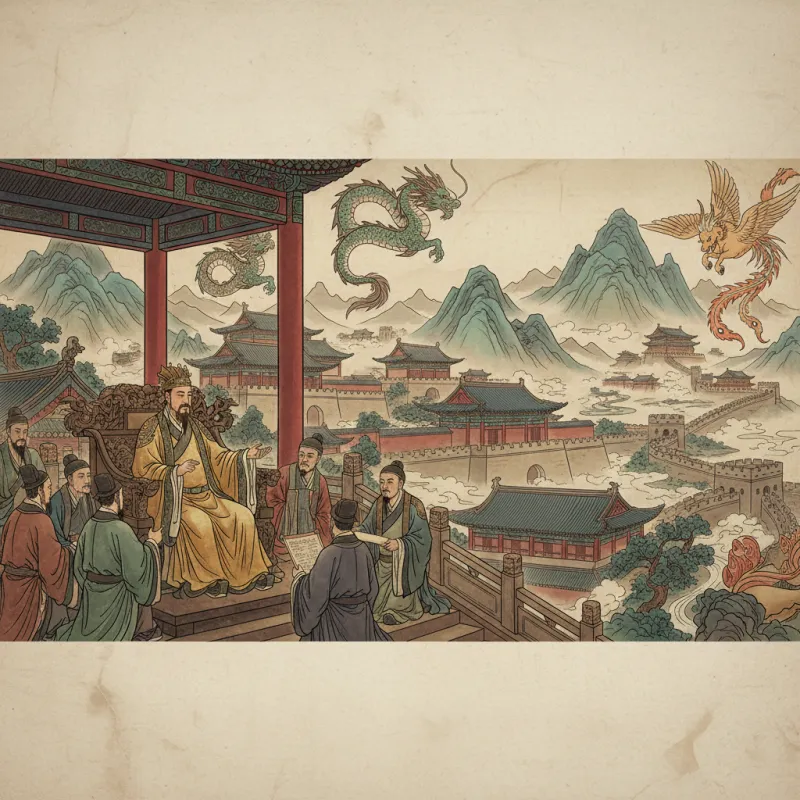
When Qin Shi Huang ordered the burning of books and burial of scholars alive in 213 BCE, he wasn't just being paranoid—he understood something fundamental about Chinese civilization that we're still grappling with today. Ideas, not armies, were the real threat to his empire. The philosophical systems that emerged during China's ancient dynasties weren't abstract intellectual exercises debated in ivory towers. They were competing operating systems for running an entire civilization, and the dynasty that chose the right philosophy often determined whether it would last decades or centuries.
The Warring States Crucible: When Philosophy Became Survival
The explosion of philosophical thought during the Warring States period (475-221 BCE) wasn't coincidental—it was desperate. Seven major kingdoms were locked in existential combat, and rulers were willing to try anything that might give them an edge. This created a philosophical marketplace where thinkers like Confucius (孔子, Kǒngzǐ), Mozi (墨子, Mòzǐ), and Han Feizi (韓非子, Hán Fēizǐ) competed for patronage by offering radically different visions of how to organize society.
Confucius wandered from court to court for thirteen years, essentially unemployed, because his ideas about ritual propriety and benevolent governance seemed quaint when kingdoms were being swallowed whole. Meanwhile, the Legalists were telling rulers exactly what they wanted to hear: that harsh laws and severe punishments were the path to power. When Qin finally unified China, it did so using Legalist principles—and then promptly collapsed after just fifteen years, suggesting that winning and governing require different philosophies entirely.
The Han Synthesis: Confucianism With Teeth
The Han Dynasty (206 BCE - 220 CE) pulled off one of history's great ideological pivots. Emperor Wu (漢武帝, Hàn Wǔdì) officially adopted Confucianism in 136 BCE, but it wasn't the gentle, idealistic Confucianism that Confucius himself had preached. The Han version, systematized by Dong Zhongshu (董仲舒, Dǒng Zhòngshū), was Confucianism reinforced with Legalist institutions and flavored with yin-yang cosmology. It was a pragmatic hybrid that gave the emperor both moral legitimacy and practical tools for control.
This wasn't hypocrisy—it was genius. The civil service examination system, established during this period, created a meritocratic bureaucracy theoretically open to anyone who could master the Confucian classics. In practice, it produced a scholar-official class whose interests were aligned with the dynasty's survival. The exams tested knowledge of texts like the Analects and the Book of Rites, ensuring that everyone who wielded power spoke the same philosophical language. This system, refined over centuries, would last until 1905—making it arguably the most successful application of philosophy to governance in human history.
Daoism's Paradoxical Power: The Philosophy of Not Governing
While Confucianism dominated official ideology, Daoism (道教, Dàojiào) offered an alternative that was simultaneously subversive and complementary. Laozi's (老子, Lǎozǐ) Daodejing (道德經, Dàodéjīng) advocated for wuwei (無為, wúwéi)—often translated as "non-action" but better understood as "effortless action" or "action in accordance with nature." For a philosophy that preached doing nothing, it had a remarkable impact on how emperors thought about power.
The Daoist influence is most visible during periods of dynastic transition and crisis. When the rigid Confucian system failed—and it failed regularly—Daoism provided a pressure valve. Disillusioned officials would "retire" to the mountains, write poetry, and cultivate immortality through alchemical practices. This wasn't escapism; it was a form of political protest that the system could tolerate because it removed potential troublemakers without creating martyrs. The relationship between Confucianism and Daoism resembles the relationship between an operating system and its sleep mode—both necessary for the system's long-term health.
Buddhism's Arrival: Foreign Philosophy, Chinese Characteristics
When Buddhism entered China during the Han Dynasty, it faced a civilization that already had two sophisticated philosophical systems. The initial reception was confused—early Chinese translators used Daoist terminology to explain Buddhist concepts, creating hybrid ideas that would have baffled Indian monks. But by the Tang Dynasty (618-907 CE), Buddhism had been thoroughly sinicized, producing uniquely Chinese schools like Chan (禪, Chán, later known as Zen in Japan).
The Tang represented the high point of philosophical pluralism in ancient China. Emperor Taizong (唐太宗, Táng Tàizōng) famously declared that the three teachings—Confucianism, Daoism, and Buddhism—were like the three legs of a tripod, each necessary for stability. This wasn't just pretty rhetoric. The examination system tested Confucian texts, but Buddhist monasteries provided social services and Daoist priests performed state rituals. The system worked because each philosophy occupied a different niche: Confucianism for governance, Buddhism for personal salvation, and Daoism for harmony with nature.
Of course, this harmony was always fragile. The Great Anti-Buddhist Persecution of 845 CE, when Emperor Wuzong (唐武宗, Táng Wǔzōng) destroyed thousands of monasteries and forced hundreds of thousands of monks and nuns to return to lay life, showed what happened when one philosophy was perceived as threatening the others. The persecution was justified in Confucian and Daoist terms—Buddhism was foreign, monasteries didn't pay taxes, and monks didn't produce children—but the real issue was power and resources.
The Song Neo-Confucian Revolution: Philosophy Gets Metaphysical
The Song Dynasty (960-1279 CE) witnessed what might be called the second founding of Confucianism. Thinkers like Zhu Xi (朱熹, Zhū Xī) weren't content with Confucianism as a system of ethics and governance—they wanted it to answer the big metaphysical questions that Buddhism had been addressing. The result was Neo-Confucianism (理學, lǐxué, "School of Principle"), which incorporated Buddhist and Daoist concepts while maintaining Confucian social values.
Zhu Xi's synthesis introduced concepts like li (理, lǐ, "principle" or "pattern") and qi (氣, qì, "vital energy" or "material force") to explain everything from cosmology to human nature. This wasn't just academic philosophy—it had practical implications. If human nature contained the same li as the cosmos, then self-cultivation wasn't just about following rules; it was about aligning yourself with the fundamental structure of reality. The Neo-Confucian approach to self-cultivation became the dominant framework for educated Chinese for the next seven centuries.
The Ming and Qing: Philosophy Ossified and Challenged
By the Ming Dynasty (1368-1644 CE), the philosophical legacy of ancient China had become simultaneously its greatest strength and its greatest weakness. The examination system produced a remarkably literate elite, but one that was trained to look backward to classical texts rather than forward to new solutions. Wang Yangming (王陽明, Wáng Yángmíng) tried to shake things up with his School of Mind, which emphasized intuitive moral knowledge over textual study, but the system was too entrenched to change fundamentally.
The Qing Dynasty (1644-1912 CE), ruled by Manchu conquerors, doubled down on Confucian orthodoxy as a way to legitimize their rule over the Han Chinese majority. They sponsored massive scholarly projects like the Complete Library of the Four Treasuries, which preserved texts but also enforced ideological conformity. By the time Western powers arrived in the 19th century with their own philosophical systems—liberalism, nationalism, scientific materialism—China's ancient philosophical legacy had become a cage as much as a foundation.
The Enduring Questions: What Ancient Philosophy Teaches Modern China
The philosophical systems developed during China's ancient dynasties weren't perfect—they justified hierarchy, subordinated women, and sometimes stifled innovation. But they also created a civilization that survived for millennia, absorbed foreign conquerors, and produced sophisticated theories about ethics, governance, and the nature of reality. The questions they grappled with—how to balance individual freedom with social harmony, how to select leaders, how to maintain cultural continuity while adapting to change—remain relevant today.
Modern China's relationship with its philosophical legacy is complicated. The Communist Party officially rejected Confucianism as feudal superstition, yet increasingly invokes Confucian values like harmony and filial piety. The contemporary revival of Confucian studies isn't just nostalgia—it's an attempt to find resources within Chinese tradition for addressing modern problems. Whether ancient philosophy can provide answers for a technological, globalized society remains an open question, but the fact that people are still asking it 2,500 years after Confucius suggests these ideas have more life in them yet.
Related Reading
- Mohism: The Lost Philosophy of Universal Love
- Legalism and the Qin Dynasty: When Ruthless Efficiency Built an Empire
- The Hundred Schools of Thought: China's Golden Age of Philosophy
- Chinese Philosophy in Five Minutes: Confucius, Laozi, and the Arguments That Shaped a Civilization
- Confucius vs. Laozi: The Debate That Shaped Chinese Civilization
- Diplomacy and Cultural Exchange in Chinese Ancient Dynasties
- Exploring Ancient Agricultural Practices in Chinese Dynasties
- The Role of Trade in Shaping Ancient Chinese Dynasties and Culture