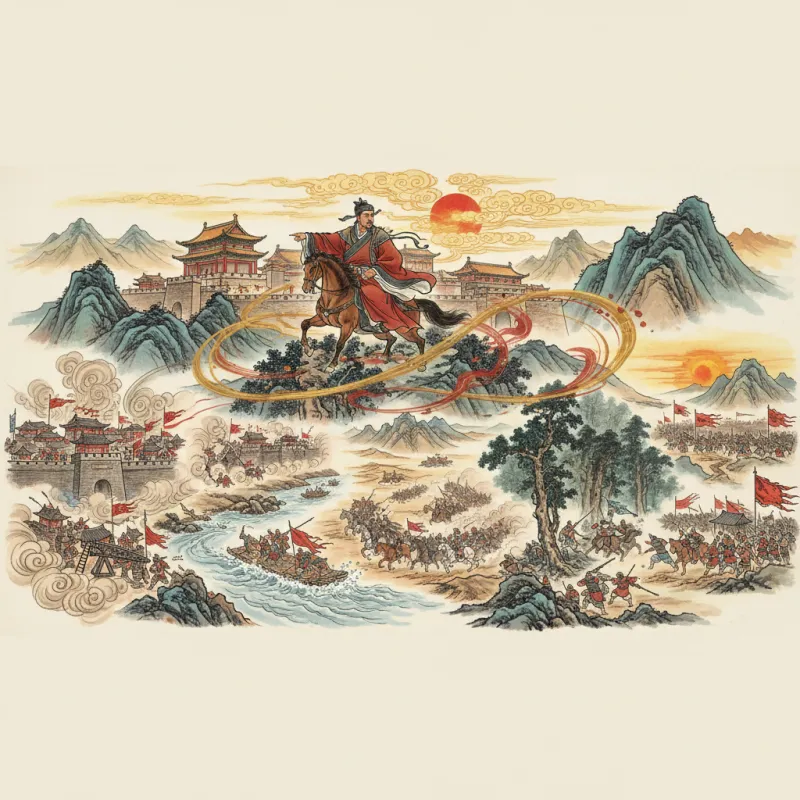
When the Wu army stood at the gates of Chu's capital in 506 BCE, they had just accomplished something that should have been impossible: a force of 30,000 men had defeated a kingdom with ten times their population in five consecutive battles over the course of sixteen days. The architect of this campaign, Sun Wu (孙武 Sūn Wǔ) — better known as Sun Tzu — had turned his own treatise into a masterclass of applied violence. This wasn't theory. This was The Art of War (孙子兵法 Sūnzǐ Bīngfǎ) written in blood.
The text itself emerged during the Spring and Autumn period (春秋时代 Chūnqiū Shídài, 770-476 BCE), an era when China fractured into competing states that treated warfare as both art form and existential necessity. Sun Tzu's genius was recognizing that battles are won before the first sword is drawn — through intelligence, deception, and forcing your enemy to fight on your terms. But did his principles actually work when commanders staked their lives on them? The historical record provides five compelling answers.
The Battle of Boju (506 BCE): Attack Where Undefended
Sun Tzu served as a general for King Helü of Wu, and the Battle of Boju (柏举之战 Bǎijǔ Zhī Zhàn) represents his principles in their purest form. The kingdom of Chu was a regional superpower — wealthy, populous, and confident. Wu was the upstart. Conventional wisdom said Wu should avoid direct confrontation.
Sun Tzu did the opposite, but with calculated precision. His strategy embodied the principle "攻其无备,出其不意" (gōng qí wú bèi, chū qí bù yì) — "attack where they are unprepared, appear where you are not expected." Rather than a frontal assault on Chu's fortified positions, the Wu army struck deep into Chu territory through an unexpected route, moving so rapidly that Chu's forces couldn't consolidate their numerical advantage.
The campaign featured five battles in rapid succession: Boju, Zhui, Yong, Qianxi, and Jiaxi. Each engagement prevented Chu from regrouping. Sun Tzu understood that momentum itself becomes a weapon — the psychological impact of consecutive defeats compounds faster than physical losses. By the time Wu reached Ying (郢), Chu's capital, the defending army had disintegrated not through casualties but through shattered morale.
The Chu king fled. Wu occupied the capital. A force one-tenth the size had conquered a kingdom because Sun Tzu grasped what The Art of War makes explicit: "兵贵胜,不贵久" (bīng guì shèng, bù guì jiǔ) — "in war, value the quick victory, not the prolonged campaign." Speed negates numerical superiority.
The Battle of Guiling (353 BCE): Besiege Wei to Rescue Zhao
A half-century after Sun Tzu's death, his descendant Sun Bin (孙膑 Sūn Bìn) faced a strategic puzzle during the Warring States period (战国时代 Zhànguó Shídài, 475-221 BCE). The state of Wei had besieged Zhao's capital, Handan. Zhao appealed to Qi for help. The obvious move was to march directly to Handan and engage Wei's besieging army.
Sun Bin, serving as Qi's military strategist, proposed something counterintuitive: ignore Handan entirely and attack Wei's capital, Daliang. This strategy — "围魏救赵" (wéi Wèi jiù Zhào), "besiege Wei to rescue Zhao" — became one of the Thirty-Six Stratagems and perfectly demonstrates Sun Tzu's principle that "the supreme art of war is to subdue the enemy without fighting."
When Wei's general Pang Juan learned that his homeland was under attack, he had no choice but to abandon the siege and rush back. Sun Bin didn't need to fight Wei's army at its strongest point (the siege lines at Handan). Instead, he forced Wei to fight on Qi's terms — with exhausted troops, disrupted supply lines, and shattered strategic initiative.
The Qi army ambushed Wei's forces at Guiling as they hurried home. Pang Juan's army, strung out on the march and psychologically defeated before the battle began, suffered a crushing defeat. Zhao was saved without Qi ever approaching Handan. Sun Bin had weaponized his enemy's strategic priorities against them, a technique his ancestor had codified: "故善战者,致人而不致于人" (gù shàn zhàn zhě, zhì rén ér bù zhì yú rén) — "the skilled warrior brings the enemy to the battlefield; he is not brought there by the enemy."
The Battle of Maling (341 BCE): Deception and Terrain
Sun Bin wasn't finished with Pang Juan. Twelve years after Guiling, Wei invaded Qi's ally Han, and once again Qi sent Sun Bin to respond. This time, Sun Bin orchestrated one of history's most elaborate tactical deceptions, demonstrating The Art of War's opening principle: "兵者,诡道也" (bīng zhě, guǐ dào yě) — "all warfare is based on deception."
Sun Bin ordered his army to retreat, but with a twist. On the first day of retreat, they built 100,000 cooking fires. On the second day, 50,000 fires. On the third day, 30,000 fires. Pang Juan, pursuing with Wei's army, interpreted this as mass desertion — Qi's soldiers were fleeing in panic, abandoning their posts by the thousands.
Convinced he was chasing a disintegrating army, Pang Juan abandoned caution and rushed forward with only his fastest troops, leaving his main force behind. Sun Bin had predicted this exact response. He chose the ambush site carefully: a narrow defile at Maling (马陵 Mǎlíng), where terrain would negate Wei's numerical advantage.
The Qi army stripped bark from a tree at the narrowest point and carved characters into the exposed wood: "庞涓死于此树之下" (Páng Juān sǐ yú cǐ shù zhī xià) — "Pang Juan dies beneath this tree." They positioned 10,000 crossbowmen in the surrounding hills with orders to fire when they saw torchlight at the tree.
Pang Juan arrived at dusk, saw the carved characters, and lit a torch to read them. The crossbow volley killed him instantly. His army, strung out in the narrow pass without their commander, was slaughtered. Sun Bin had turned every element of the battlefield — terrain, timing, psychology, and his enemy's own assumptions — into weapons. This is The Art of War at its most surgical: "知彼知己,百战不殆" (zhī bǐ zhī jǐ, bǎi zhàn bù dài) — "know the enemy and know yourself; in a hundred battles you will never be defeated."
The Battle of Julu (207 BCE): Breaking the Cauldrons
By the late Qin Dynasty (秦朝 Qín Cháo, 221-206 BCE), Sun Tzu's text had become required reading for Chinese commanders. Xiang Yu (项羽 Xiàng Yǔ), leading a rebel army against Qin forces besieging Zhao, faced impossible odds: his 20,000 troops against 300,000 Qin soldiers commanded by generals Zhang Han and Wang Li.
Xiang Yu's response demonstrated a principle that sounds paradoxical until you understand its psychology: "投之亡地然后存,陷之死地然后生" (tóu zhī wáng dì rán hòu cún, xiàn zhī sǐ dì rán hòu shēng) — "throw your soldiers into positions from which there is no escape, and they will prefer death to flight."
After crossing the Zhang River, Xiang Yu ordered his men to sink their boats and smash their cooking pots — "破釜沉舟" (pò fǔ chén zhōu), "break the cauldrons and sink the boats." This wasn't reckless bravado. It was calculated psychological warfare directed at his own troops. With no possibility of retreat, every soldier understood the battle had exactly two outcomes: victory or death.
The transformation was immediate. Xiang Yu's army fought with suicidal intensity, each man worth ten of the enemy. They shattered the Qin siege lines, killed Wang Li, and forced Zhang Han into a humiliating surrender. The numerical advantage meant nothing against troops who had transcended the fear of death.
Sun Tzu wrote: "兵士甚陷则不惧,无所往则固" (bīng shì shèn xiàn zé bù jù, wú suǒ wǎng zé gù) — "when troops are in desperate straits they lose their sense of fear; when there is nowhere to go they stand firm." Xiang Yu proved that a commander who understands his soldiers' psychology can multiply their effectiveness beyond any rational calculation. The Battle of Julu didn't just break the Qin siege — it shattered the Qin Dynasty's military reputation and accelerated its collapse. For more on the Qin Dynasty's military innovations, see The Terracotta Army: Guardian Force of China's First Emperor.
The Battle of Red Cliffs (208-209 CE): Alliance and Fire
The Battle of Red Cliffs (赤壁之战 Chìbì Zhī Zhàn) occurred four centuries after Sun Tzu, during the chaotic end of the Han Dynasty (汉朝 Hàn Cháo, 206 BCE-220 CE). Cao Cao (曹操 Cáo Cāo), controlling northern China, marched south with an army estimated at 220,000 to crush the allied forces of Liu Bei and Sun Quan, who together could muster perhaps 50,000 troops.
The allied commanders — Zhou Yu (周瑜 Zhōu Yú) for Sun Quan and Zhuge Liang (诸葛亮 Zhūgě Liàng) advising Liu Bei — faced the same problem Sun Tzu had confronted at Boju: how to defeat a vastly superior force. Their solution synthesized multiple Art of War principles into a single devastating operation.
First, alliance: "夫未战而庙算胜者,得算多也" (fū wèi zhàn ér miào suàn shèng zhě, dé suàn duō yě) — "the general who wins makes many calculations before the battle." Zhou Yu and Zhuge Liang recognized that neither could survive alone. Their alliance doubled their effective strength and forced Cao Cao to divide his attention.
Second, deception: they sent Huang Gai (黄盖 Huáng Gài) to Cao Cao with a false defection, claiming he would surrender with ships full of supplies. Cao Cao, confident in his numerical superiority, accepted the defection at face value.
Third, exploiting weakness: Cao Cao's northern troops were unfamiliar with naval warfare. To reduce seasickness, he chained his ships together — creating stability but eliminating maneuverability. Zhou Yu recognized this as a fatal vulnerability.
Fourth, environmental factors: "天时不如地利,地利不如人和" (tiān shí bù rú dì lì, dì lì bù rú rén hé) — "timing is not as important as terrain, terrain is not as important as unity." The allies waited for winter winds from the southeast, rare but predictable.
When conditions aligned, Huang Gai's "defection" ships — actually fire ships loaded with oil-soaked materials — sailed into Cao Cao's chained fleet. The winter wind spread flames across the immobilized armada. Cao Cao's numerical advantage became a liability as ships couldn't escape the inferno. His army disintegrated, and he fled north, never again attempting to conquer the south.
Red Cliffs established the Three Kingdoms period (三国时代 Sānguó Shídài, 220-280 CE) and demonstrated that Sun Tzu's principles scaled across centuries. The battle combined intelligence, alliance, deception, environmental awareness, and exploitation of enemy weakness — essentially a checklist of Art of War maxims executed in concert. For more on this transformative period, see Three Kingdoms: The Real History Behind Romance of the Three Kingdoms.
The Enduring Calculus
These five battles span four centuries and involve different commanders, technologies, and political contexts. Yet they share a common thread: victory through superior strategy rather than superior force. Sun Tzu's insight was recognizing that warfare operates on multiple dimensions simultaneously — physical, psychological, temporal, environmental — and that dominance in the non-physical dimensions can overcome material disadvantages.
The modern fascination with The Art of War often misses this specificity. Corporate executives quote "know your enemy" without understanding that Sun Tzu meant literal intelligence gathering — spies, reconnaissance, interrogation. Motivational speakers cite "appear weak when you are strong" without grasping that this requires elaborate deception operations, not just attitude.
What makes these historical battles compelling is their concreteness. Sun Bin didn't abstractly "think outside the box" at Guiling — he calculated exactly how long it would take Wei's army to march home and positioned his forces at the precise point of maximum enemy vulnerability. Xiang Yu didn't "commit fully" at Julu — he eliminated his soldiers' cognitive option to retreat, forcing a neurological shift in their threat assessment.
The Art of War works when commanders understand it as a systematic framework for analyzing asymmetric conflicts, not as a collection of inspirational aphorisms. These five battles prove that Sun Tzu's principles, properly applied, can consistently defeat larger, wealthier, better-equipped opponents. The text has survived 2,500 years not because it sounds wise, but because it wins wars.
Related Reading
- The Military Strategies and Key Battles of Ancient Chinese Dynasties
- The Terracotta Army: 8,000 Soldiers Guarding an Emperor's Tomb
- The Art of War Is Not About War (It Is About Avoiding It)
- Chinese Military Strategy: Sun Tzu and the Art of Winning Without Fighting
- The Great Wall of China: The Complete History Beyond the Myth
- The Yuan Dynasty: When Mongols Ruled China
- Unveiling the Role of Women in Ancient Chinese Dynasties
- Unraveling the Economic Tapestry of Ancient Chinese Dynasties