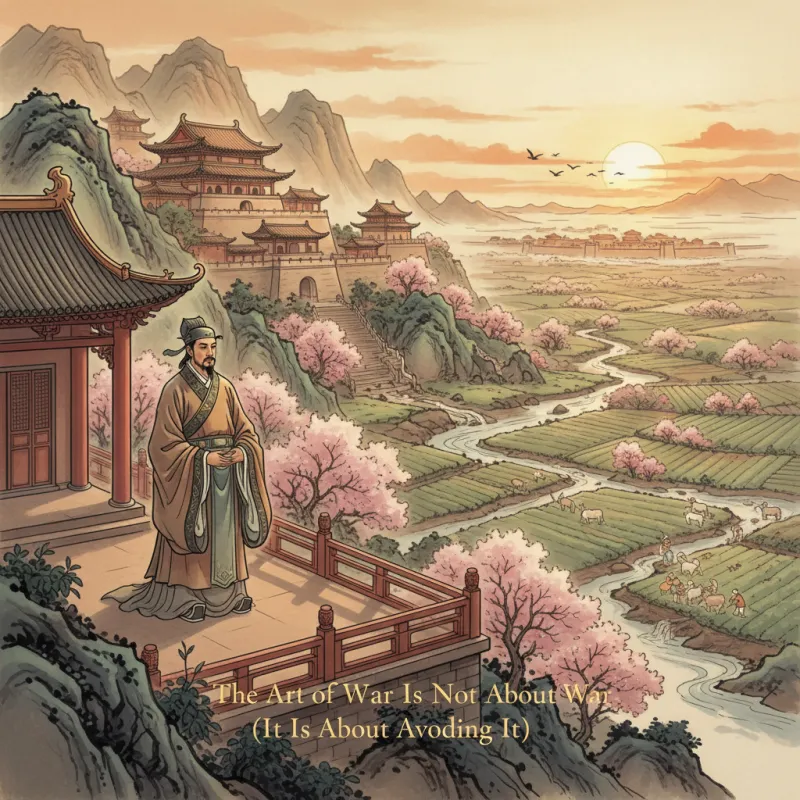
Most people think Sun Tzu wrote a manual for winning wars. He didn't. He wrote a manual for not fighting them.
The opening chapter of The Art of War (孙子兵法, Sūnzǐ Bīngfǎ) states this plainly: "故善战者,不战而屈人之兵" — "The supreme art of war is to subdue the enemy without fighting." Not "win decisively." Not "crush your opponents." Subdue without fighting. Everything that follows in the text serves this single principle. War, in Sun Tzu's view, is what happens when strategy has already failed.
This isn't the book that gets quoted in boardrooms and business schools. That version is about dominance, competitive advantage, and crushing the competition. It's a fantasy Sun Tzu would have found baffling. The real text, written sometime during the Warring States period (475-221 BCE), emerged from a world drowning in pointless violence. Seven major states fought for supremacy over what would become China. Armies numbered in the hundreds of thousands. Entire populations were enslaved or massacred. Sun Tzu watched this carnage and concluded that anyone who glorified war was an idiot.
The Economics of Not Fighting
Sun Tzu opens with math, not inspiration. Chapter one calculates the cost of fielding an army: "千里馈粮,则内外之费,宾客之用,胶漆之材,车甲之奉,日费千金" — "When provisions are transported a thousand li, the expenses borne by the people and the government, including entertainment of envoys and advisors, materials like glue and lacquer, and maintenance of chariots and armor, will amount to a thousand pieces of gold per day."
A thousand gold pieces. Per day. For a single campaign.
He continues: prolonged war exhausts the state, impoverishes the people, and creates opportunities for rivals. Even victory is expensive. The ideal outcome is to take an enemy's territory intact, their army surrendered, their cities unburned. Destroying what you're fighting for is not strategy — it's waste.
This is why Sun Tzu ranks military options in strict hierarchy. Best is to attack the enemy's strategy, disrupting their plans before armies mobilize. Second best is to attack their alliances, isolating them diplomatically. Third is to attack their army in the field. Worst — absolute last resort — is to besiege their cities, which guarantees massive casualties and destruction on both sides.
Modern readers skip past this. They want the tactical bits about terrain and deception. But Sun Tzu's point is that if you're reading the tactical chapters, you've already lost. Good strategy happens in council chambers and diplomatic missions, not battlefields.
What "Know Your Enemy" Actually Means
The most butchered quote in the book is "知彼知己,百战不殆" — usually rendered as "know your enemy and know yourself, and you will win a hundred battles." The actual meaning: "know the other and know yourself, and in a hundred battles you will not be in danger."
Not victory. Safety.
Sun Tzu doesn't promise you'll win. He promises you won't lose catastrophically. The goal is to avoid danger, not to seek glory. This distinction runs through the entire text. When he discusses terrain, he's not teaching you how to win battles — he's teaching you which battles to avoid. When he discusses fire attacks, he's explaining their risks and limitations, not encouraging their use.
The chapter on knowing yourself and the enemy continues: "不知彼而知己,一胜一负;不知彼不知己,每战必败" — "If you know yourself but not the enemy, for every victory you will suffer a defeat. If you know neither yourself nor the enemy, you will lose every battle." This is risk assessment, not motivational speaking. Sun Tzu is calculating probabilities, not pumping you up for combat.
Compare this to Western military classics. Clausewitz's On War treats battle as the ultimate arbiter, the moment when political will is tested through violence. Sun Tzu treats battle as evidence of failure. If you're fighting, someone miscalculated. Possibly you.
Deception as Damage Control
Sun Tzu's famous emphasis on deception — "兵者,诡道也" (warfare is the way of deception) — is often read as endorsing trickery for its own sake. Look closer. Every example of deception in the text serves the same purpose: ending conflicts quickly with minimal casualties.
When he says "appear weak when you are strong, and strong when you are weak," he's not teaching you to be sneaky. He's teaching you to avoid unnecessary battles. If enemies think you're weak, they might negotiate. If they think you're strong, they might retreat. Either way, you're not fighting.
The chapter on fire attacks is instructive here. Sun Tzu describes five types of fire warfare in detail, then immediately warns against using them: "主不可以怒而兴师,将不可以愠而致战" — "A sovereign should not launch a war out of anger, nor should a general give battle out of resentment." Fire attacks are devastating, but anger is not strategy. If you're burning cities because you're mad, you're not following Sun Tzu — you're ignoring him.
This connects to his broader point about emotional control. The text repeatedly warns against acting from anger, fear, or pride. These emotions lead to predictable behavior, and predictable behavior gets you killed. More importantly, emotional decisions lead to unnecessary wars. A general who fights to prove his courage is wasting lives. A ruler who invades because he's been insulted is bankrupting his state.
The Paradox of Preparation
Here's where Sun Tzu gets genuinely strange. He insists on thorough military preparation while simultaneously arguing you should avoid using it. Chapter three states: "故善用兵者,屈人之兵而非战也" — "One skilled in warfare subdues the enemy without battle." But the entire book is about warfare skills.
The resolution is that preparation prevents war. If your army is well-trained, well-supplied, and well-led, enemies will negotiate rather than fight. Your military strength is a deterrent, not a tool. This is why Sun Tzu obsesses over logistics, morale, and intelligence gathering. These aren't preparations for war — they're investments in not having one.
The ancient Chinese military strategy of the Warring States period understood this. States that maintained strong defenses and clear military capability often avoided invasion. States that appeared weak invited attack. Sun Tzu's contemporary, the strategist Wu Qi, made similar arguments: the purpose of military strength is to make its use unnecessary.
This creates an odd reading experience. Sun Tzu describes tactical formations, then explains why you shouldn't need them. He details siege warfare, then argues sieges are failures. He's teaching you skills while hoping you never use them. It's like a martial arts master who spends decades perfecting techniques he considers morally wrong to employ.
Why We Get It Wrong
The modern misreading of The Art of War isn't accidental. It's useful. Business culture wants a text that justifies competition, aggression, and winner-take-all thinking. "All warfare is based on deception" sounds like permission to be ruthless. "Attack where they are unprepared" sounds like a competitive advantage framework.
But Sun Tzu's world wasn't capitalist competition — it was existential survival. The Warring States period killed millions. Entire populations were enslaved or exterminated. When the state of Qin unified China in 221 BCE, it did so by ignoring Sun Tzu's advice, fighting massive battles and accepting enormous casualties. They won, but at a cost that nearly destroyed Chinese civilization.
Sun Tzu wrote for a different audience: rulers and generals who understood that war was expensive, destructive, and often pointless. His advice assumes you want to preserve your state, not expand it indefinitely. He's writing for people who have something to lose.
Modern readers don't have that context. We read The Art of War as a success manual, not a survival guide. We skip the parts about cost and focus on the parts about winning. We ignore his warnings about prolonged conflict and highlight his tactical advice. We've turned a text about avoiding war into a manual for fighting it.
What Sun Tzu Would Think of Us
If Sun Tzu could see how his book is used today, he'd probably be horrified. Business school students quoting him to justify hostile takeovers. Sports coaches using his tactics to win games. Dating advisors applying his strategies to relationships.
None of this is warfare. None of it involves existential risk. None of it requires the careful cost-benefit analysis that Sun Tzu considered essential. We've taken a text written in blood and turned it into a self-help book.
The real Art of War is darker and more practical than its modern reputation suggests. It's a book written by someone who saw too much violence and wanted less of it. Someone who understood that victory is expensive and defeat is catastrophic, so the only rational choice is to avoid both. Someone who knew that the best general is the one whose wars are never fought.
That's not a message modern culture wants to hear. We prefer the fantasy version: the clever strategist who always wins, the bold leader who crushes competition, the tactical genius who sees three moves ahead. Sun Tzu offers something less exciting and more valuable: the wisdom to know when not to fight, and the discipline to choose survival over glory.
"故善战者,不战而屈人之兵" — subdue the enemy without fighting. Not because you're clever. Because you're wise enough to know that fighting, even when you win, is still losing.
Related Reading
- Sun Tzu in Action: 5 Real Battles That Used Art of War Strategy
- The Military Strategies and Key Battles of Ancient Chinese Dynasties
- Chinese Military Strategy: Sun Tzu and the Art of Winning Without Fighting
- The Great Wall of China: The Complete History Beyond the Myth
- The Terracotta Army: 8,000 Soldiers Guarding an Emperor's Tomb
- Ancient Chinese Fashion: What People Really Wore Through the Dynasties
- The Role of Trade in Shaping Ancient Chinese Dynasties and Culture
- Legalism: The Philosophy That Built an Empire