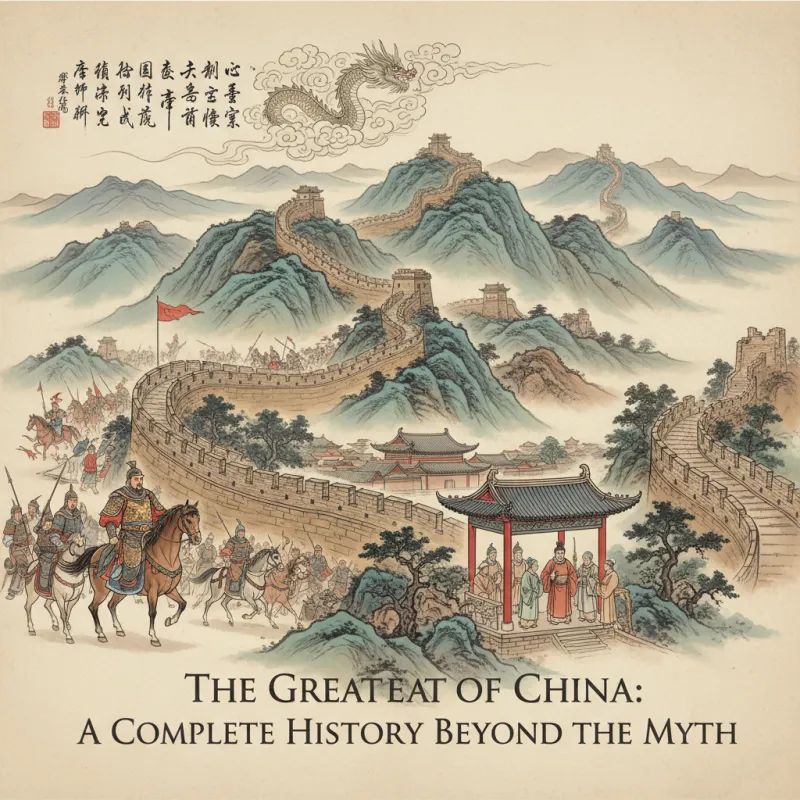
The astronaut squints through the window of the International Space Station, scanning Earth's surface for the legendary structure everyone swears is visible from orbit. He sees nothing. Because the Great Wall of China (长城 Chángchéng, literally "Long Wall") — despite being the world's most famous fortification — is based on a fundamental misunderstanding. It's not one wall. It's not even primarily about walls.
What we call "the Great Wall" is actually a 2,300-year argument about borders, written in rammed earth, stone, and the bodies of millions of workers. It's a discontinuous network of fortifications, beacon towers, trenches, and natural barriers that stretches across northern China like a scar tissue of imperial anxiety. And the version tourists photograph today? That's mostly Ming Dynasty reconstruction from the 1400s-1600s — built not to keep out the Mongols (who had already conquered China centuries earlier), but to manage a different threat entirely.
The Warring States: When Walls Meant Survival
The first defensive walls weren't built by a unified China because unified China didn't exist yet. During the Warring States period (战国时代 Zhànguó Shídài, 475-221 BCE), seven major kingdoms fought for supremacy, and several built long defensive walls — not against northern "barbarians," but against each other. The states of Qi, Yan, and Zhao constructed extensive fortifications along their borders, using rammed earth construction that could be built quickly with conscripted labor.
These early walls were pragmatic military infrastructure. Zhao's northern wall, built around 300 BCE, protected against raids from the Xiongnu (匈奴 Xiōngnú), nomadic peoples who would become China's primary northern adversary for centuries. But the wall wasn't meant to stop armies — it was an early warning system and a way to control trade routes. Beacon towers spaced every few miles could relay smoke signals across hundreds of miles in hours, giving frontier commanders time to mobilize cavalry responses.
The Zhao wall reveals something crucial: Chinese military strategists never believed walls alone could stop invasions. They were one component of a defense-in-depth strategy that included mobile cavalry, frontier garrisons, diplomatic marriages, tribute payments, and trade agreements. The wall was the skeleton; the real defense was the system built around it.
Qin Shi Huang: The First Emperor's Obsession
When Qin Shi Huang (秦始皇 Qín Shǐhuáng) unified China in 221 BCE, he inherited multiple defensive walls from the conquered kingdoms. His solution was characteristically brutal and ambitious: connect them into a single northern frontier defense system. This is the project that created the "Great Wall" concept, though almost nothing from this period survives today.
The Qin wall project was less about military necessity than political theater. Qin Shi Huang was obsessed with boundaries — he standardized weights, measures, currency, and even the width of cart axles across his new empire. The wall was a physical manifestation of where "civilization" ended and "barbarism" began, a line drawn across the landscape that said: this far, no further.
The human cost was staggering. Estimates suggest 400,000 workers died during Qin construction, though reliable numbers are impossible. The wall became a symbol of tyranny in Chinese literature — the folk tale of Meng Jiangnu (孟姜女 Mèng Jiāngnǚ), whose tears brought down a section of wall where her husband was buried, has been retold for two millennia as a protest against imperial overreach.
But here's what's rarely mentioned: the Qin wall didn't work. The Xiongnu continued raiding. The wall required constant maintenance and massive garrison forces. Within decades of Qin Shi Huang's death, much of it had fallen into disrepair. The early Han Dynasty (206 BCE - 220 CE) initially abandoned the wall strategy entirely, preferring diplomatic solutions and mobile cavalry forces.
The Han Dynasty: Walls as Economic Infrastructure
The Han eventually returned to wall-building, but with a different philosophy. Emperor Wu (汉武帝 Hàn Wǔdì, r. 141-87 BCE) extended walls westward into the Gansu corridor, but these weren't primarily military fortifications — they were infrastructure for the Silk Road. The walls protected trade caravans, marked territorial claims, and provided staging posts for the relay stations that made long-distance commerce possible.
Archaeological evidence from Han wall sites reveals extensive agricultural settlements, suggesting the walls were as much about colonization as defense. The government offered tax incentives to farmers who would settle in frontier regions, using the wall garrisons as anchors for agricultural development. This is frontier policy as economic development program.
The Han walls also incorporated sophisticated signaling technology. Beacon towers used smoke signals during the day and fire at night, with different combinations indicating the size of attacking forces. A system of five fires meant 500 or more enemy riders — enough to trigger mobilization of regional military commands. This communication network was arguably more valuable than the physical barrier.
The Ming Dynasty: Building the Wall We Know
Fast forward a thousand years. The Mongols had conquered China, ruled as the Yuan Dynasty (1271-1368), and been expelled. The Ming Dynasty (明朝 Míngcháo, 1368-1644) faced a new problem: Mongol successor states that knew Chinese military tactics intimately and could exploit weaknesses in frontier defense.
The Ming response was the most extensive wall-building project in history. Between 1368 and 1644, Ming emperors constructed or reconstructed over 5,500 miles of fortifications, using brick and stone instead of rammed earth. This is the wall tourists visit today — the photogenic sections at Badaling and Mutianyu with their dramatic mountain ridgelines and restored watchtowers.
But the Ming wall was built from a position of weakness, not strength. The dynasty had lost control of the Ordos region (the loop of the Yellow River) and couldn't project military power deep into Mongolia as the Han and Tang dynasties had. The wall marked the limit of Ming control, a admission that they couldn't dominate the steppe through cavalry warfare.
The economics were crushing. Maintaining the wall and its garrison forces consumed up to one-third of Ming government revenue in some years. Soldiers stationed on the wall were supposed to be self-sufficient through military farms, but the land was marginal and harvests unreliable. Desertion rates were high. By the late Ming period, many sections were undermanned or abandoned.
And here's the ultimate irony: when the Ming Dynasty fell in 1644, it wasn't because the wall failed. The Manchu armies that founded the Qing Dynasty (清朝 Qīngcháo) didn't breach the wall — they were invited through it by a Ming general who had switched sides. The wall was irrelevant to the dynasty's collapse.
What the Wall Actually Reveals
The Great Wall's real significance isn't military — it's as a record of Chinese political culture across two millennia. Every dynasty that built walls was making a statement about the relationship between the settled agricultural heartland and the nomadic frontier. The wall was where two economic systems met and usually clashed: farmers who needed stable borders and predictable seasons versus herders who needed mobility and access to seasonal pastures.
Chinese historians have long debated whether the wall represented strength or weakness. The Tang Dynasty (618-907 CE), often considered China's golden age, built almost no walls because they dominated the steppe through military superiority and diplomatic skill. The Song Dynasty (960-1279), militarily weaker, built extensively. The pattern suggests walls were a defensive fallback when China couldn't project power northward.
The wall also reveals the limits of centralized control. Despite imperial edicts and massive resource allocation, local commanders often ignored wall-building orders or diverted funds to other purposes. Sections were built to different specifications, using local materials and techniques. The "Great Wall" was never a unified project with consistent standards — it was thousands of local projects loosely coordinated by central government.
The Modern Myth-Making
The idea of the Great Wall as a single, continuous structure visible from space emerged in the 20th century, particularly after the 1969 moon landing. It became a symbol of Chinese civilization's antiquity and engineering prowess, useful for both nationalist narratives and tourism marketing. The Chinese government has invested heavily in restoring photogenic sections while letting others crumble.
This selective preservation creates a distorted picture. The restored sections at Badaling, visited by millions annually, represent less than 1% of the wall's total length and show only Ming-era construction. The rammed earth walls of earlier dynasties, which made up the majority of historical construction, are barely visible — just low mounds in the landscape that most people wouldn't recognize as fortifications.
The wall has become more powerful as symbol than it ever was as military infrastructure. It represents Chinese resilience, the ability to undertake multi-generational projects, and the relationship between civilization and wilderness. These meanings are real, even if the structure itself never quite lived up to its defensive purpose.
The Wall's True Legacy
If you want to understand the Great Wall, don't think of it as a wall. Think of it as a 2,300-year conversation about borders, security, and the cost of defense. Every dynasty that built walls was answering the same questions: How do you protect a settled agricultural society from mobile raiders? How much should defense cost? Where does "China" end and "not-China" begin?
The answers changed with each dynasty, but the questions remained constant. The wall is the physical record of those changing answers, written in millions of tons of earth and stone. It's a monument to human ambition and human limitation, to the power of centralized states and the impossibility of total control.
And perhaps most importantly, it's a reminder that the most famous solutions are often the least effective ones. The wall didn't stop invasions. Diplomacy, trade, intermarriage, and military expeditions into the steppe were far more successful at managing the northern frontier. But those strategies don't leave photogenic ruins on mountain ridges, so they're forgotten while the wall endures.
The next time someone tells you the Great Wall is visible from space, you can correct them. But more importantly, you can tell them what the wall really represents: not Chinese strength, but Chinese anxiety. Not a solution, but an ongoing argument about how to live next to people who organize their society completely differently. That argument is still relevant today, which is why the wall still matters — not as military history, but as a monument to the eternal problem of borders and the people on either side of them.
Related Reading
- Sun Tzu in Action: 5 Real Battles That Used Art of War Strategy
- Chinese Military Strategy: Sun Tzu and the Art of Winning Without Fighting
- The Terracotta Army: 8,000 Soldiers Guarding an Emperor's Tomb
- The Military Strategies and Key Battles of Ancient Chinese Dynasties
- The Art of War Is Not About War (It Is About Avoiding It)
- Ancient Chinese Fashion: What People Really Wore Through the Dynasties
- Confucius: Teachings That Shaped a Civilization
- Ancient Chinese Medicine: A Look into Dynasties and Healing Practices