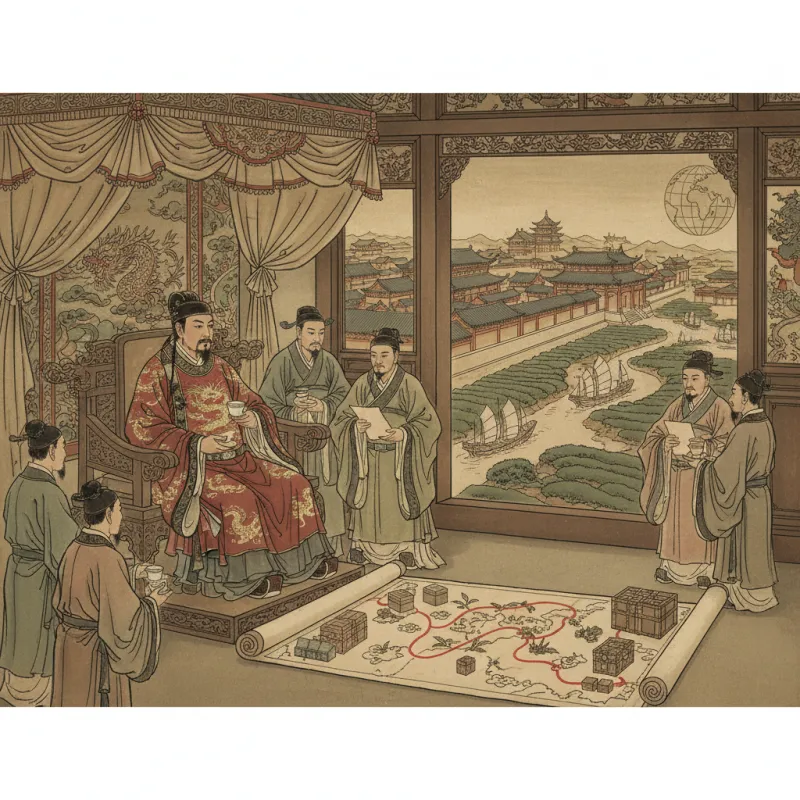
A British merchant once calculated that if you stacked all the tea chests shipped from Canton to London in a single year, the tower would reach higher than St. Paul's Cathedral. By the 1830s, Britain was spending one-tenth of its entire national budget on Chinese tea—a dependency so complete that when supplies ran low, the government considered it a national emergency. How did leaves from a Chinese shrub become so powerful that empires would go to war over them?
The Accidental Discovery That Changed Everything
Chinese legend credits the mythical emperor Shennong (神农 Shénnóng) with discovering tea around 2737 BCE when leaves supposedly drifted into his pot of boiling water. The real story is less poetic but more fascinating. Archaeological evidence from Han dynasty tombs suggests tea was initially consumed as a medicinal bitter brew in Sichuan and Yunnan provinces. Buddhist monks adopted it during the Tang dynasty (618-907 CE) because it kept them awake during long meditation sessions—essentially, tea started as a performance-enhancing drug for spiritual athletes.
The transformation from monastic stimulant to national obsession happened under the Tang. The scholar Lu Yu (陆羽 Lù Yǔ) wrote the Chajing (茶经 Chájīng, "The Classic of Tea") in 760 CE, systematizing tea cultivation, preparation, and appreciation into an art form. His work did for tea what wine critics do for Bordeaux—it created a culture of connoisseurship. Suddenly, the quality of your water source, the shape of your tea bowl, and the season of harvest all mattered intensely.
The Silk Road's Liquid Cargo
Tea traveled west along the same routes as silk and porcelain, but it moved differently. While silk could survive months of transport, tea was perishable and required careful handling. The solution was brick tea (砖茶 zhuānchá)—compressed blocks of tea leaves that could withstand the journey to Tibet, Mongolia, and eventually Russia. These tea bricks became so valuable they functioned as currency in border regions. Tibetan nomads would trade horses for tea at rates that made Chinese merchants wealthy enough to rival provincial governors.
The Tea Horse Road (茶马古道 Chámǎ Gǔdào) through Yunnan and Sichuan was arguably more important than the Silk Road for China's southwestern frontier. The Ming dynasty (1368-1644) operated government tea monopolies specifically to control this trade, using tea as a strategic resource to secure horses for military campaigns. When you needed cavalry to defend against northern invasions, tea wasn't just a beverage—it was national security.
Europe's Expensive Addiction
When Portuguese traders first brought tea to Europe in the early 1600s, it was marketed as an exotic medicine that could cure everything from headaches to moral weakness. The Dutch East India Company began regular imports by 1610, but tea remained a luxury for aristocrats who could afford to pay more per pound than they'd spend on silver.
Britain's obsession began in earnest when Catherine of Braganza, a Portuguese princess, married Charles II in 1662 and brought her tea-drinking habit to the English court. Within a generation, tea had transformed from a curiosity into a necessity. By 1750, the British were consuming over 2.5 million pounds of tea annually. By 1800, that number had exploded to 20 million pounds.
The problem was simple and catastrophic: China would only accept silver in payment for tea. The British East India Company was hemorrhaging precious metals to Canton at a rate that threatened to bankrupt the empire. Chinese merchants had no interest in British wool, manufactured goods, or anything else Europe produced. The trade imbalance was so severe that it triggered one of history's most consequential acts of economic warfare.
The Opium Solution and Its Consequences
Britain's answer to the tea-silver crisis was opium. The East India Company began cultivating opium in Bengal and smuggling it into China through private traders, creating millions of addicts and reversing the flow of silver. When the Qing dynasty tried to stop the drug trade in 1839, Britain responded with gunboats. The First Opium War (1839-1842) was fundamentally a war fought to protect Britain's ability to pay for tea.
The Treaty of Nanking that ended the war forced China to cede Hong Kong and open five treaty ports to foreign trade. But it didn't solve Britain's underlying problem: China still controlled tea production. Every leaf still came from Chinese soil, processed by Chinese methods, and sold at Chinese prices. The British Empire, which controlled a quarter of the world's land surface, remained dependent on a product it couldn't produce.
The Greatest Heist in Agricultural History
In 1848, the British East India Company hired a Scottish botanist named Robert Fortune to steal China's tea secrets. Fortune spent three years traveling through China's tea-growing regions disguised in Chinese clothing, speaking Mandarin, and pretending to be a merchant from a distant province. He smuggled out thousands of tea plants and, more importantly, convinced Chinese tea workers to relocate to India and reveal their processing techniques.
This wasn't casual industrial espionage—it was a systematic effort to break a four-thousand-year monopoly. Fortune's theft succeeded beyond Britain's wildest projections. By the 1870s, Indian tea plantations in Assam and Darjeeling were producing commercial quantities. By 1900, India and Ceylon (Sri Lanka) had surpassed China as the world's largest tea exporters. China's share of global tea trade collapsed from nearly 100% to less than 10% in just fifty years.
The consequences for China were devastating. Tea exports had been a major source of Qing dynasty revenue. The loss of the tea monopoly, combined with the opium crisis and military defeats, contributed to the dynasty's eventual collapse in 1911. A plant that had been uniquely Chinese for millennia was now growing on British colonial plantations, processed by methods stolen from Chinese workers, and sold at prices that undercut Chinese producers.
Tea's Revolutionary Legacy
Tea's influence extended far beyond trade statistics. The Boston Tea Party in 1773, when American colonists dumped 342 chests of tea into Boston Harbor, was a protest against British taxation that helped trigger the American Revolution. The tea being destroyed was Chinese, shipped by the British East India Company, and taxed by a parliament in which colonists had no representation. A Chinese plant became the symbol of American independence.
In Britain, tea transformed social structures. The afternoon tea ritual, popularized by Anna, Duchess of Bedford, in the 1840s, created new spaces for women's social and political organizing. The temperance movement promoted tea as an alternative to alcohol. Factory workers demanded tea breaks, which became enshrined in labor law. Tea wasn't just a drink—it was a social technology that reshaped daily life.
The Modern Tea World
Today's global tea industry is worth over $200 billion annually, with China having reclaimed its position as the world's largest producer. But the tea world has fragmented in ways that would astonish Tang dynasty merchants. Japan developed its own tea culture centered on matcha and the tea ceremony. Taiwan pioneered oolong cultivation techniques. Kenya became Africa's largest tea exporter. Even the United States, which historically preferred coffee, now has a specialty tea market rivaling craft beer in sophistication.
The irony is that while tea is now grown on every continent except Antarctica, the finest teas still come from China's original growing regions. Pu-erh from Yunnan, Longjing from Hangzhou, and Tieguanyin from Fujian command prices that would make Qing dynasty merchants nod in recognition. The plant may have spread worldwide, but terroir—the unique combination of soil, climate, and technique—still matters. You can grow tea anywhere, but you can't replicate four thousand years of accumulated knowledge.
Lessons from a Leaf
The tea trade reveals how commodities shape geopolitics in ways that outlast empires. China's tea monopoly lasted longer than most civilizations, but it couldn't survive the combination of military force and industrial espionage that characterized 19th-century imperialism. The same pattern would repeat with rubber, quinine, and other colonial commodities—indigenous knowledge extracted, monopolies broken, and profits redirected to imperial powers.
But tea also demonstrates the limits of theft. You can steal plants and techniques, but you can't steal culture. Chinese tea culture—the poetry, the ceramics, the philosophy of tea appreciation—remains distinctly Chinese. The Japanese tea ceremony borrowed the plant but created something entirely new. British tea culture, with its milk and sugar, would be unrecognizable to Lu Yu. The plant traveled, but its meanings multiplied and diverged.
Walk into any tea shop today and you're participating in a tradition that connects you to Tang dynasty monks, Tibetan horse traders, Qing dynasty merchants, British imperialists, Indian plantation workers, and millions of others who found meaning in leaves and hot water. That's the real power of tea—not the caffeine or the antioxidants, but the way a simple plant can carry four thousand years of human history in every cup.
Related Reading
- Chinese Porcelain: The Luxury Good That Changed World Trade
- Ancient Chinese Currency: From Cowrie Shells to Paper Money
- The Porcelain Trade: How Chinese Pottery Conquered the World
- The Grand Canal: China Greatest Engineering Project
- The Art of War Is Not About War (It Is About Avoiding It)
- Traditional Chinese Medicine: 2,500 Years of Healing
- Wu Zetian: How China's Only Female Emperor Seized and Kept Power