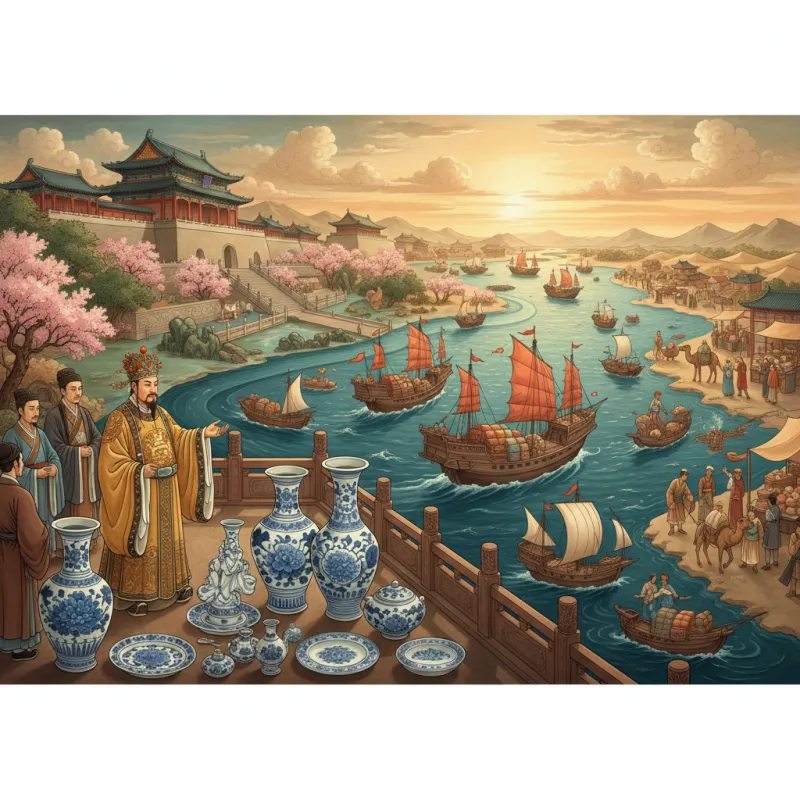
When a single dinner plate costs more than a house, you know you're dealing with something extraordinary. In 17th-century Amsterdam, a wealthy merchant paid 3,000 guilders—enough to buy a canal-side mansion—for a set of Chinese porcelain dishes. His neighbors thought him mad. History proved him prescient. Those plates, fired in kilns half a world away, represented the culmination of a thousand-year technological monopoly that no European power could break, despite deploying spies, bribing defectors, and funding alchemists who promised to transmute common clay into "white gold."
The Accidental Monopoly
Chinese potters didn't set out to dominate world trade. They were solving a practical problem: how to make vessels that wouldn't crack when you poured boiling tea into them. Around 200 CE, during the Eastern Han Dynasty (东汉 Dōng Hàn), craftsmen in Zhejiang province stumbled onto something remarkable. By mixing kaolin clay (高岭土 gāolǐng tǔ)—a pure white clay named after the Gaoling mountain where it was mined—with petuntse stone (瓷石 císhí) and firing the combination at temperatures exceeding 1,300°C, they created a material unlike anything the world had seen.
The result was 瓷器 (cíqì), true porcelain: translucent when held to light, resonant when struck, impervious to liquids, and impossibly smooth. Early examples were greenish celadon wares, but by the Tang Dynasty (618-907 CE), potters had mastered pure white porcelain that seemed to glow from within. The Chinese called it "artificial jade," and they weren't exaggerating. The material possessed an almost supernatural quality that made earthenware look like mud by comparison.
What made this monopoly unbreakable wasn't just skill—it was geology. China had unique deposits of kaolin and petuntse in the right proportions, plus access to kilns that could sustain the extreme temperatures required. European potters, working with different clays and lower-temperature kilns, produced only pottery and stoneware. Their best efforts looked crude next to Chinese porcelain, like comparing a wooden cart to a silk palanquin.
The Silk Road's Ceramic Cousin
Porcelain traveled the same routes as silk, but it told a different story. While silk degraded, porcelain endured. Archaeologists have found Tang Dynasty shards in East African ports, Abbasid palaces in Baghdad, and Viking graves in Scandinavia. Each piece was a small miracle that had survived months of overland caravan travel or monsoon-tossed sea voyages.
The Silk Road trade networks carried porcelain westward in limited quantities during the Tang and Song dynasties, but the real explosion came with the Yuan Dynasty (1271-1368) under Mongol rule. Kublai Khan, ever the pragmatist, recognized porcelain's export potential and expanded production at Jingdezhen (景德镇 Jǐngdézhèn), a city in Jiangxi province that would become synonymous with the finest porcelain for the next seven centuries.
Jingdezhen had everything: nearby kaolin deposits, the Yangtze River for transportation, forests for kiln fuel, and a critical mass of master craftsmen whose techniques were passed down through family workshops. By the Ming Dynasty (1368-1644), the city operated thousands of kilns and employed over a million workers in related industries. It was essentially a single-product industrial city, centuries before the Industrial Revolution.
Blue and White: The Design That Conquered the World
If you picture Chinese porcelain, you're probably imagining blue and white: cobalt blue designs on a white background. This wasn't the original Chinese aesthetic—it was an innovation driven by export demand. During the Yuan Dynasty, Persian and Arab traders brought cobalt blue pigment (回青 huíqīng, literally "Muslim blue") to Chinese potters, who discovered it could withstand the high firing temperatures that destroyed other colors.
The result was 青花瓷 (qīnghuā cí), blue and white porcelain, which debuted around 1330 and became an instant sensation across the Islamic world. The irony is delicious: the style most associated with "Chinese" porcelain was actually a fusion product, created when Chinese technical mastery met Middle Eastern aesthetic preferences and Persian raw materials.
Ming Dynasty potters perfected the technique, creating pieces of breathtaking complexity. The Xuande Emperor (1426-1435) was particularly obsessed with porcelain quality, personally overseeing imperial kiln production. Pieces from his reign—marked with his reign name on the base—are considered the pinnacle of blue and white porcelain. A Xuande-marked vase sold at auction in 2011 for $10 million, proving that 600-year-old ceramics can still command mansion-level prices.
The European Obsession
When Portuguese ships reached China in 1517, they encountered porcelain in quantities that boggled European minds. The Portuguese called it "porcelana" after the cowrie shell (whose translucent quality it resembled), and began shipping it back to Lisbon by the ton. What started as curiosity became mania.
European royalty went porcelain-mad. Augustus the Strong of Saxony owned over 20,000 pieces and built an entire palace—the Japanese Palace in Dresden—to house his collection. He once traded a regiment of 600 soldiers to the Prussian king for 48 large porcelain vases. That's roughly 12.5 soldiers per vase, a exchange rate that tells you everything about porcelain's perceived value.
The Dutch East India Company (VOC) turned porcelain into an industrial-scale business. Between 1602 and 1682, they shipped an estimated 43 million pieces of Chinese porcelain to Europe. To put that in perspective, that's roughly one piece for every person then living in Europe. The VOC didn't just transport porcelain—they commissioned specific designs, sending wooden models and drawings to Jingdezhen to create pieces tailored for European tastes. Chinese potters found themselves painting Dutch windmills, Christian religious scenes, and European coats of arms onto porcelain, creating a bizarre fusion of East and West.
The Secret Breaks
For European rulers, the inability to produce porcelain was both an economic drain and a matter of national pride. They threw money at the problem. The Medici family in Florence created a soft-paste imitation in the 1570s, but it wasn't true porcelain—it couldn't match the hardness, translucency, or firing temperature of the Chinese original.
The breakthrough came in 1708 in an unlikely place: a locked laboratory in Dresden, where Augustus the Strong had imprisoned an alchemist named Johann Friedrich Böttger. Böttger had claimed he could transmute lead into gold—a lie that got him arrested. To save his neck, he pivoted to porcelain research, working with scientist Ehrenfried Walther von Tschirnhaus. After years of experiments, they discovered European kaolin deposits near Meissen and figured out the firing process.
The Meissen porcelain factory, established in 1710, was run like a military installation. Workers were forbidden to leave, formulas were encrypted, and guards patrolled the grounds. Despite these precautions, the secret leaked. By 1750, porcelain factories had opened across Europe—Sèvres in France, Wedgwood in England, Capodimonte in Italy. The Chinese monopoly was broken.
The Reversal of Fortune
Here's where the story gets interesting. Just as Europeans learned to make porcelain, Chinese production faced catastrophic disruption. The Taiping Rebellion (1850-1864) devastated Jingdezhen, destroying kilns and scattering craftsmen. Meanwhile, European factories industrialized, using coal-fired kilns, mechanical throwing wheels, and transfer-printing techniques that could produce decorated porcelain at a fraction of the cost.
By 1900, the trade had reversed. European porcelain was being exported to China, where it was seen as modern and fashionable. The tea trade routes that once carried Chinese porcelain to Europe now brought European ceramics to Shanghai. It was a stunning reversal for an industry that had dominated global trade for a millennium.
The Legacy in Your Cabinet
Walk into any upscale restaurant today, and you're experiencing porcelain's legacy. The white plates, the delicate teacups, the expectation that fine dining requires fine ceramics—all of this traces back to Chinese potters who perfected their craft over centuries. Even the word "china" as a synonym for dishes reflects the material's origin.
But porcelain's impact goes beyond aesthetics. It was one of the first truly global commodities, creating trade networks that connected Asia, Europe, Africa, and eventually the Americas. The Spanish galleons that crossed the Pacific from Manila to Acapulco carried Chinese porcelain alongside silver, creating the first regular trans-Pacific trade route. Porcelain helped monetize the global economy, serving as a store of value that was universally desired and relatively standardized.
The technology transfer that eventually broke China's monopoly also demonstrated something crucial about innovation: technical secrets, no matter how closely guarded, eventually diffuse. The thousand-year head start meant Chinese potters set the global standard, but it couldn't prevent others from eventually matching and then industrializing the process.
Today, Jingdezhen still produces porcelain, though it's now one of many global production centers. The city's historical kilns are tourist attractions, and master craftsmen still practice traditional techniques, creating pieces that sell for thousands of dollars to collectors who appreciate the connection to a millennium of ceramic excellence. The monopoly is long gone, but the mystique remains—a reminder that sometimes the most valuable things aren't gold or jewels, but the knowledge of how to transform ordinary earth into something extraordinary.
Related Reading
- The Porcelain Trade: How Chinese Pottery Conquered the World
- Ancient Chinese Currency: From Cowrie Shells to Paper Money
- The Grand Canal: China Greatest Engineering Project
- The Tea Trade: How a Chinese Plant Reshaped the World
- The Real Mulan: History, Legend, and the Disney Version
- The Legacy of Chinese Emperors: Dynasties, Power, and Cultural Influence
- Delving into Ancient China: A Journey Through Dynasties, Emperors, and Cultural Treasures