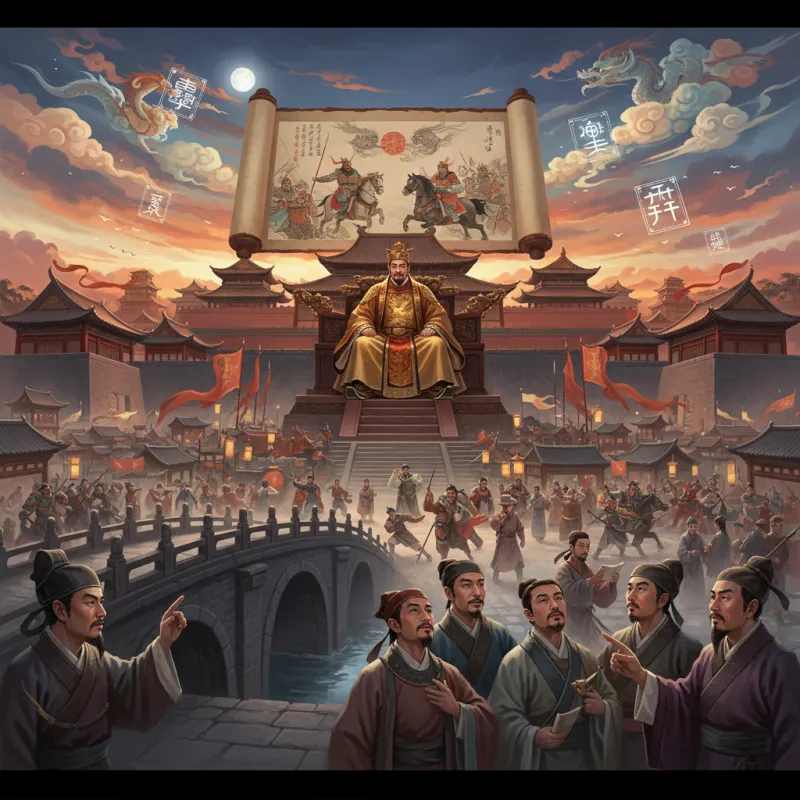
Picture this: It's 208 CE, and 100,000 soldiers are about to burn alive on the Yangtze River. Cao Cao, the most powerful warlord in China, has chained his warships together to prevent seasickness among his northern troops. His advisors warned him. He ignored them. Now a single fire arrow from Zhou Yu's fleet is about to turn that decision into the most catastrophic naval defeat in Chinese history — and one of the most famous scenes in world literature.
This is the Battle of Red Cliffs (赤壁之战 Chìbì zhī Zhàn), and it's the moment when the Three Kingdoms period stopped being just another civil war and became China's defining epic. But here's what makes this story endlessly fascinating: we're not entirely sure how much of it actually happened.
When History Becomes Legend
The Three Kingdoms period (三国时代 Sānguó Shídài, 220–280 CE) began with the collapse of the Han Dynasty and ended with reunification under the Jin. Sixty years of warfare, political intrigue, and shifting alliances that reshaped China. The historical record exists — Chen Shou's Records of the Three Kingdoms (三国志 Sānguó Zhì), completed around 290 CE, documents the major events with reasonable accuracy.
Then, over a thousand years later, Luo Guanzhong wrote Romance of the Three Kingdoms (三国演义 Sānguó Yǎnyì), and everything changed. Published in the 14th century during the Ming Dynasty, Luo's novel took Chen Shou's historical framework and transformed it into something far more powerful: a story about loyalty, strategy, ambition, and the tragic impossibility of restoring a golden age.
The novel's famous opening line captures this perfectly: "The empire, long divided, must unite; long united, must divide" (话说天下大势,分久必合,合久必分 Huàshuō tiānxià dàshì, fēn jiǔ bì hé, hé jiǔ bì fēn). It's not just describing the Three Kingdoms — it's describing all of Chinese history as a cyclical pattern. This philosophical framing elevates the story from historical chronicle to timeless meditation on power and fate.
The Three Powers and Their Philosophies
The period gets its name from the three kingdoms that emerged from the Han's collapse: Wei (魏) in the north, Shu Han (蜀汉) in the southwest, and Wu (吴) in the southeast. Each kingdom embodied different values and attracted different types of followers.
Wei, founded by Cao Cao (曹操) and later ruled by his son Cao Pi, controlled the wealthy northern plains and the old Han capital. Cao Cao remains Chinese history's most complex figure — brilliant strategist, accomplished poet, ruthless pragmatist, and the novel's primary antagonist. He famously declared "I would rather betray the world than let the world betray me" (宁教我负天下人,休教天下人负我 Nìng jiào wǒ fù tiānxià rén, xiū jiào tiānxià rén fù wǒ), a line that defines his character but may be entirely fictional. Wei represented meritocracy and practical governance, but also the taint of usurpation.
Shu Han, established by Liu Bei (刘备) in the mountainous southwest, claimed legitimacy as the continuation of the Han Dynasty. Liu Bei positioned himself as the righteous restorer, and the novel treats him as the protagonist. His sworn brotherhood with Guan Yu (关羽) and Zhang Fei (张飞) — the famous Oath in the Peach Garden — became the template for Chinese concepts of loyalty. His military strategist Zhuge Liang (诸葛亮), known as Kongming, is portrayed as near-superhuman in wisdom, though the historical figure was probably just very good at logistics. Shu represented Confucian virtue and legitimate authority, but also romantic idealism doomed to fail.
Wu, founded by Sun Quan (孙权) in the prosperous Yangtze River delta, often gets overlooked in popular retellings. The Sun family built their power on naval superiority and southern wealth. Zhou Yu (周瑜), their brilliant young commander, orchestrated the Red Cliffs victory but died young — the novel suggests from anger at being constantly outwitted by Zhuge Liang, though historians doubt this. Wu represented regional autonomy and practical survival, but lacked the ideological clarity of its rivals.
Why This Story Refuses to Die
Walk into any Chinese bookstore, gaming cafe, or streaming platform, and you'll find Three Kingdoms content. The 1994 TV series ran 84 episodes and remains the definitive adaptation for many Chinese viewers. The Dynasty Warriors video game franchise has sold over 21 million copies worldwide. Three Kingdoms board games, card games, and mobile games generate billions in revenue. New films and series appear constantly, each offering fresh interpretations.
This isn't nostalgia or cultural obligation — it's genuine obsession. But why?
First, the characters work as archetypes without becoming simplistic. Cao Cao embodies ruthless ambition, but he's also a talented poet who wept at the beauty of the landscape. Liu Bei represents virtue, but he's also politically calculating when necessary. Zhuge Liang is the wise advisor, but his northern campaigns arguably weakened Shu rather than strengthening it. These contradictions make them endlessly reinterpretable.
Second, the strategic wisdom embedded in the story remains relevant. Zhuge Liang's "Empty Fort Strategy" (空城计 Kōngchéng Jì) — where he opened the city gates and sat playing music while enemy troops, suspecting a trap, retreated — teaches that psychological warfare can defeat superior numbers. The Red Cliffs battle demonstrates how environmental factors and intelligence gathering matter more than raw military power. These lessons apply to business, politics, and daily life, which is why Chinese executives still quote Three Kingdoms strategy.
Third, the story asks questions without providing easy answers. Was Cao Cao a villain or a visionary? Should Liu Bei have focused on governing Shu well rather than attempting to restore the Han? Did Zhuge Liang's loyalty to Liu Bei's dream ultimately harm the people he served? Different eras and different readers answer these questions differently, making the story a mirror for contemporary concerns.
The Fiction Problem
Here's where it gets complicated: most Chinese people learn Three Kingdoms through the novel, not the history. The novel claims to be "seven parts history, three parts fiction" (七分实,三分虚 qī fēn shí, sān fēn xū), but that ratio is generous. Entire famous scenes — the Oath in the Peach Garden, Zhuge Liang's supernatural abilities, many of the dramatic confrontations — are fictional or heavily embellished.
This creates a fascinating cultural phenomenon where historical figures are understood primarily through their fictional portrayals. Guan Yu, a capable but not exceptional general historically, became deified as the God of War (关公 Guān Gōng) based largely on his novel characterization. Temples dedicated to him appear throughout China and the Chinese diaspora. Police stations, triads, and businesses all claim him as their patron — a remarkable legacy for someone whose historical achievements were relatively modest.
The novel's bias toward Shu Han also distorts understanding. Luo Guanzhong clearly favored Liu Bei's cause, portraying Wei as villainous and Wu as opportunistic. Modern historians recognize that Wei actually governed more effectively than Shu, and Cao Cao's meritocratic reforms were genuinely progressive for their time. But the novel's moral framework — legitimacy matters more than effectiveness — reflects deep Confucian values about rightful authority.
The Strategy That Shaped a Civilization
The Three Kingdoms period produced Romance of the Three Kingdoms, but it also influenced another foundational text: The Thirty-Six Stratagems (三十六计 Sānshíliù Jì), a collection of military tactics that draws heavily on Three Kingdoms examples. Strategies like "Kill with a Borrowed Knife" (借刀杀人 Jiè dāo shā rén) and "Feign Madness but Keep Your Balance" (假痴不癫 Jiǎ chī bù diān) appear throughout the novel and remain part of Chinese strategic thinking.
This strategic legacy extends beyond military matters. Chinese business culture, diplomatic approaches, and even interpersonal relationships reflect Three Kingdoms thinking. The concept of guanxi (关系) — relationship networks — echoes the novel's emphasis on sworn brotherhoods and personal loyalty. The preference for indirect communication and strategic ambiguity mirrors the novel's complex political maneuvering.
Compare this to Western epics like the Iliad or Arthurian legends, which emphasize individual heroism and moral absolutes. Three Kingdoms celebrates cleverness, adaptability, and understanding that circumstances determine morality. Zhuge Liang's most famous quote — "Do your best and leave the rest to fate" (尽人事,听天命 Jìn rénshì, tīng tiānmìng) — captures this pragmatic philosophy.
The Modern Three Kingdoms
Contemporary adaptations keep finding new angles. John Woo's 2008 film Red Cliff emphasized the battle's spectacle and Zhou Yu's perspective, giving Wu its cinematic due. The 2010 TV series Three Kingdoms took a more historically grounded approach, portraying Cao Cao sympathetically and questioning Liu Bei's idealism. Video games let players rewrite history entirely, creating alternate timelines where Wei unifies China or minor characters become major players.
These reinterpretations reflect changing Chinese values. During periods emphasizing revolutionary change, Cao Cao's pragmatic reforms look appealing. During periods valuing stability and tradition, Liu Bei's legitimacy claims resonate more strongly. The story's flexibility makes it perpetually relevant.
The international success of Three Kingdoms content — from Dynasty Warriors to Netflix's Three Kingdoms series — suggests its themes transcend cultural boundaries. The tension between idealism and pragmatism, the complexity of loyalty, the tragedy of talented people trapped in impossible situations — these resonate universally, even when the specific cultural context requires explanation.
Why Everyone's Still Obsessed
The Three Kingdoms period lasted sixty years. The novel about it has remained popular for six hundred years. That's a 10:1 ratio of fiction to history, and it keeps growing. New adaptations appear annually, each generation finds fresh relevance in the story, and the characters remain more vivid than most historical figures who actually accomplished more.
This endurance comes from the story's fundamental insight: history isn't about what happened, it's about what we need the past to mean. The Three Kingdoms gives Chinese culture a space to debate loyalty versus pragmatism, legitimacy versus effectiveness, individual ambition versus collective good. These debates never resolve because they're not meant to — they're the questions that define civilization itself.
When modern Chinese people quote Zhuge Liang's strategies, invoke Guan Yu's loyalty, or reference Cao Cao's ruthlessness, they're not just recalling history. They're participating in an ongoing conversation about what matters, what works, and what we owe each other. That's why everyone's obsessed: the Three Kingdoms isn't just China's greatest story. It's China's most important argument with itself, and the argument never ends.
For more on how this period influenced Chinese governance, see The Han Dynasty. To understand the military innovations that emerged from this era, explore Ancient Chinese Warfare.
Related Reading
- Three Kingdoms: The History That Became China's Greatest Story
- The Three Kingdoms: Why China's Favorite Story Is About Failure
- Zhuge Liang: The Sleeping Dragon Who Became China's Greatest Strategist
- Liu Bei vs. Cao Cao: The Ultimate Rivalry in Chinese History
- The Imperial Examination: The World's First Standardized Test
- Chinese Calligraphy: The Art of Writing as High Culture
- Unraveling the Economic Tapestry of Ancient Chinese Dynasties