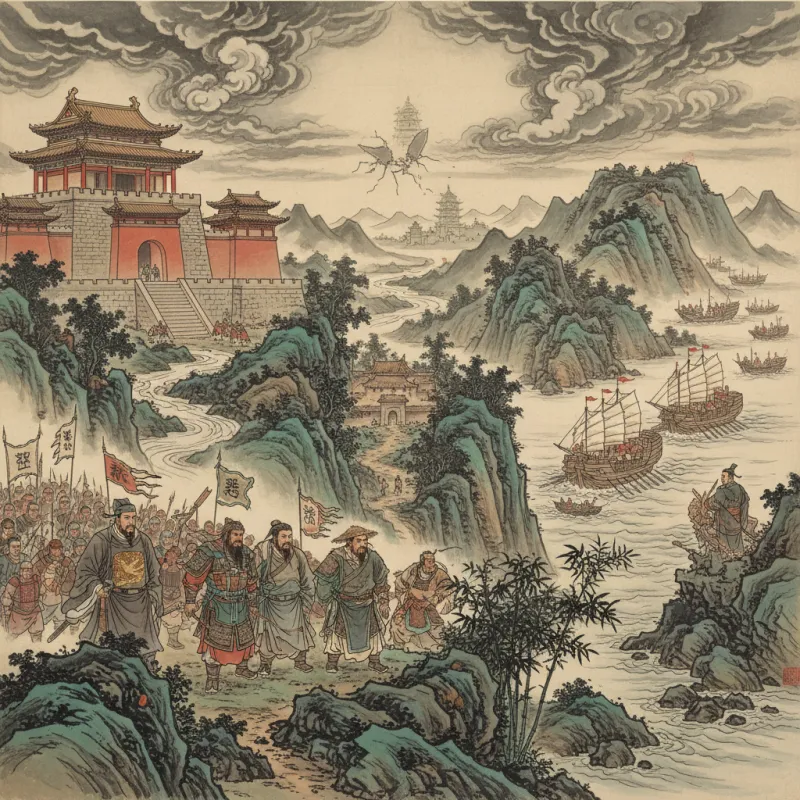
Liu Bei is dying. The brilliant strategist who helped him build a kingdom from nothing, Zhuge Liang, kneels beside his deathbed. Liu Bei grabs his hand and says something that would echo through Chinese culture for 1,800 years: "If my son is worthy, assist him. If he is not, you may take the throne yourself." Zhuge Liang weeps and refuses. He will serve the unworthy son faithfully until his own death, watching everything they built crumble. This is the emotional core of China's favorite story — and it's about losing.
The Three Kingdoms period (三国 Sānguó, 220–280 CE) dominates Chinese popular culture in a way that's hard to overstate. The 14th-century novel Romance of the Three Kingdoms (三国演义 Sānguó Yǎnyì) is one of China's Four Great Classical Novels. It's been adapted into hundreds of films, TV series, operas, and video games. Children grow up knowing the characters. Adults quote the strategies. The period features the most brilliant tactician (Zhuge Liang 诸葛亮), the most complex villain-hero (Cao Cao 曹操), the most romanticized brotherhood (Liu Bei 刘备, Guan Yu 关羽, Zhang Fei 张飞), and battles that military academies still study.
And every single protagonist loses. Wei, Shu Han, and Wu — all three kingdoms — are conquered by the Jin Dynasty (晋朝 Jìn Cháo), founded not by any of the heroes but by Sima Yi (司马懿), a cautious bureaucrat who survived by doing nothing heroic. The man who unified China wasn't the genius Zhuge Liang or the charismatic Liu Bei or even the ruthless Cao Cao. It was Sima Yi's grandson, who waited until everyone interesting was dead.
The Failure Is the Point
Western audiences often assume the Three Kingdoms story is popular despite its depressing ending. They're wrong. The ending is why it resonates. Chinese culture has a complicated relationship with failure that Western narratives often miss. Success is temporary. Virtue doesn't guarantee victory. The righteous lose. The clever die young. The cautious inherit everything.
This isn't pessimism — it's realism shaped by thousands of years of dynastic cycles. Every dynasty falls. Every empire fragments. The Han Dynasty lasted four centuries and collapsed into chaos. The Three Kingdoms emerged from that collapse, and they too fell. The Jin Dynasty that replaced them lasted barely a century before its own civil war. Chinese audiences don't need happy endings because they know history doesn't provide them.
What matters isn't winning. It's how you lose. Liu Bei loses with dignity, never betraying his principles even when pragmatism would save him. Zhuge Liang loses while remaining loyal to an unworthy emperor, because loyalty matters more than success. Guan Yu loses because he's too proud to retreat, becoming a god precisely because he died for his principles. These aren't tragic flaws — they're virtues that make failure meaningful.
The Three Ways to Lose
The novel presents three distinct philosophies through its three kingdoms, and all three fail for different reasons. This isn't accidental. Author Luo Guanzhong (罗贯中) was writing during the Ming Dynasty, watching his own government's corruption, and he embedded a political argument into his historical fiction.
Cao Cao's Wei represents pragmatic authoritarianism. Cao Cao is brilliant, ruthless, and effective. He controls the richest territory, commands the largest army, and makes the hard decisions that idealists avoid. The novel's famous line about him — "I'd rather betray the world than let the world betray me" — captures his philosophy perfectly. He wins every practical victory and loses the moral war. His kingdom becomes a military dictatorship that his own generals eventually overthrow. Efficiency without legitimacy is unstable.
Liu Bei's Shu Han represents Confucian idealism. Liu Bei claims descent from the Han imperial family and positions himself as the legitimate heir. He treats people with benevolence (仁 rén), practices righteousness (义 yì), and builds a government based on virtue rather than force. He attracts the best talent — Zhuge Liang chooses him specifically because of his principles. But idealism without power is impotent. Shu Han controls the poorest territory, loses its best generals to age and war, and collapses the moment Zhuge Liang dies. Virtue doesn't feed armies.
Sun Quan's Wu represents regional autonomy. The Sun family controls the wealthy Yangtze River delta and wants to be left alone. They're not interested in reunifying China or claiming the Mandate of Heaven — they just want to protect their territory and maintain their independence. This defensive pragmatism works for decades. Wu outlasts both Wei and Shu Han. But survival without purpose is hollow. When Jin finally invades, Wu surrenders almost immediately because nobody believes in it enough to die for it.
The Man Who Won by Waiting
Sima Yi is the story's secret protagonist, and he's the least heroic character imaginable. He's cautious to the point of cowardice, politically flexible to the point of treachery, and willing to endure any humiliation to survive. When Zhuge Liang tries to provoke him into battle by sending him women's clothing (implying he's too cowardly to fight), Sima Yi wears the dress and stays in his fortress. When his political enemies gain power, he pretends to be senile and harmless. When Cao Cao's descendants trust him with military command, he waits until they're vulnerable and seizes power in a coup.
He's everything Chinese culture claims to despise — disloyal, unheroic, opportunistic. And he wins. His family founds the Jin Dynasty. His strategy of "do nothing until your enemies destroy themselves" proves more effective than Zhuge Liang's brilliant tactics or Cao Cao's ruthless efficiency or Liu Bei's moral authority.
The novel doesn't celebrate this. It presents Sima Yi's victory as a tragedy, proof that heaven is unjust. But it also presents it as inevitable. The heroes exhaust themselves fighting each other. The survivor inherits their ruins. This is how dynasties actually change in Chinese history — not through heroic conquest but through patient accumulation of power by whoever's still standing when the dust settles.
Why China Loves This Story
The Three Kingdoms story endures because it validates a specifically Chinese understanding of history and human nature. Western narratives often follow a heroic arc: the protagonist struggles, grows, and triumphs. Chinese narratives follow a cyclical pattern: rise, peak, decline, fall, and eventually someone else's rise. The Mandate of Heaven doesn't guarantee permanent success — it rotates through dynasties like seasons.
This creates a culture that's simultaneously idealistic and cynical. You should pursue virtue even though virtue doesn't guarantee success. You should remain loyal even when your lord is unworthy. You should fight for your principles even when you know you'll lose. Because the alternative — Sima Yi's amoral pragmatism — is spiritually empty even when it's practically effective.
The novel's most famous scene captures this perfectly. Zhuge Liang sits alone on a city wall playing his guqin (古琴, a traditional Chinese instrument) while Sima Yi's army approaches. The city is undefended — Zhuge Liang sent his troops away and has only a few servants. Sima Yi sees him sitting calmly and assumes it's a trap. He retreats. It's called the Empty Fort Strategy (空城计 kōngchéng jì), and it's probably fictional, but it's become a metaphor for bluffing with style. Zhuge Liang wins through reputation and psychology, not force. And yet he still loses the war. Brilliance isn't enough.
The Lesson Nobody Wants to Learn
Modern China has a complicated relationship with the Three Kingdoms story. The Communist Party officially promotes it as a tale of national unity — the Jin Dynasty eventually reunified China, ending the chaos. But that's not what audiences take from it. They love the divided period, not the unified ending. They love the heroes who failed, not the bureaucrat who succeeded.
This creates an interesting tension. The story teaches that individual brilliance, moral authority, and military genius all ultimately fail against patient institutional power. Sima Yi wins because he controls the bureaucracy and outlasts the heroes. This is arguably a lesson about why stable institutions matter more than charismatic individuals. But Chinese audiences don't celebrate Sima Yi — they celebrate Zhuge Liang, who died exhausted at 54, having failed to reunify China despite being the smartest person in the room.
Maybe that's the real lesson. History is made by Sima Yis, but it's remembered through Zhuge Liangs. Success is temporary and often morally hollow. Failure with integrity is permanent and meaningful. The Romance of the Three Kingdoms isn't popular despite being a story about failure — it's popular because it's a story about failure. It tells Chinese audiences what they already know from thousands of years of dynastic cycles: everything falls apart eventually, so what matters is how you conduct yourself while it's falling.
Liu Bei dies telling Zhuge Liang to take the throne if his son is unworthy. Zhuge Liang refuses and serves the unworthy son faithfully until his own death. The kingdom collapses. The Jin Dynasty takes over. And 1,800 years later, Chinese children still learn Zhuge Liang's name while Sima Yi's descendants are forgotten. That's the victory that matters.
Related Reading
- The Three Kingdoms: History, Fiction, and Why Everyone's Obsessed
- Zhuge Liang: The Sleeping Dragon Who Became China's Greatest Strategist
- Liu Bei vs. Cao Cao: The Ultimate Rivalry in Chinese History
- Three Kingdoms: The History That Became China's Greatest Story
- The Cultural Revolution: What Actually Happened
- Wu Zetian: China's Only Female Emperor
- Ancient Chinese Medicine: A Look into Dynasties and Healing Practices